



Every foreign ministry in the world organises itself around a map. India's is no exception. There's a division that handles West Asia and North Africa. There are separate divisions that handle Pakistan, Afghanistan, and the rest of South Asia. It's a sensible way to divide labour, and it has worked reasonably well for decades, because the two regions mostly behaved like two regions.
Mostly. Not anymore, I think.
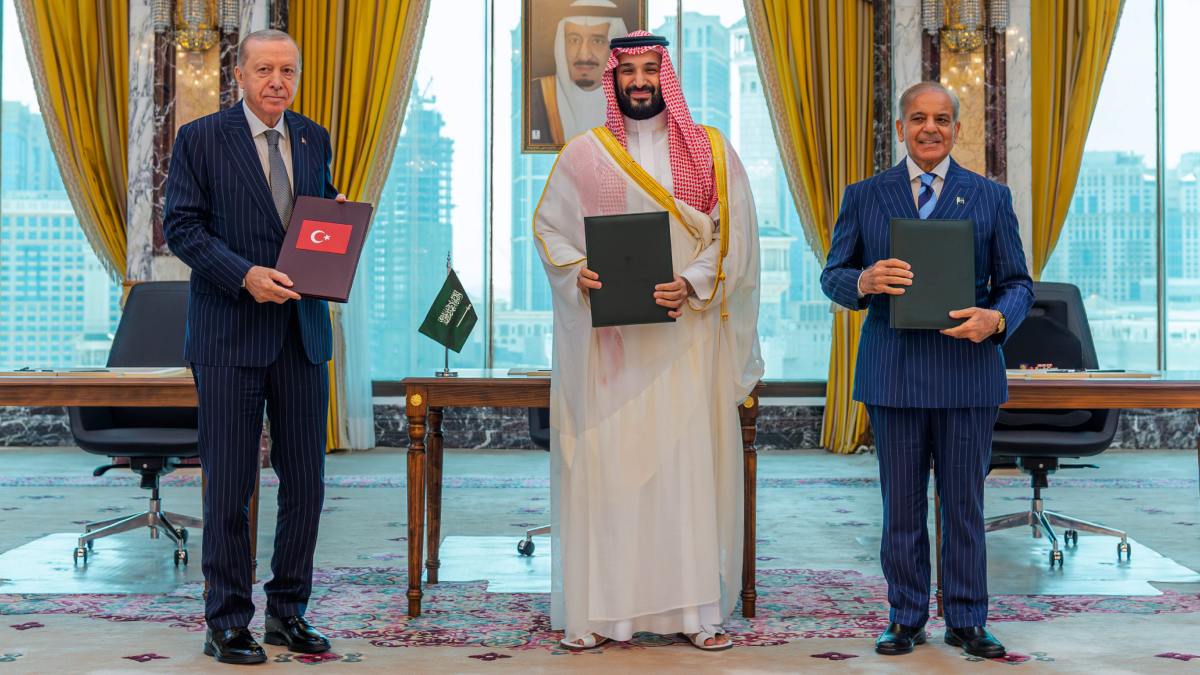
On August 7, Saudi Arabia, Turkiye and Pakistan signed the Mecca Joint Deterrence Agreement — a mutual defence pact treating an attack on one as an attack on all three. I have already written elsewhere about why this shouldn't send India into a defensive crouch over Pakistan specifically. That's not what this piece is about. This piece is about a quieter, more structural problem: the pact is a West Asian document with a South Asian signatory, and India's own institutional architecture doesn't have an obvious desk for exactly that kind of thing.
Two files, one cabinet
Think about what actually sits inside each of India's regional silos. The West Asia desk worries about oil, about the Gulf's sovereign wealth, about Israel, about Iran, about the Houthis and Yemen and the endless churn of that neighbourhood. The South Asia desk worries about Pakistan, about Afghanistan's instability, about Bangladesh, about the Line of Control. For most of my career, those genuinely were separate conversations, held by mostly separate people, briefed to mostly separate ministers.
The Mecca pact doesn't respect that division, and neither, increasingly, does anything else happening in the region. Turkish drones show up in Pakistani skies and Gulf financing. Saudi investment shows up in Indian infrastructure and, separately, in Pakistani debt relief. Iran's Chabahar port matters to India's access into Central Asia and, simultaneously, to a completely different set of calculations about Gulf shipping lanes. The map has stopped being two maps. It has become one slightly messy map that nobody has been assigned to own in full.
A story from a staff course, oddly relevant here
Years ago, on a staff course, we were given an exercise involving two adjoining sectors of a defended front, each commanded separately, with a boundary drawn neatly between them on the map. The whole point of the exercise was to demonstrate what everyone eventually learns the hard way; an enemy unfortunately does not respect boundaries drawn for administrative convenience. The most dangerous gaps in any defence rarely open up inside a sector. They open up exactly on the seam between two sectors, where each commander assumes the other is watching that particular stretch of ground.
India's West Asia and South Asia desks are, in effect, two adjoining sectors with a seam running straight through the Mecca pact. Nobody at that seam is doing anything wrong, necessarily. But a seam that used to be quiet is no longer quiet, and quiet seams are exactly the ones that get neglected until something forces attention onto them.
What this would actually mean, institutionally
I am not arguing for a dramatic bureaucratic reorganisation of the ministry of external affairs — that's a bigger conversation than one column can responsibly have, and institutional restructuring for its own sake rarely produces the outcomes it promises. What I am arguing for is something more modest and, I would guess, more achievable: a standing cross-desk mechanism, something closer to a joint working group than a full merger, specifically tasked with tracking exactly the kind of cross-regional development the Mecca pact represents. Not owned entirely by West Asia. Not owned entirely by South Asia. Owned, deliberately, by the seam.
Turkish Foreign Minister Hakan Fidan's comment that Ankara wants the pact opened to more members is precisely the kind of development that would benefit from that structure. Is a wider membership list a West Asia story, because it involves Gulf and Mediterranean diplomacy? Or a South Asia story, because Pakistan is already inside the tent? The honest answer is that it's both, simultaneously, and an institution built around a map that no longer matches the territory will always be a half-step slow in answering that question.
The map nobody draws until they have to
Institutions redraw their internal maps reluctantly, usually only after a crisis makes the old map's failures embarrassingly obvious. India has an opportunity here to redraw it early, on its own terms, before a crisis forces the question. That's a genuinely rare position to be in, and it would be a pity to waste it simply because the old map was comfortable and the org chart was already printed.
The Mecca pact will likely fade from headlines within a few news cycles, the way most signing-ceremony stories do. The structural question it has exposed — whether India's diplomatic architecture is built for a region that increasingly refuses to stay divided — will still be sitting there, quietly, waiting for someone in South Block to actually redraw the map rather than simply annotate the old one.
(Colonel M.V. Shashidhar (Retd) is a Defence & Strategic Affairs Expert, Certified Independent Director (IICA), ESG Advocate and Governance Thought Leader.
Contact: 5cg9220rg@gmail.com | +91-7620080437 | linkedin.com/in/mylapore-venkata-shashidhar)
(The opinions expressed in this article are those of the author and do not purport to reflect the opinions or views of THE WEEK.)
