



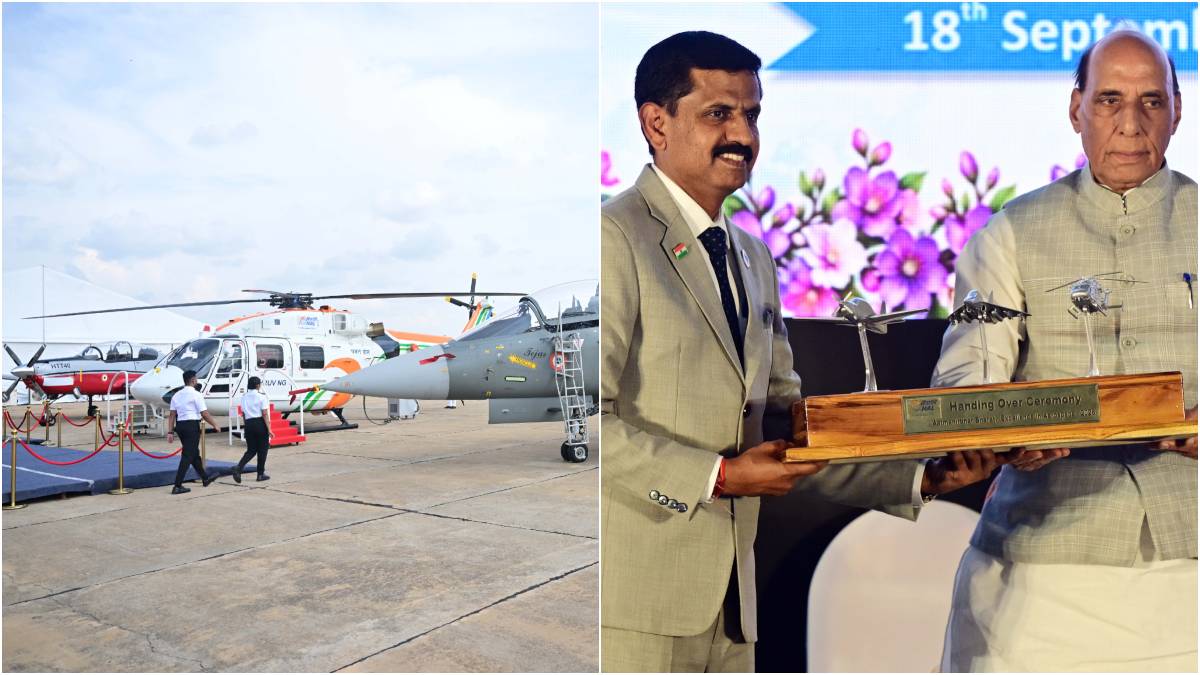
India's continued push for greater self-reliance in defence received another boost on Friday as state-run Hindustan Aeronautics Limited (HAL) delivered three different indigenous platforms. HAL handed over two LCA Tejas Final Operational Clearance (FOC) twin-seater trainers and the first series-production HTT-40 basic trainer aircraft to the Indian Air Force, and four Dhruv Next Generation helicopters to Pawan Hans Limited.
The platforms were displayed at the handing-over ceremony in the presence of Defence Minister Rajnath Singh and Civil Aviation Minister K. Rammohan Naidu. A pooja was also performed on the occasion.
The handovers reveal HAL's ability to design, develop and produce different categories of aircraft while also strengthening the wider domestic aerospace ecosystem through its industry partners.
HAL handed over two LCA FOC Trainer aircraft to the IAF, completing twin-seater deliveries under the FOC contract. The LCA FOC trainer is a lightweight, all-weather, multi-role 4.5-generation aircraft designed primarily to meet the IAF's training requirements. It also retains the capability to undertake fighter operations when required.
The aircraft incorporates technologies including relaxed static stability, a quadruplex fly-by-wire flight-control system, carefree manoeuvring, an advanced glass cockpit, integrated digital avionics and extensive use of advanced composite materials in the airframe.
According to HAL, these technologies have allowed India to develop and operationalise an advanced twin-seat fighter aircraft capability.
“I am confident that the HTT-40 trainer will play a significant role in preparing our pilots for this demanding operational environment... For years, this basic training relied on imported aircraft, such as the Hawk trainer or the Pilatus; such imports created a heavy dependency. However, Hindustan Aeronautics Limited has now indigenously manufactured the HTT-40, and the first aircraft from the series production line has been handed over to the Indian Air Force today,” the defence minister said.
Another important development was the handover of the first series-production HTT-40 basic trainer, which was named Ankur. The handover to the IAF marks the beginning of deliveries under the contract for 70 aircraft. The HTT-40 is an indigenously designed and developed basic trainer intended to meet the primary training requirements of the Indian defence services.
Designed by HAL's Aircraft Research and Design Centre, the aircraft has a modern cockpit and avionics suite and can perform several training roles, including aerobatics, general handling, instrument flying, navigation, night flying and close-formation flying.
HAL also handed over four Dhruv NG helicopters to Pawan Hans, marking the induction of the civil-certified Dhruv NG into the civil aviation segment. The 5.5-tonne light twin-engine, multi-role helicopter has been designed and manufactured by HAL.
The Dhruv NG has a civil-certified glass cockpit, modern avionics, advanced navigation systems and enhanced situational awareness. Its safety features include crashworthy seats, self-sealing fuel tanks and a twin-engine configuration providing redundancy.
The platform has been developed to operate under demanding Indian conditions and upgraded to meet the requirements of the global civil aviation market.
'Not merely a handover ceremony'
Rajnath Singh described the occasion as an important step in India's journey towards building indigenous aerospace capabilities. "Today is not merely about a handover ceremony; it represents a significant milestone in our progress towards indigenous aerospace capabilities, technological prowess, self-confidence, and Atmanirbhar Bharat," he said.
Singh stressed that building aerospace capabilities is a gradual process rather than something that can be achieved through a sudden "Big Bang".
According to him, every indigenous product and component represents another step towards developing a stronger aerospace ecosystem, with the challenges encountered along the way forming part of that journey.
He also highlighted the significance of an indigenous helicopter being deployed by ONGC for offshore operations and said the integration of the DGCA-certified indigenous Shakti engine further strengthened India's aerospace capabilities.
Singh said increasing production of such platforms would contribute not only to national security but also to the economy. He added that the ultimate objective should be an integrated aerospace ecosystem that is completely self-reliant across different domains.
He also highlighted the parallel roles of defence public sector undertakings and private companies in achieving that goal.
While DPSUs have opportunities to expand their capabilities in defence, private industry has also been encouraged through a level playing field, he said.
