



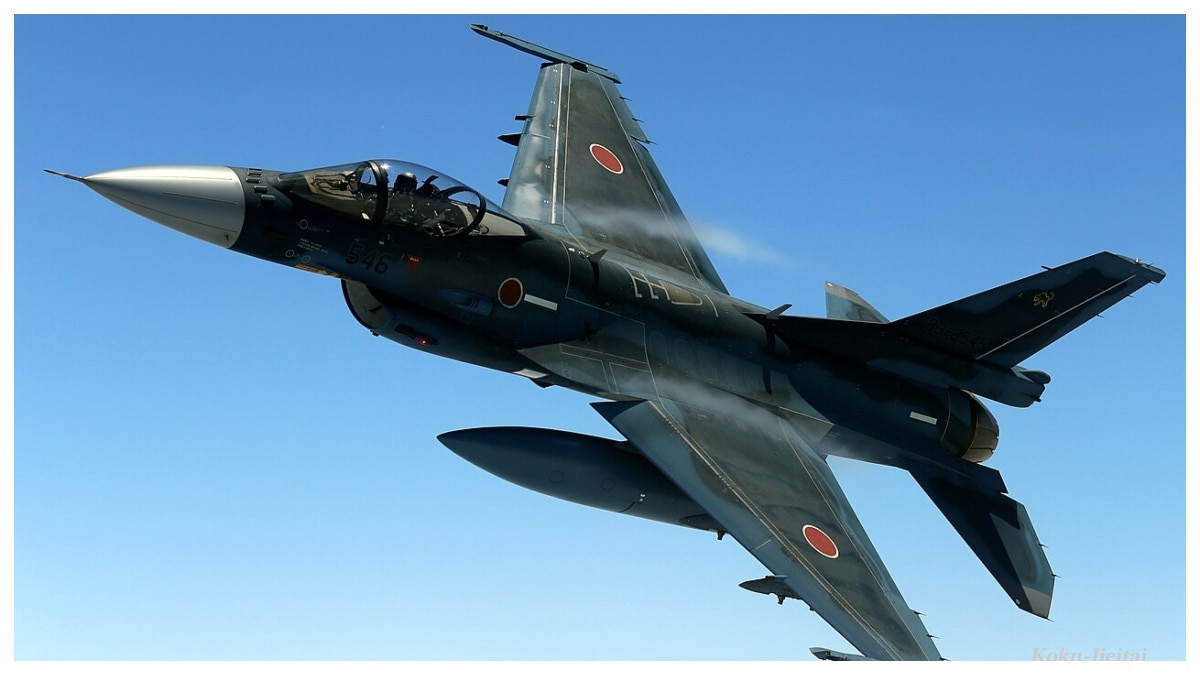
The upcoming training exercise between the air forces of India and Japan, Exercise Veer Guardian 2026, to be held from September 9 to 21, is expected to give the Indian Air Force (IAF) a rare opportunity to train alongside an aircraft that shares its design lineage with Pakistan's F-16 fleet—the Mitsubishi F-2A fighter jets. Pakistan reportedly had deployed the fighter jet against India during Operation Sindoor.
The exercise between the IAF and the Japan Air Self-Defense Force (JASDF) will be held at Air Force Station Jodhpur. The Japanese contingent has already begun arriving, with two JASDF C-2 transport aircraft landing at the base ahead of the drills.
The IAF, in a tweet, said Ex Veer Guardian will enhance interoperability, operational synergy and mutual understanding between the two air forces while reinforcing the growing defence relationship between India and Japan.
According to reports, JASDF will deploy three F-2A fighters for the exercise, marking the first deployment of Japanese fighter aircraft to India for a bilateral air combat exercise.
Why does the deployment matter?
The Mitsubishi F-2 evolved from the American F-16 Fighting Falcon and was jointly developed by Mitsubishi Heavy Industries and Lockheed Martin. Although heavily modified and larger than the original F-16, the aircraft retains the basic design characteristics and aerodynamic lineage of the original.
This makes the exercise particularly relevant for the IAF because Pakistan operates a fleet of around 75 to 80 F-16 Fighting Falcons, which remain among the Pakistan Air Force's most important combat assets.
Training alongside and potentially against the F-2 could therefore provide Indian pilots an opportunity to study and operate against an aircraft that closely resembles the F-16 in size, shape and overall configuration.
The fighter, however, is different.
Although derived from the F-16, the F-2 features several significant modifications. It has a wing area around 25 per cent larger than the F-16, a longer fuselage and larger horizontal tails. The larger wing allows additional fuel storage and more weapon stations.
The aircraft was also the first production fighter to enter service with an Active Electronically Scanned Array (AESA) radar and incorporates Japanese-developed systems such as its fly-by-wire flight controls and integrated electronic warfare suite.
Designed as a multi-role fighter, the F-2 can perform both air-to-air and air-to-surface missions, though it is optimised for maritime strike and coastal defence operations.
