



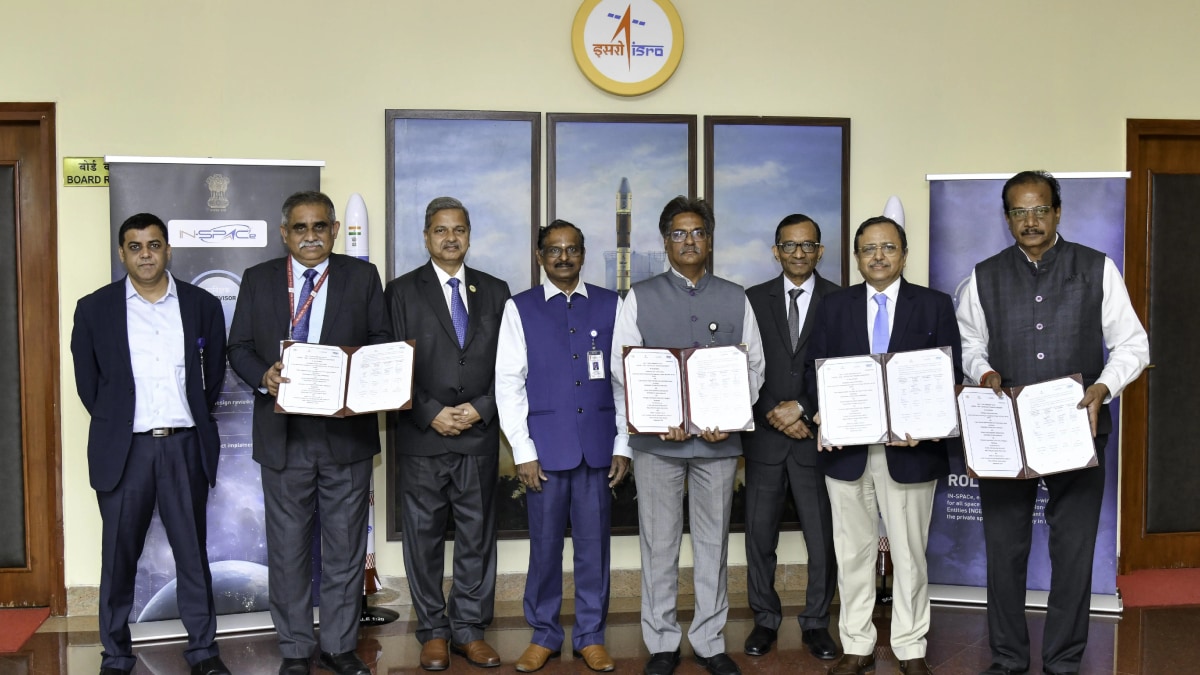
On September 10, 2025, in Bengaluru, India did something that no space agency had done before. NewSpace India Limited, under ISRO, IN-SPACe & Hindustan Aeronautics Limited (HAL), signed an agreement handing over not a valve, not a nozzle, not a subsystem, but an entire rocket system technology. The Small Satellite Launch Vehicle (SSLV) tech went to HAL for ₹511 crore. Two strong rivals, one led by Adani-backed Alpha Design Technologies, another by Bharat Dynamics, were left behind. It was India's 100th space technology transfer, and the first time a complete launch vehicle technology changed hands so that a company could build, own and sell it on its own. That single signature raises three plain questions every Indian should ask: is this worth doing, how long will full mastery take, and will it actually make rocket-making faster?
So what has been given away?
The SSLV is a compact three-stage solid rocket with a small liquid stage on top. It stands 34 metres tall, two metres wide, and weighs 120 tonnes at lift-off. It can place 500 kg into a 500 km low-earth orbit, or about 300 kg into a sun-synchronous orbit, where the satellite crosses the same spot at the same local time each day. Most earth-observation and communication satellites sit comfortably in that range. The first three stages burn HTPB, a rubber-like solid fuel. Stage one gives it the heavy push off the pad, stage two continues the climb, stage three delivers the final boost. Then the Velocity Trimming Module takes charge, using two liquids that catch fire the moment they touch and 16 small thrusters, giving a gentle 172 metres-per-second nudge that parks the satellite exactly where it belongs. It was built for low cost, quick turnaround and very little ground infrastructure.
Is it worth transferring all this to private players?
Experts point out that the it can be a major advantage provided the transfer is treated as the beginning of a relationship, not the closing of a file. “The logic is simple. ISRO's finest engineers are needed on the hard frontiers: Gaganyaan, heavier rockets, deep-space probes. Sending small satellites up, launch after launch, is production work, and industry is built for production. India cannot move from a handful of launches a year to nearly one every two weeks, or claim a share of a small-satellite launch market projected at 44 billion dollars by 2033, if ISRO remains the only manufacturer. Private players bring production discipline, commercial urgency and the freedom to run parallel assembly lines. They can negotiate supply chains the way aircraft makers do, instead of waiting for government procedures,” explained space analyst Girish Linganna.
How many years will the complete transfer take?
This is where expectations must be realistic. Under the deal, HAL receives the full package design data, manufacturing processes, quality rules, integration steps, launch manuals and post-flight analysis methods. ISRO engineers will work shoulder to shoulder while the first two vehicles are built and flown, and that hand-holding is capped at 24 months. Drawings travel in minutes; real know-how travels only through people.
“ISRO itself spent more than a decade refining the SSLV through static tests, three development flights and the painful lesson of one failure. International experience points the same way. Japan's licensed aircraft production and South Korea's long absorption of engine technology both show that genuine mastery needs five to seven years of continuous partnership, repeated flights and open access to the original design teams. Complete independence and the confidence to improve the vehicle without looking over one's shoulder usually takes closer to ten years,” remarked Linganna.
Will it streamline manufacturing?
It can, but only if culture changes along with the drawings. Large public-sector organisations sometimes treat a technology-transfer agreement as a paper to be signed and filed away. Private firms succeed when they treat every vehicle as a chance to shorten the cycle, cut the cost and raise reliability. The licence is non-exclusive and non-transferable, which keeps healthy pressure on everyone: if one company moves slowly, another can still be brought in, and start-ups building their own rockets keep the ecosystem competitive. ISRO keeps the patents but is not bound to keep helping.
The real test comes with the third, fourth and fifth rockets built without daily ISRO supervision. If they fly on time, within budget and with commercial dependability, the transfer has worked. If not, the bottleneck has merely shifted address.
