



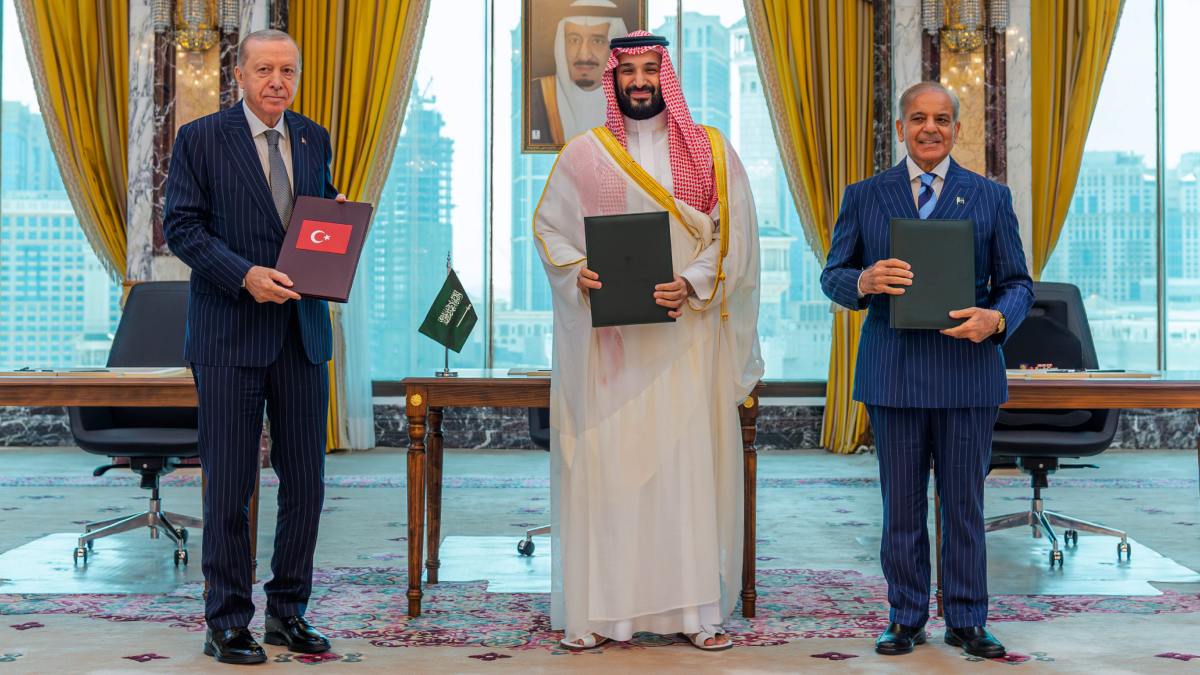
In signs of an escalatory move in the troubled West Asia region, the coming together of Pakistan, Turkey and Saudi Arabia on Friday for a trilateral defence agreement called the ‘Mecca Joint Defence Agreement’ has ominous implications for India in its influence in West Asia and South Asia.
Also being seen to contain the green shoots of an ‘Islamic NATO’, a joint statement issued and signed by Saudi Crown Prince Mohammed bin Salman, Turkish President Recep Tayyip Erdoğan, and Pakistani Prime Minister Shehbaz Sharif, said the agreement is “intended to strengthen collective deterrence against any act of aggression and stipulates that an armed attack against any of the three would be regarded as an attack on all.”
What is significant in this alliance of three powerful Sunni Muslim nations is that while Pakistan is a nuclear nation—the only Muslim country to possess the nuclear bomb—Turkey has NATO’s second biggest military and oil-rich Saudi Arabia is the traditional leader in the Muslim world and home to Islam’s holiest sites in Mecca and Medina.
To India, it is definitely bad news. First, it means the waning power and reduced footprint of the US and its close ally Israel in West Asia. India has significant business and military ties with both the US and Israel. By extension, therefore, it reduces India’s influence in the region.
Second, the raising of a new security structure in West Asia with the potential to supplant American influence and power is detrimental to India as it enhances the stature and strategic profile of Pakistan.
Third, Pakistan would also be assured of military aid by Turkey and Saudi Arabia in case of another conflict with India.
But there are obvious fault-lines within the trilateral grouping.
First, the aim of the grouping is unclear and also indicative of a schism within the Muslim world. Saudi Arabia, the prime proponent of Arab nationalism, has turned against the very ideals it stood for. Arab nationalism was primed to counter Turkey, but in the new grouping, Saudi Arabia has aligned with Turkey. Important Arab nations like Egypt, Bahrain, Kuwait, UAE, Jordan, and Qatar are not part of the grouping.
Second, the objectives of all the three member countries in erecting such a platform are different. For Pakistan’s beleagured economy, close association with Saudi Arabia and Turkey can be a big help. In April, it was Saudi Arabia that bailed out Pakistan with a $3 billion payout after the UAE sought repayment of the debt Pakistan owed.
For Turkey, it is an insurance against aggression by Israel and acknowledgement of the fact that after Iran, it figures at the top of the Israeli hit-list.
For Saudi Arabia, it is to ward off Iran's inimical attitude against it. Iran and Saudi Arabia have a serious rivalry, being the two major economic and political powers in West Asia. Moreover, there is already an ongoing conflict with Iran’s proxies in Yemen and Iraq.
So, in a way, the aims of the three powers joining in an alliance are different and often contradictory to each other.
Third, the close association of Pakistan with Turkey, which is a NATO member, will really test Pakistan’s growing proximity with China, which, along with Iran and Russia, is a member of the increasingly powerful BRICS grouping.
Therefore, the Mecca Agreement, on paper, looks rather like a motley grouping than one of clearly laid aims and strategy.
