



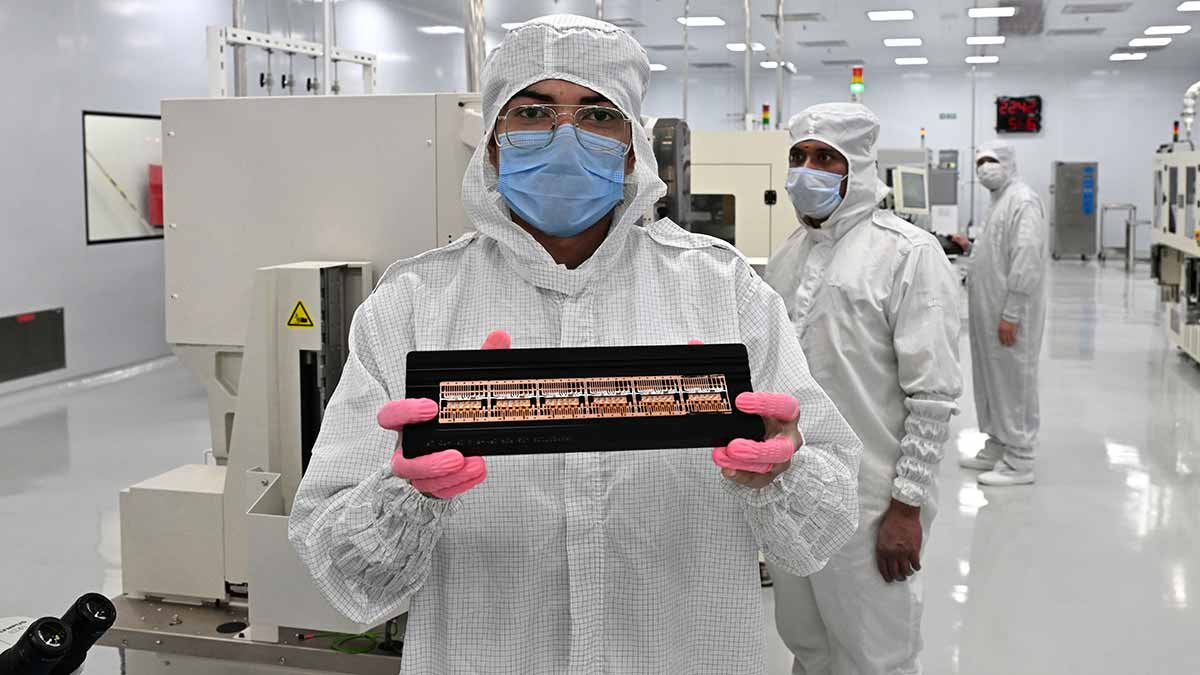
Early this year, Microsoft made an announcement that sent ripples through the global technology community. Its Majorana 2 chip, the company claimed, represented a breakthrough in quantum computing—a step closer to machines that could, in theory, solve problems that would take today's most powerful supercomputers millions of years to crack. Potential applications span drug discovery, climate modelling, financial risk analysis, cryptography and defence. The implications, if the technology fulfils its promise, are vast.
Scientists will debate the details for months. Quantum computing has a history of announcements that outpace reality. But the signal beneath the noise is unmistakable. The world's most powerful technology companies and governments are no longer asking whether quantum computing will arrive. They are asking who will be ready when it does.
For India, that question deserves an urgent and honest answer.
The countries that win the quantum age may not be those that build the first chip. They may be those that build the best ecosystem.
India has made a start. The National Quantum Mission, launched in 2023 with an outlay of over ₹6,000 crore, signals a political commitment. Research institutions are engaged. Some domestic hardware development is underway. But commitment and readiness are different things. And the global quantum race is shifting in a direction that demands India think bigger, and differently.
The dominant conversation in quantum circles is about qubits, error rates and chip architectures. These matter. But history offers a more instructive lens.
When the United States invested in the internet, GPS and space technologies, nobody had mapped out the applications in advance. The World Wide Web, ride-sharing, precision agriculture and digital navigation were not in anyone's plan. What governments built was infrastructure and capability. The applications followed.
Quantum computing is unlikely to be different. And India, of all countries, should understand this instinctively.
Consider what India has already built in the digital domain. Aadhaar enrolled over a billion citizens into a biometric identity system. UPI became the world's largest real-time payments platform. The National Knowledge Network connected hundreds of universities and research institutions. These were not products of waiting for technology to mature elsewhere. They were the result of India deciding to build foundational infrastructure at scale, on its own terms.
The quantum era calls for the same ambition.
Just as the National Knowledge Network connected India's research institutions to knowledge resources, India should explore the creation of a National Quantum Access Network that connects universities, laboratories, start-ups, hospitals, industries and government agencies to quantum computing resources. Such a framework would democratise access, accelerate experimentation and help create the applications that will ultimately determine the value of quantum technologies.
The question is not whether every Indian will use a quantum computer. The question is whether Indian researchers, hospitals, industries, financial institutions and government agencies will have timely access to quantum capabilities when they become economically and strategically useful.
What India needs is not merely a programme to develop quantum hardware. Equally important is the creation of a robust National Quantum Infrastructure—a sovereign, secure and scalable platform through which researchers, hospitals, defence establishments, start-ups, industries and government agencies can access quantum computing resources.
In practical terms, this could take the form of a national quantum cloud hosted within India, allowing authorised users across sectors to access quantum computing resources without owning the underlying hardware. Not every institution needs its own quantum computer, any more than every company needs its own data centre. What matters is reliable access, which is governed by Indian laws and operating within Indian jurisdiction.
This is not a counsel of dependency. In the early phases, such infrastructure could incorporate a judicious mix of indigenous and international technologies, hosted on Indian soil, operating under Indian law and governed by Indian frameworks. The objective would be to build operational experience, develop homegrown software stacks, train a generation of quantum-literate professionals and catalyse application development across sectors, all while domestic hardware capabilities continue to mature.
Utilisation rarely precedes infrastructure. Infrastructure creates utilisation.
A common objection to large quantum investments is uncertainty about demand. Who will use these machines, and for what? It is the wrong question, and it has always been the wrong question. Roads are built before traffic materialises. Ports are built before trade routes are proven. The history of transformative technology consistently shows that utilisation follows infrastructure, not the other way around.
India's sectoral breadth makes the potential applications especially compelling.
In pharmaceuticals, quantum algorithms could accelerate drug discovery in ways that could transform Indian generics into a global innovation force. In agriculture, quantum-enhanced climate and crop modelling could help feed a growing population more efficiently. In defence, quantum-safe cryptography is not a future concern, since adversaries are already harvesting encrypted data today, betting they can decrypt it once quantum computers mature. In financial services, portfolio optimisation, fraud detection and risk modelling could reshape markets. Weather forecasting, logistics, energy management and advanced materials research are other areas where quantum capabilities could eventually become significant national assets.
None of this happens automatically. It requires deliberate policy, institutional design and the willingness to treat quantum infrastructure with the same strategic seriousness that earlier generations treated railways, telecommunications and nuclear energy.
The risk is not that India will miss the first generation of quantum hardware. The greater risk is that, by waiting, it may become dependent on quantum services, standards and ecosystems designed elsewhere.
Microsoft's Majorana 2 announcement, whatever its ultimate scientific verdict, is a useful prompt. It reminds us that the quantum transition is no longer a matter of if, but when. The countries and economies that will benefit most will not necessarily be those that produce the first or most powerful quantum chip. They will be those that have built the ecosystems, the infrastructure, the workforce, the applications and the governance frameworks to absorb and deploy quantum capabilities when they arrive.
India has the software talent, the digital infrastructure, the institutional experience and the strategic need. What remains is the decision: to be a consumer of quantum services developed elsewhere, or to build the sovereign quantum ecosystem that national ambition demands.
That decision cannot wait for the technology to be fully proven. It never could. It never should.
Quantum readiness is no longer a scientific challenge alone; it is an infrastructure challenge, an access challenge, an economic challenge and ultimately a strategic choice.
(Lt Gen M.U. Nair (Retired) is the former National Cyber Security Coordinator, Government of India, and a former Signal Officer in Chief, Indian Army.)
(The opinions expressed in this article are those of the author and do not purport to reflect the opinions or views of THE WEEK.)
