



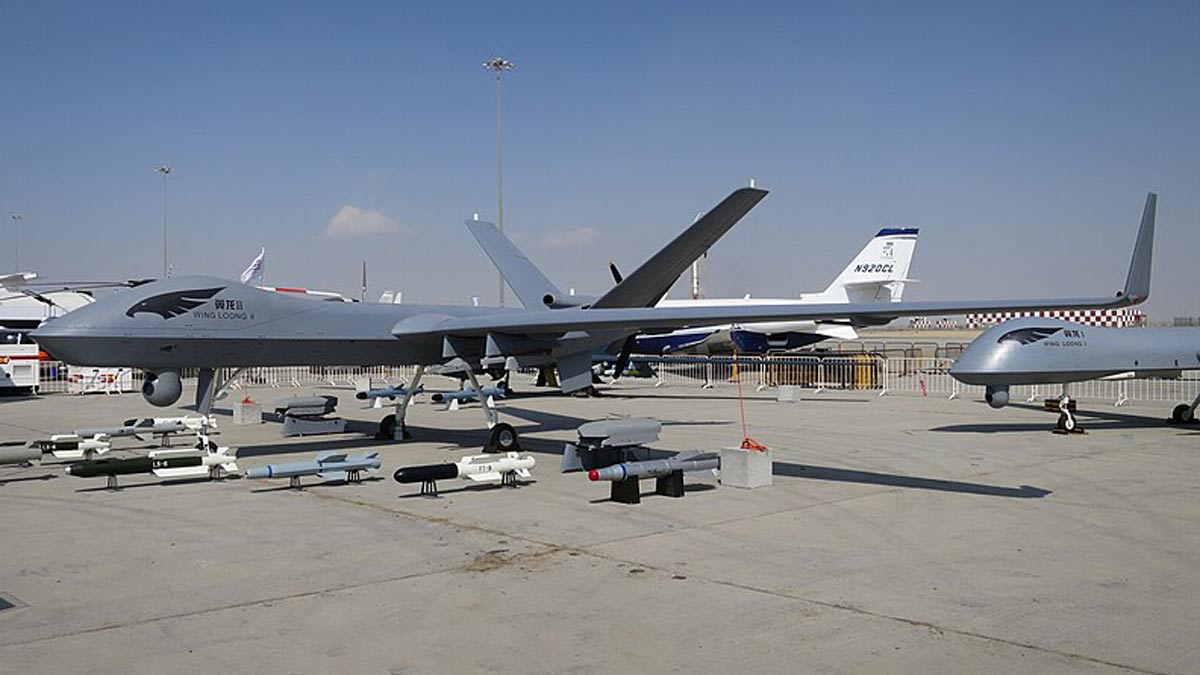
When an American F-15 went down in contested airspace this year during the West Asia war, one pilot described what he saw just before he was hit as “flying into a minefield of drones.” Whether the pilot’s description sticks or not, the image is apt: we are glimpsing an inflection in air warfare where the sky itself can be seeded with cheap, autonomous platforms that complicate—and sometimes defeat—expensive aircraft and missiles. The result is not simply another weapons system to be added to the shelf. It is a doctrinal rupture that will reorder tactics, budgets and the very meaning of air superiority.
For decades, air defence revolved around layered, ground-centric arrays: radar belts that detect, command posts that decide, and guided interceptors or guns that engage. These systems are effective in conventional settings, but they assume a scale and economy the modern battlefield may not permit. Missiles and manned fighters are costly; many unmanned systems are not. That asymmetry is the fuel behind the aerial minefield: by distributing risk across swarms of inexpensive drones—many expendable—an adversary can impose attrition costs and operational friction that traditional defences struggle to absorb.
From batteries to swarms
The essence of the aerial minefield is not a single type of drone but an integrated ecosystem. Practical implementations rest on four functional layers working together. First, persistent surveillance drones carry electro-optical, infrared and passive electronic sensors that find and track targets.
Second, communication-relay “motherships” sustain swarm coherence and distribute targeting information to subordinate units.
Third, low-cost kinetic or kamikaze interceptors physically threaten aircraft and missiles.
Fourth, electronic-warfare platforms jam, spoof and degrade an attacker’s sensors and links.
Crucially, artificial intelligence binds these layers. Swarm algorithms permit scores or thousands of nodes to distribute tasks, adapt to losses, prioritise threats and cooperate in real time. Human operators cannot micromanage such numbers; autonomy is an operational necessity, not mere convenience. The result is an aerial obstacle course: aircraft must thread formations, distinguish friends from foes, and face the prospect that every empty patch of sky could hide a lethal node.
Ukraine and Iran as laboratories
The Russia-Ukraine war has become the world’s laboratory for massed unmanned systems. Ukrainian units routinely deploy small interceptors against Russian drones, use first-person-view attack UAVs for tactical strikes, and entwine electronic warfare and cyber measures at the tactical edge. These engagements have normalised drone-versus-drone combat and shown how layered, affordable defences can blunt more sophisticated adversaries.
Iran’s forays into swarm tactics—and the reported use of drones in the strikes and harassment campaigns of recent years— offer a different, worrying confirmation: states willing to mass-produce cheap UAVs can alter local air dynamics quickly. The combination of large numbers, kamikaze tactics, and electronic countermeasures produces effects disproportionate to the cost of individual units.
Economics: The decisive variable
Military history is full of examples where economics drives innovation. An F-35 or a long-range cruise missile carries a price tag in the tens of millions of dollars; many combat drones can be manufactured for thousands or less. Using a cheap drone to neutralise an expensive asset flips the attrition calculus. Nations with manufacturing scale and doctrinal commitment to swarms—notably China, Iran, Russia and Pakistan—are already exploiting this asymmetry.
China’s investments are especially consequential. Its exercises have demonstrated hundreds of coordinated UAVs operating under AI-enabled control, and its industrial base means it can field such systems at scale. For India—which faces both a technologically advanced neighbour on one border and growing drone inventories on the other—this is not a hypothetical threat; it is a near-term strategic reality.
AI: Software as a strategic asset
If platforms are the body of a drone force, software is the nervous system. Swarm intelligence, distributed decision-making, graph neural networks for perception, and resilient ad-hoc communications convert fleets of airframes into effective defensive lattices. The state that masters sovereign AI for contested environments—secure, explainable, and operable under electronic attack—will enjoy a decisive edge.
That raises two connected points. First, reliance on foreign cloud services or opaque commercial autonomy is a wartime vulnerability. Second, the competitive advantage will accrue less to the buyer of the most airframes than to the developer of robust, field-hardened autonomy. In practice, that means substantial investment not just in airframes, but in algorithmic research, data collection, simulation infrastructure and explainable systems that can operate without pristine networks.
Manned aircraft will not be discarded
A common fear is that swarms will make manned fighters obsolete. The reality is more nuanced. The foreseeable future is one of manned-unmanned teaming. Pilots will increasingly operate as commanders of constellations: fighters will orchestrate swarms that scout, screen, jam and absorb enemy fire so the manned platform can prosecute the mission with reduced risk. In other scenarios, expendable swarms will undertake the most dangerous tasks entirely.
The core measure of air superiority will shift from the performance envelope of a single airframe to the quality of networks and software that coordinate many platforms. A squadron of autonomous agents, well commanded and resilient, can impose strategic effects that even the best fighter fleets will find hard to counter.
Counters and limits
Aerial minefields are not invulnerable. Electronic warfare—jamming, spoofing and cyber intrusions—can sever swarm cohesion. Directed energy weapons, high-power microwaves, and even mass small-arms fire can reduce drone density. Weather, terrain, and logistics impose operational limits. And engineering robust, low-latency, secure communications at scale under attack is extraordinarily hard.
Thus, the coming decade will see a contest between swarms and counter-swarm technologies: mesh nets versus jammers, lasers versus curtain formations, and cyber offensives against autonomy stacks. Doctrine, training and redundancy will matter as much as hardware.
What India should do
For India, the response must be strategic, not ad hoc. Three broad lines of action should guide New Delhi:
- Create theatre-level drone air-defence units tasked with persistent aerial denial and interception, integrated with existing missile and radar networks. Make interceptor drones a standard element of air-defence brigades rather than experimental add-ons.
- Prioritise sovereign swarm-AI research and development within DRDO, iDEX and the private sector, with clear pathways from prototype to fielding. Invest in secure, explainable autonomy, contested-environment testing ranges, and high-fidelity simulation for tactics and logistics.
- Build industrial scale and supply-chain resilience for low-cost airframes, sensors and propulsion so that “mass through autonomy” is an industrial reality as well as doctrine. Concurrently, fold electronic warfare and cyber capabilities into every swarm architecture, and establish hard rules for anti-spoofing and counter-deception.
Institutional reform will help. An autonomous systems command could codify doctrine, procurement, safety, testing and operational employment. That office should coordinate with civilian regulators, academic centres and industry to accelerate innovation while safeguarding safety and interoperability.
Policy and ethical guardrails
As India pursues autonomy, it must also set guardrails. Rules of engagement for autonomous systems, minimum human-in-the-loop thresholds for lethal decisions, export controls to prevent proliferation, and safeguards against unintended escalation are essential. India should also champion international dialogue on responsible military AI and explore cooperative norms or arms-control measures for swarms. Without norms, the risk of miscalculation and rapid escalation grows.
Conclusion: Code as deterrent
Military revolutions have a pattern: those who adapt doctrine, industry and procurement together win. The aerial minefield is plausible now because airframes, sensors, networking and AI have converged. Whether it becomes a dominant paradigm depends on how quickly states integrate autonomy with existing defence structures and close industrial and algorithmic gaps.
For India, the lesson is stark and actionable. The future of air defence will be less about buying a few exquisite systems and more about fielding many intelligently coordinated ones. The decisive advantage may come not from a stealthy jet or a longer-range missile, but from the nation that best combines mass production, secure software and sovereign AI. In the coming age, the most important weapons will not only be forged in factories—they will be written in code.
(The writer was Vice Chief of the Indian Army.)
(The opinions expressed in this article are those of the author and do not purport to reflect the opinions or views of THE WEEK.)
