



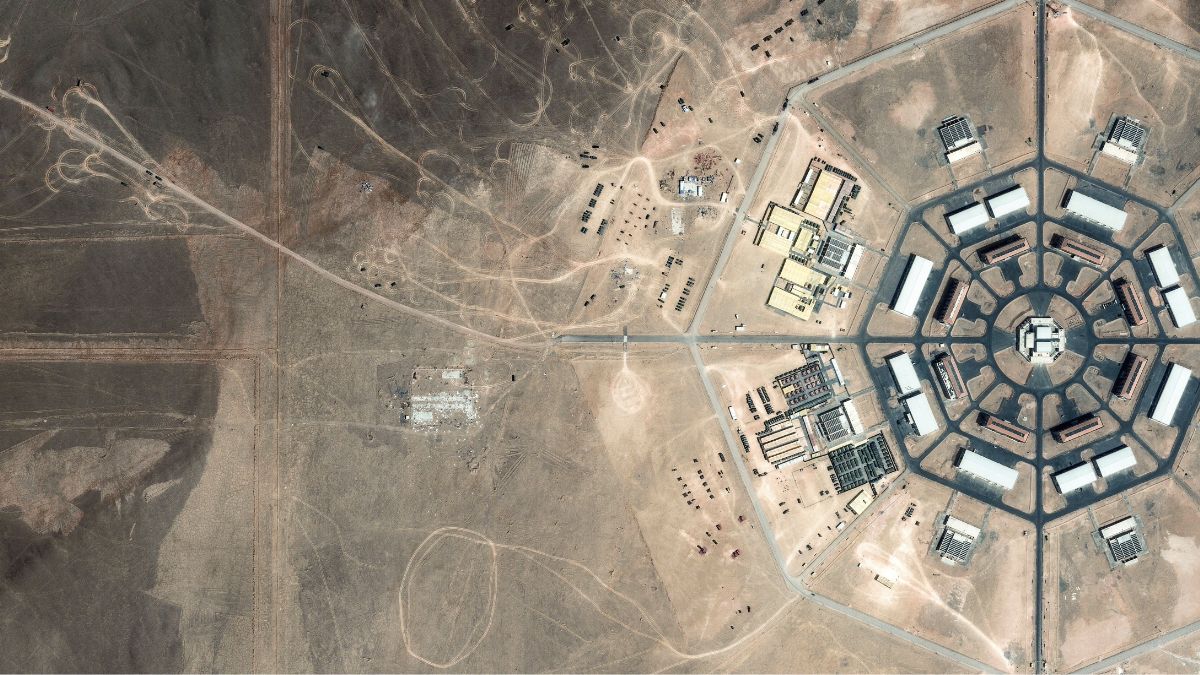
China is reportedly building a web of launch pads, bunkers and communication nodes near its isolated nuclear sites listed in its northwestern desert.
The new military infrastructure, seen in images reviewed by Reuters, has raised concerns of an escalation in the rivalry between Beijing and Washington.
Security scholars say that the military complex being built ensures China’s ability to strike back even if there were an American strike on China’s arsenal first.
The images show more than 80 launch pads that could possibly be used for China’s mobile missile launchers and air defence batteries.
The images also show that the facilities can serve electronic warfare, satellite communications and command operations, three security analysts who analysed the images told Reuters.
The construction is reportedly part of an expansion of infrastructure designed to protect, increase the survivability and operate China’s land-based nuclear forces.
The network of construction also comes amid the intensifying tension with the US over Taiwan.
China’s nuclear strategy is based on its ability to respond to a nuclear attack rather than launch the first one. It had maintained a policy of keeping a relatively small but credible nuclear deterrent.
Alexander Neill, an adjunct fellow at Hawaii’s Pacific Forum, told Reuters, “We can see this infrastructure is being built on a grand scale, covering thousands of square kilometres of desert beyond the silo fields.”
“We can see this infrastructure is being built on a grand scale, covering thousands of square kilometres of desert beyond the silo fields,” he added.
The desert silos situated in the Xinjiang region and the Gansu province are the core of Beijing's nuclear forces.
What are the structures?

The new infrastructure consists of two octagon shaped installation eastern Xinjiang, south-west of the Hami nuclear silo fields. The installations were built over the course of six years and contain housing for personnel and large military vehicles.
The housing is flanked by armoured bunkers and fortified weapons storage areas. They also contain airfields and railheads that connect the octagons to the Hami silos.
Large military vehicles were seen around the northern octagon in Exercises in May and April this year.
While security scholars agreed that the infrastructure could support China’s nuclear program, they also cautioned that key details about the structure remain unknown, including the weapons that could be deployed at the launch pads. The pads could be used to deploy mobile air-defence missiles, electronic warfare nodes or, from some of the larger ones, road-mobile ICBM launchers, three security scholars said.
The octagons sit at a network of dirt roads and stretch into the desert.
A December Pentagon report said that China, reportedly, is on track to field about 1000 warheads by 2030, and is likely to have loaded 100 intercontinental missiles across its three silo fields.
A northernmost octagon, which appears to be under construction, has satellite dishes and two large towers.
Tong Zhao, a senior fellow in nuclear policy at the Carnegie Endowment for International Peace, said, “Taken together, I think there is a real possibility that the octagonal structures and the strange towers are linked to C3 - command, control, and communications - as well as maintenance and storage activities related to China’s nuclear operations at the Hami ICBM silo site.”
The third octagon, which is less developed, seemed to be used as a target range. There are damaged buildings, and according to Vantor, mock-ups of Western fighter jets.
Hans Kristensen, director of the Federation of American Scientists’ Nuclear Information Project, said that the defensive network China is building near its silos sets it apart from methods used by the US and Russia, with the latter two relying on the number of silos, their isolation and the hardened construction rather than a missile defence system.
“I’ve never seen anything quite like it,” Kristensen said. “It’s an extraordinary effort.”
