



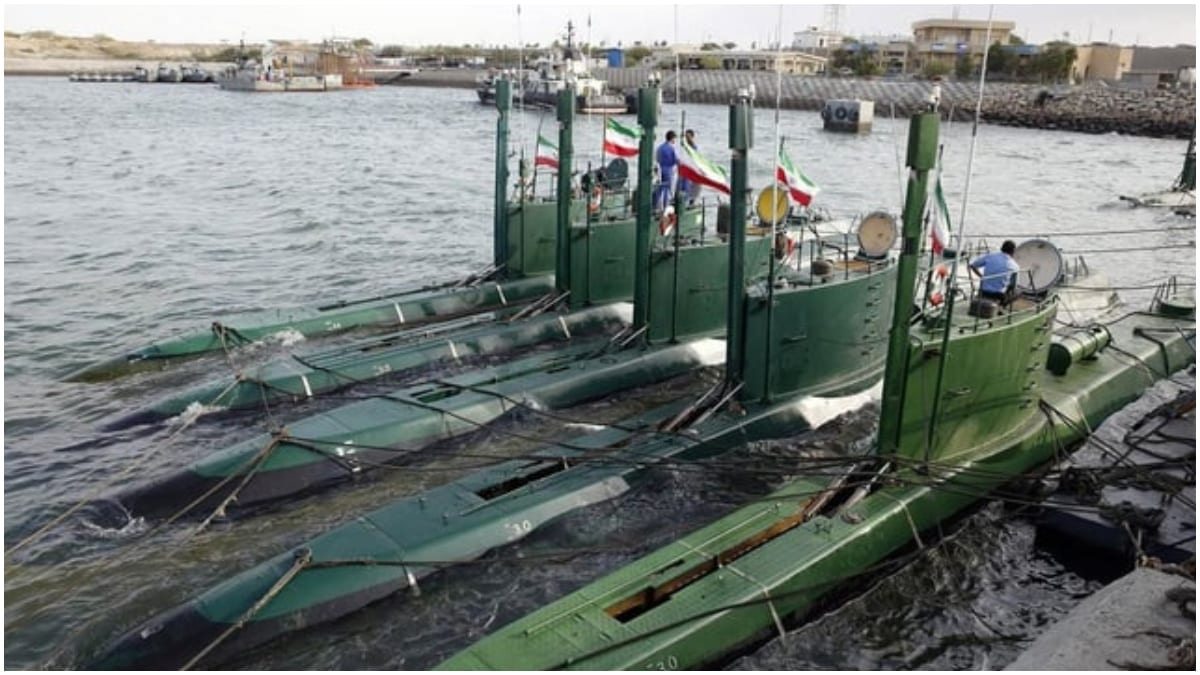
It is estimated that Iran has no fewer than 14 Ghadir-class submarines, a number which could well be closer to 20. They are rumoured to be supported by a handful of North Korean-made diesel-electric attack submarines—all capable of firing a variety of torpedoes.
But none of these fall under the "most modern" category — built and upgraded in the past decade or so. This is where the theory stems from that Iranian attack submarines pose no threat to US Navy formations. The aircraft carriers, amphibious warships, and submarines of the United States cannot be realistically harmed in combat or during an unlikely ambush, some claim.
However, a noted military news portal has claimed that Iranian submarines can sink any US Naval asset currently deployed in the region.
Iranian attack submarines vs US Naval fleet
The report was based on an analysis of the decades-long combat record of the U.S. Navy against diesel-electric submarines. Contributing to the study were several naval exercises that the United States had featured in over the decades. When the forces of Sweden, Australia, Chile, and Japan, using identical submarine classes, turned to tactics such as resting on the seabed, U.S. anti-submarine warfare efforts often faced "particular complications," the report said.
ALSO READ | Strait of Hormuz erupts: US and Iran exchange heavy fire, ceasefire on brink
Australia's Collins-class diesel-electric attack submarines have been particularly menacing for U.S. warships, the report said. Its "kills" during drills over the years include two U.S. nuclear submarines and two American amphibious assault ships, Military Watch Magazine said in a report.
During one such drill, it sailed dangerously close to the supercarrier USS Abraham Lincoln but was not neutralised, the report said. In another instance, the U.S. carrier group knew that the Australians were in the designated target area, but still failed to locate them. This is particularly bad news for the US, as the tough sonar conditions in the Strait of Hormuz could be exploited by Iran's Ghadirs, Military Watch Magazine pointed out.
The great size, speed, and acceleration of a U.S. warship can become a liability when facing submarines, as they create more noise in the effort to move faster, effectively making them easier to pick out.
However, there is no guarantee that Iranian sailors are as battle-ready as their North Korean or American counterparts. The standard of the crew could still be a decisive factor, and there is no guarantee that when the time comes, the Iranian Navy can live up to the challenge.
