



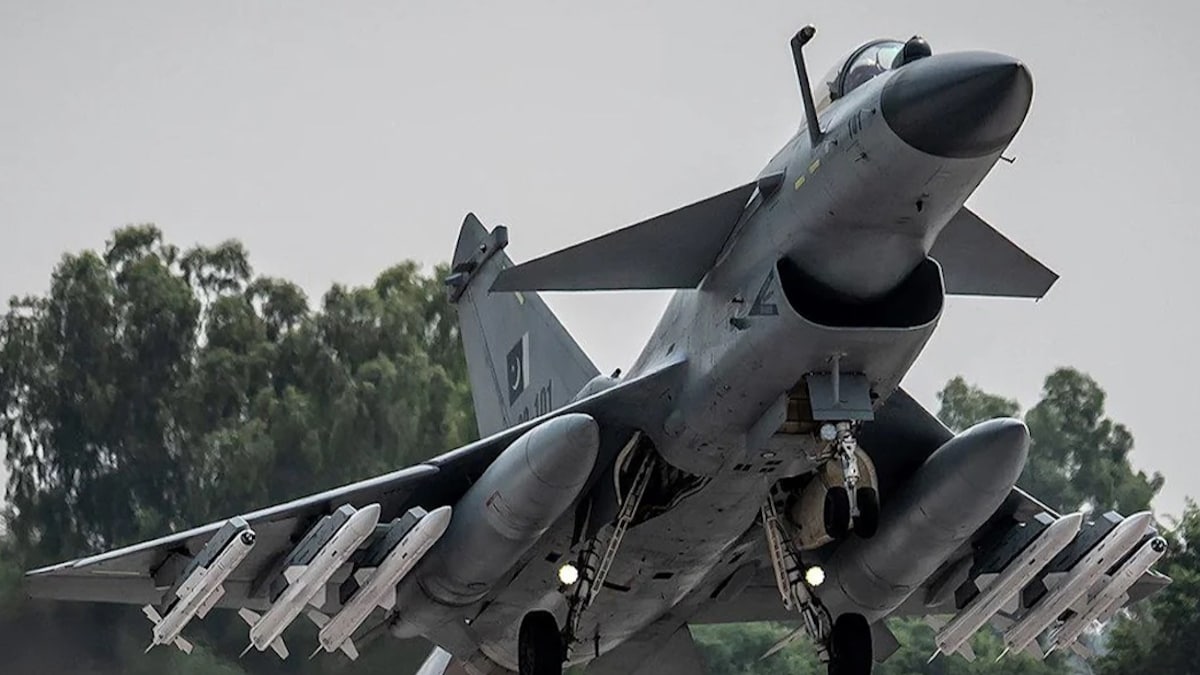
The Chinese-built J-10C fighter, which is the export variant of the J-10 series, will be integrated with PL-17 ultra-long-range air-to-air missiles, a new report said. The news is particularly crucial for India, as the development could potentially turn the Pakistan Air Force's (PAF) J-10C fleet into "hunters" of Airborne Warning & Control Systems (AWACS) and refuellers.
The Week had reported earlier that the Chinese PL-17 missiles are unparalleled in terms of range and are often referred to as the People's Liberation Army Air Force's (PLAAF) most potent weapon. The PL-17 missile, developed by the Shanghai Academy of Spaceflight Technology, is almost six metres long, weighs around 500 kilograms, and has a speed exceeding Mach 4. It was created to take out an enemy's command, control, and surveillance ecosystem located even at great distances.
The initial setbacks that the IAF openly confessed to have suffered while striking terror launchpads in Pak-occupied Kashmir during Operation Sindoor were said to be a consequence of underestimating the Pakistan Air Force (PAF) J-10C fighters armed with PL-15Es, a report had said. The PL-15E already outclasses many of India’s Beyond Visual Range (BVR) assets, and the PL-17 now threatens New Delhi's AWACS, refuellers, ISR aircraft, and stand-off jammers, the report added.
PL-17: China’s most powerful missile
A Malaysian report in 2025 had named India’s Netra and Phalcon AWACS, IL-78 refuelling tankers, and long-range maritime surveillance aircraft as "exactly the types of high-value assets the PL-17 was built to destroy."
"The pairing of the PL-17 with the J-10C would effectively give Pakistan a stand-off anti-AWACS strike capability comparable to those traditionally reserved for major air powers such as the United States and China," Defence Central Asia said in a report.
As a consequence, the IAF will be forced to operate its AWACS and refuellers well inside its mainland, which could significantly reduce its radar coverage and capability to contribute to frontline operations. In the case of AWACS, its early-warning timelines could well be affected if forced to stay deeper inside Indian airspace for its own safety.
Pakistan Air Force’s Chinese arsenal
It was in March 2022 that the PAF inducted the Chinese-built J-10C fighter into service. The J-10C is significantly larger and can carry a heavier payload of weapons and fuel than the JF-17. It is equipped with an infrared search-and-track (IRST) system on the nose. IRST can detect aircraft or missiles by their heat signature. Unlike radars, IRST does not give away the host jet's position and thus increases its survivability.
However, there is no official confirmation so far that the PL-17 export variant has been approved for overseas delivery or operational integration on the Pakistan Air Force's J-10CE fighter jet, Defence Security Asia said in a report.
India incorporates its own technology along with that from the West, Russia, and even Israel to equip its fighter aircraft, while Pakistan's entire system is driven by Chinese tech. This could be a single area where Pakistan holds the edge, as a lack of uniformity could make systems integration much more difficult for the IAF, reports had earlier said.
