



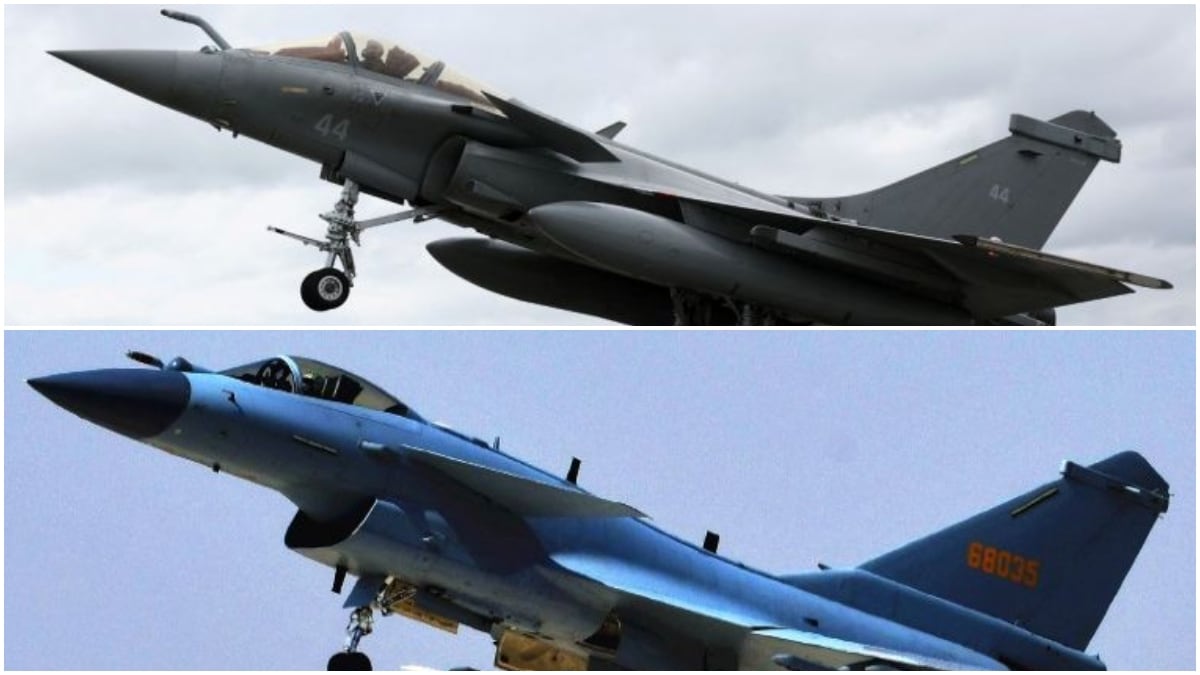
Amidst Pakistan claiming that the Indian Air Force (IAF) lost its French Rafale jets in a retaliatory strike by its forces using beyond visual range weapons, a noted defence analyst has come forward to explain why the argument is not flawless. The expert also added that 'Operation Sindoor' cannot be analysed as a face-off between Chinese and Western war machinery as there were several "difficult-to-quantify things" at play during the three-day standoff between the two countries.
Pakistan has claimed to have brought down Indian fighter jets, including the French Rafales that were used for the initial precision strikes targeting terrorist launchpads in Pakistan-Occupied Kashmir (POK) and Pakistan mainland. They had credited its Chengdu J-10 (J-10C) jets for the kills. Social media was littered with pictures of aircraft debris, which Islamabad claimed belonged to India's "fallen" Rafale. However, the authenticity of these images were questioned even by government reports in the US, which said that Chinese propaganda machinery was working overtime as it was an opportunity to highlight its own fighter aircraft and missiles over Western competitors like the Rafale.
To date, Pakistan has not been able to pinpoint where the Rafale or other Indian jets crashed after being struck by its weapons, Michael Dahm said, while mentioning that India’s air force is bigger than Pakistan’s. Did Pakistan strike the Rafales after they had completed the mission? Did the IAF pilots fire salvos at them? None of this is being answered by PAF despite its hurry to claim J-10Cs managing to bring down the French aircraft, he added. Dahm stated that such arguments “probably tells us absolutely nothing.”
India's Meteor missile are no pushovers
He also pointed out that while Pakistan and China want to play down the impact of Meteor missiles that are equipped on IAF Rafales, these European active radar guided beyond-visual-range air-to-air missiles (BVRAAM) are still the best in business. Even if one is to believe the Pak theory of India losing a Rafale during the conflict, they cannot discredit the Meteor missiles. While the Sino-Pak nexus would like to portray IAF's go-to aircraft and weaponry as vulnerable, they have not been able to prove it due to obvious reasons. Even in the viral images that were propagated by pro-Islamabad handles in the aftermath of the conflict, there was no sighting of Meteor missiles amidst the wreckage, he pointed out.
“...from the very, very limited reporting we have, there are no indications the Rafale was shot down with a Meteor missile still intact. They found the wreckage. There was a shorter-range infrared missile found in the wreckage, but there was no indication that the Meteor was there. Now, maybe the Rafale had a Meteor and it fired it. Maybe it wasn’t carrying one at all. But I don’t think this really tells us anything about how good the J-10 is compared to the Rafale, or how good the Chinese technology is compared to the Western tech,” Michael Dahm was quoted as saying by the Air and Space Forces Magazine.
Had they been fired, India would have almost certainly taken out the intended targets as he described the missiles as "wicked" which offers a "no-escape zone" for the enemy.
India vs Pakistan was battle of tactics over tech
India incorporates its own technology along with those from the West, Russia, and even Israel to equip its fighter aircraft while Pakistan's entire system is driven by Chinese tech. This could be a single area where Pakistan holds the edge as the lack of uniformity could make systems integration much more difficult for the IAF, he reportedly said.
Even then, the comparison of Chinese aviation technology with that of the West in the light of the conflict is unjustified as the Indo-Pak standoff was more about tactics, skills, and the like rather than the relative capabilities of the jets involved. “What does this say about Chinese technology versus Western technology? Probably not a whole lot, but it probably says a lot more about systems of systems, about training, about tactics … about all of those difficult-to-quantify things,” rather than the relative capabilities of the J-10 versus the Rafale, Dahm said.
Who is Michael Dahm?
Michael Dahm is a renowned security and defence analyst with expertise in East Asian military affairs, with a special focus on the Chinese People’s Liberation Army (PLA). Dahm served as a U.S. Navy intelligence officer for over 25 years in several diverse staff and operational assignments, including combat tours in the Balkans and Iraq. According to the Elliott School of International Affairs, in his final tour he served as the Senior Naval Intelligence Officer for China at the Office of Naval Intelligence.
He has also served as a senior researcher at the RAND Corporation, a non-profit global policy think tank, and has authored a number of widely cited articles on military issues in the Indo-Pacific.
