



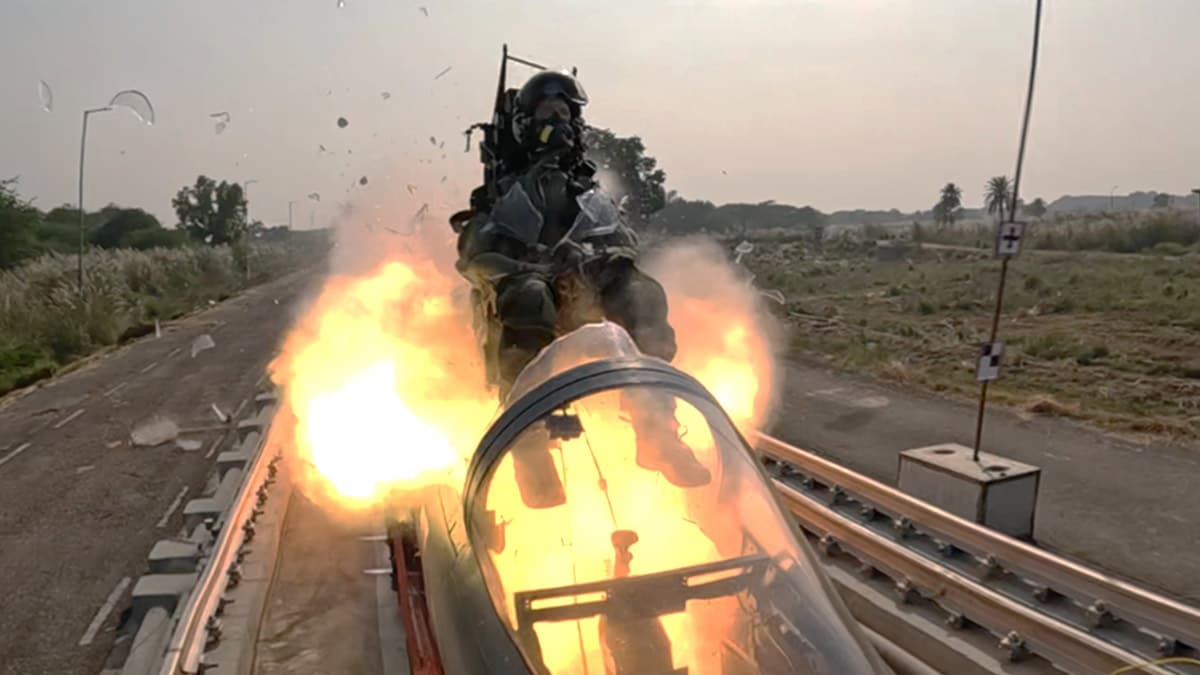
Defence Research and Development Organisation (DRDO), in collaboration with Aeronautical Development Agency (ADA) and Hindustan Aeronautics Limited (HAL), successfully conducted a high-speed rocket-sled test of a fighter aircraft escape system at controlled velocity.
The trial demonstrated that the escape system can function accurately and safely under extreme conditions comparable to those experienced by frontline fighter jets during critical phases of flight.
According to defence ministry, this complex dynamic test, which has been dubbed a major milestone for India’s indigenous defence capability towards self-reliance, puts India in an elite club of countries with advanced in-house escape system testing capability.
ALSO READ: The battle of minds: Why India must prepare for cognitive warfare
The test, conducted at the Rail Track Rocket Sled facility of the Terminal Ballistics Research Laboratory in Chandigarh, confirmed the effectiveness of the canopy-severance system, the ejection sequence, and full aircrew recovery.
Dynamic ejection tests are far more complex than static evaluations like net tests or zero-zero tests, and offer a true measure of ejection-seat performance and the effectiveness of the canopy-severance system. In these trials, a dual-sled setup carrying the LCA aircraft forebody was propelled to a precisely controlled velocity through the phased firing of multiple solid-propellant rocket motors.
"The canopy fragilisation pattern, ejection sequencing and complete aircrew recovery process was simulated using an instrumented anthropomorphic test dummy, which recorded critical loads, moments, and accelerations that would be experienced by ejected pilots," the defence ministry said in a release.
The entire sequence, witnessed by the officials from the Indian Air Force, and the Institute of Aerospace Medicine & Certification, was captured through onboard and ground-based imaging systems.
