



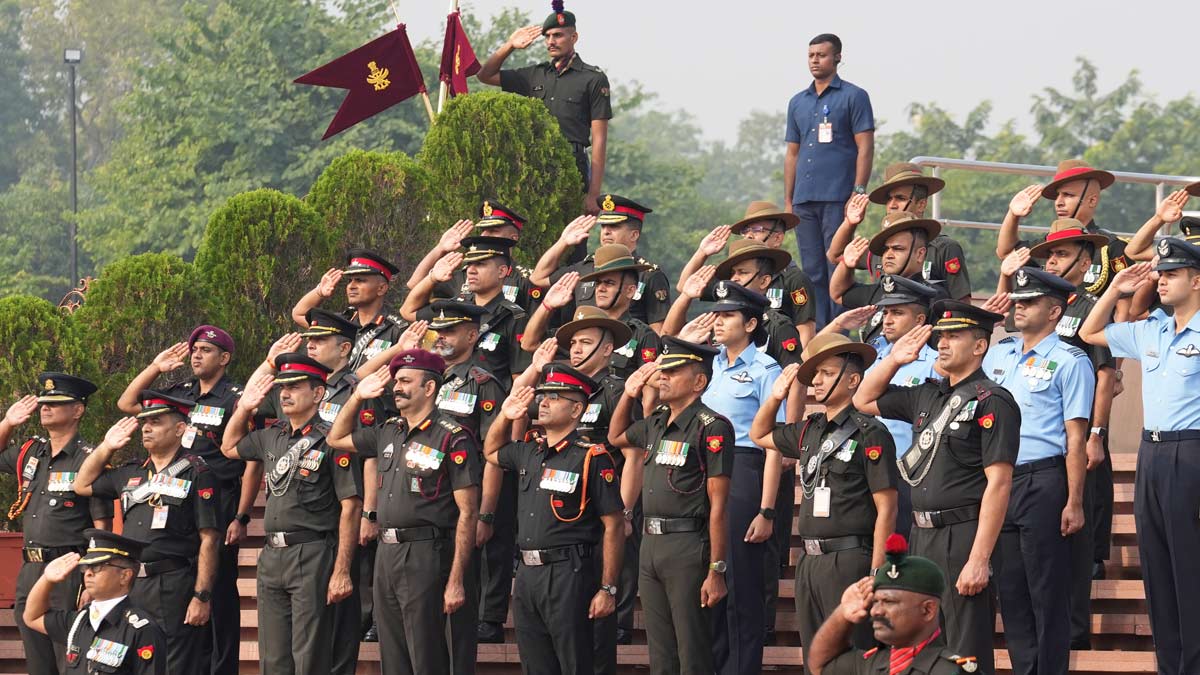
Infantrymen, the foot soldiers, have consistently served as the backbone of militaries throughout history. While airstrikes and long-range artillery do significantly damage the enemy targets, the ultimate victory is achieved with the hoisting of the flag by the infantry on the objective. The adage, “Victory is still measured by foot,” was appropriately realised by the United States during the Iraq and Afghanistan conflicts, as it became deeply entangled in combating Al-Qaeda and the Taliban following initial gains.
The Indian princely states always maintained infantry and cavalry units that were subsequently modernised by the British upon their merger with the British Indian Army. Throughout the First and Second World Wars, Indian infantry fought in theatres across the globe and established themselves as the most professional and spirited soldiers.
Post-independence, starting with the India-Pakistan war of 1947-48, the infantry has constantly been at the forefront, demonstrating its mettle in the 1962 India-China conflict, the liberation of Bangladesh, the peacekeeping mission in Sri Lanka, the Kargil War, and various insurgencies in Kashmir and the Northeast. The frequent clashes with the Chinese along the Line of Actual Control routinely test the determination, capabilities, and morale of the infantrymen, highlighting their value to the nation. Their immense contribution can be gauged by the fact that out of 21 Param Vir Chakras awarded to the Indian defence forces till now, 17 have been won by the infantry soldiers.
Indian Infantry Day, observed on October 27th, celebrates the landing of the Indian Army (1st Battalion of the Sikh Regiment) at Srinagar in 1947—an action that stopped the tribal raiders backed by the Pakistani Army and saved Kashmir. These infantrymen, and those who fought in the 1962 conflict with China, were armed with basic World War II-era bolt-action rifles and equipment—their courage, discipline, and regimental spirit partly compensating for these inadequacies.
Operation Sindoor demonstrated how technology dominates the modern battlefield. To survive and contribute in combat, the infantrymen of today have to keep pace with these developments. To retain a combat edge, its soldiers need high-quality personal gear, advanced small arms, reliable communication systems, and enhanced mobility. Various operations have repeatedly demonstrated the need to modernise the infantry. To meet this requirement, the Indian Army launched the ambitious 'Future Infantry Soldier as a System' (F-INSAS) project in 1994. However, it faced major delays due to the lack of budgetary support, resulting in its downscaling in 2015.
Seventy-eight years after the Srinagar landings and nearly three decades since the initiation of F-INSAS, a critical evaluation reveals that Indian infantry, despite playing a major role in internal and external conflicts, is yet to be fully equipped as per its needs. One positive development has been the indigenous production of AK-203 rifles, which will serve as the standard personal weapon for soldiers. However, a rifle alone is not sufficient—an integrated small arms system also requires light machine guns and carbines for close-quarter battles.
Currently, infantry soldiers carry around 25–30 kilogrammes of battle loads, which slows them down and drains their energy. Soldiers need lightweight clothing, all-terrain waterproof boots, high-energy ready-to-eat meals, and light camping equipment to remain mobile during operations. Personal protection is equally essential, and recent steps by the government to provide lightweight helmets and bulletproof jackets are a step in the right direction.
In modern warfare, situational awareness—the ability to understand the terrain and to recognise the movement of friendly forces and enemy activities—is imperative. While radars, drones, and advanced thermal imaging systems have improved surveillance at the battalion level, small teams and individual soldiers still lack adequate battlefield visibility. The Defence Research and Development Organisation (DRDO) is in the process of developing an Internet of Battlefield Things (IoBT) system that could equip helmets with real-time tactical information, though it is still at the prototype stage.
If India is to retain its military advantage, it must prioritise the modernisation of its infantry, which is a prerequisite for meeting the evolving demands of warfare. Although the cost of modernising infantry is substantial due to the sheer size of the force, it is not prohibitive enough to compromise the nation’s security and combat readiness.
The government must ensure an adequate budget for the army and expedite the implementation of modernisation efforts. The Indian infantry has stood at the vanguard of every conflict, defending the nation with grit and valour. Now, it is the nation's responsibility to equip these soldiers with the necessary tools to maintain their prominence in the 21st century.
The opinions expressed in this article are those of the author and do not purport to reflect the opinions or views of THE WEEK.
