



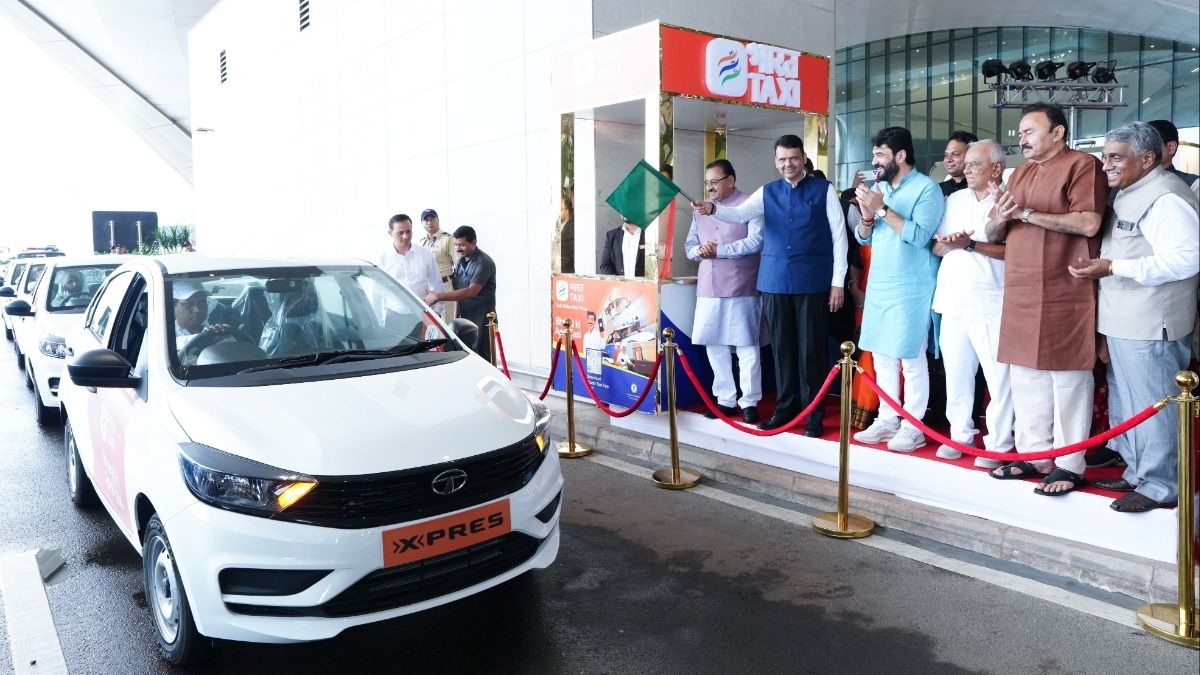
Maharashtra chief minister Devendra Fadnavis has launched the Bharat Taxi service at Navi Mumbai International Airport, bringing India’s first cooperative-led digital mobility platform to one of the country’s busiest urban corridors.
Conceived by Sahakar Taxi Cooperative Limited and backed by major national cooperatives, Bharat Taxi is designed to put drivers—called “Sarathis”—at the centre of ownership, governance and income, rather than treating them as gig workers on a commission-heavy platform.
Under the model, taxi Sarathis are enrolled as members and shareholders of the cooperative.
“Sarathis are not merely service providers but also owners and shareholders of the institution,” Fadnavis said at the launch on Thursday. The service operates without surge pricing or hidden charges, relying on a fixed service fee and promising “a surge pricing-free and hidden charge-free system…providing affordable services to passengers and fair returns to Sarathis for their hard work.”
Profits are intended to be shared with driver-members, replacing an “intermediary-centric system with a Sarathi-centric transportation framework,” according to the state government.
Cooperative taxi vs private players
The need for such a cooperative taxi option is underlined by a growing body of academic and policy research on app-based cab work.
A field study on Ola and Uber drivers in Hyderabad and Kolkata by the Tata Institute of Social Sciences found that platform commissions have risen to 20–35 per cent, with drivers often working 12–16 hours a day just to meet fuel, loan EMIs and incentive thresholds, leaving incomes “precarious and unsustainable.”
Another market study on cab aggregators by the Competition Commission of India similarly reported widespread driver dissatisfaction with earnings and algorithmic incentives, as well as passenger concerns over opaque surge pricing.
Recent Motor Vehicle Aggregator Guidelines, 2025, have attempted to cap surge fares and guarantee drivers at least 80 per cent of the fare, but they still assume a commission-based model controlled by private platforms.
In contrast, global research on platform cooperatives suggests that member-owned digital platforms can improve income stability and local accountability, especially in transport and logistics.
For Maharashtra’s extensive cooperative network, Bharat Taxi could offer a way to bring those cooperative principles into urban mobility—linking local taxi operators, youth and women drivers to a transparent, surge-free system that they collectively own.
