



Since the Narendra Modi government came to power in 2014, much of the policy debate has centred on self-reliance and building an Atmanirbhar Bharat. The focus has largely been on manufacturing, defence, semiconductors and technology. A new report argues that another sector deserves attention: consulting.
Published by the Sangh-affiliated Rambhau Mhalgi Prabodhini (RMP), Indigenous Consulting for Atmanirbhar Bharat asks whether a country aspiring to become a developed economy by 2047 can continue to depend on foreign firms for policy advice and governance reforms.
Authored by Naitik Muley and CA Anurag Singh, it calls for Indian consulting firms capable of competing with the world's largest advisory companies and argues that self-reliance in policy advice is now a "strategic necessity".
RMP had organised a national symposium in January on promoting indigenous consulting talent, inspired by Prime Minister Narendra Modi's emphasis on indigenous systems.
The report reflects concerns among some policymakers that India's strategic interests must be kept in mind as foreign consulting firms become deeply embedded in government departments, schemes, and programmes.
Writing in the report, Dr Vinay Sahasrabuddhe, RMP vice-chairman and former BJP Rajya Sabha MP, argues that the "growing footprint of international giants in public policy and governmental processes across the world has not always been matched by commensurate levels of transparency, accountability and institutional oversight".
Questions have been raised internationally, he writes, about conflicts of interest, data confidentiality, and the gap between influence and responsibility in public consulting assignments.
Sahasrabuddhe traces India's dependence on foreign firms to what he calls a "prestige bias", or the "'IBM syndrome'"—the "ingrained belief that credibility and competence reside only in globally recognised foreign names".
Beyond auditing
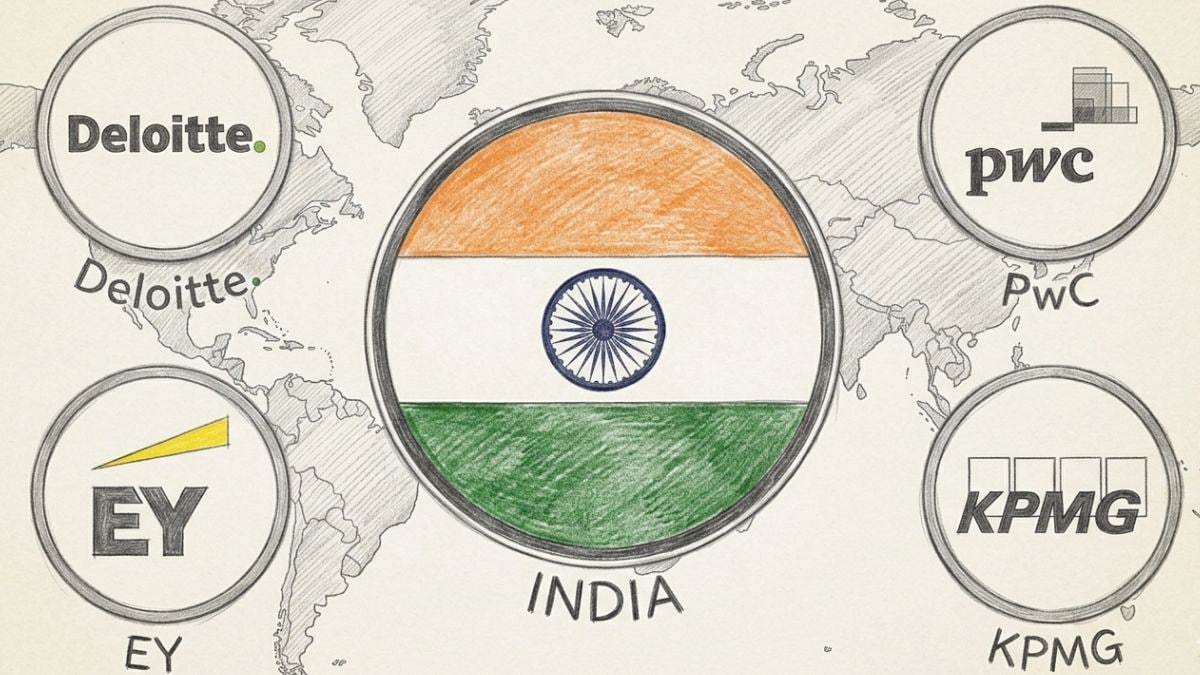
The global consulting market is worth around $240 billion. The 'Big Four'—Deloitte, PwC, EY and KPMG—began as audit firms, but have expanded into advisory, technology, tax and government consulting. The wider 'Big Seven' includes McKinsey, BCG and Bain, whose influence extends across both corporate and public policy sectors.
According to the report, two major foreign professional services firms each employ more than one lakh people in India. Together, they earned "about ₹49,900 crores (approx. $6 billion+) in total revenue in India" in FY2024.
Auditing, however, is only a small part of their business.
The report says "consulting services rather than auditing dominate the Indian revenue pie of these giants, generating over ₹44,000 crores (more than 85 per cent of total Indian revenue)".
Government and PSU contracts account for "roughly 40 per cent of this total consulting revenue, about ₹14,000 crores", spanning areas from disinvestment advisory to infrastructure policy and national programmes such as Smart Cities, ONDC, and Startup India.
Concerns over influence
The report argues that global firms often rely on a “one size fits all” model, which may not always reflect local realities.
It cites international examples where consulting models developed elsewhere failed to deliver expected outcomes when applied to different political and administrative settings.
It also raises concerns about market concentration. According to the report, restrictive arrangements and entrenched procurement practices have made it harder for domestic firms to compete, limiting their ability to develop scale, expertise and institutional memory.
Another concern is the possibility of conflicts of interest. The report points to instances abroad where consulting firms advised governments while simultaneously working for private-sector clients affected by those same policies. Such situations, it argues, can create questions about "dual loyalties" and the independence of advice.
Data security is another issue highlighted in the report. It refers to the 2023 disclosure that the Australian arm of a major consulting firm shared confidential government tax plans with multinational clients between 2013 and 2016. Given the access consulting firms often have to sensitive government information, the report argues that stronger safeguards are needed.
Building Indian firms
The report's recommendations focus on procurement, regulation, technology and finance.
It argues that public procurement rules should place greater emphasis on ownership, control and project teams, rather than relying heavily on a firm's global brand or track record. It also recommends encouraging consortiums of Indian firms so that smaller players can combine capabilities and bid for larger assignments.
The report calls for regulatory reforms that would make it easier for Indian professionals to form multidisciplinary partnerships and build larger consulting enterprises. It argues that existing rules often prevent domestic firms from achieving the scale enjoyed by international competitors.
Technology is another focus area. The report warns that global firms are investing heavily in artificial intelligence, while many Indian consultancies lack comparable resources. It calls for greater investment in digital capabilities, knowledge platforms and AI adoption.
Financial constraints, particularly delayed government payments, are identified as a major challenge. The report proposes changes that would ease working-capital pressures on consulting firms and improve access to credit for domestic players.
It also highlights Maharashtra's empanelment model, which relaxed eligibility criteria and created separate categories for companies, NGOs and academic institutions.
A similar approach, the report suggests, could be adopted nationally through the Government e-Marketplace.
Beyond the government, the report urges Indian companies expanding overseas to engage Indian consulting firms, helping them build international credentials. It also advocates a larger role for institutions such as the IITs, IIMs and public policy think tanks in advisory work.
The report does not call for excluding foreign firms. Instead, it argues for creating conditions in which Indian consultancies can grow, compete globally and develop expertise of their own.
