



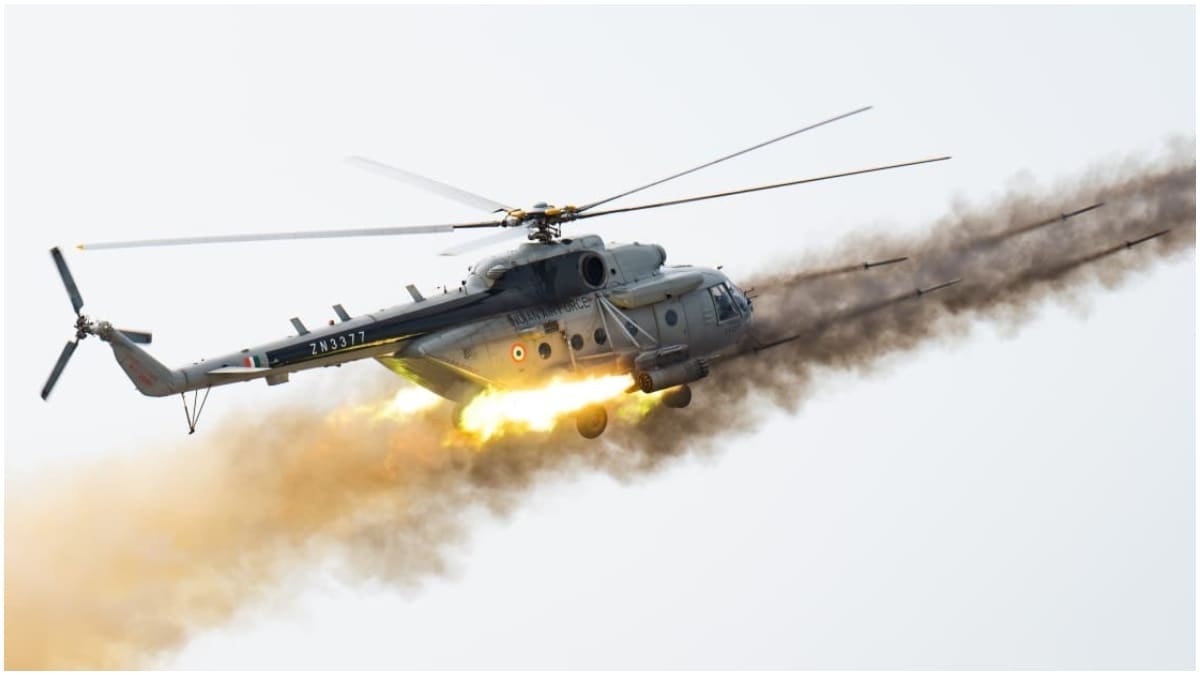
For a week, the helicopter units of the Indian Air Force (IAF) were testing their counter-drone warfare capabilities at the Pokhran Field Firing Range. Future battlefields are going to be dominated by Unmanned Aerial Vehicle (UAV) deployment and drone swarms, meaning every modern force will have to be prepared to take on increasingly sophisticated and coordinated aerial threats.
The week-long exercise named 'Rotor Clapp-III', in which several helicopter units of the IAF took part, concluded on Sunday. Since the exercise was hosted by Rajasthan, the IAF pilots got a chance to perfect seamless coordination as they operate different helicopter platforms in the challenging desert terrain.
While the theme was 'Counter Unmanned Aerial Systems (Counter-UAS)', its primary objective was to test operational concepts against emerging aerial threats and strengthen combat preparedness in an evolving battlefield environment. It also assessed strategies, techniques, and procedures for integrated helicopter operations under simulated real combat conditions.
Precision strikes, battlefield support, reconnaissance, troop insertion, casualty evacuation, and coordinated operations to counter both aerial and ground-based threats were among the areas covered during 'Rotor Clapp-III'. Almost all major helicopter platforms of the IAF participated and demonstrated their combat capabilities through a series of tactical missions, news agency PTI reported.
The drill provided aircrew and operational units an opportunity to test and validate mission planning, inter-unit coordination, rapid response, and joint functioning under near-war conditions.
The Pokhran Field Firing Range, one of India's major military training areas, provided an ideal environment for conducting live operational exercises, the PTI report said.
The conclusion of Rotor Clapp-III reaffirms the Indian Air Force's commitment to maintaining a high level of operational readiness and adapting to emerging security challenges, sources said.
