



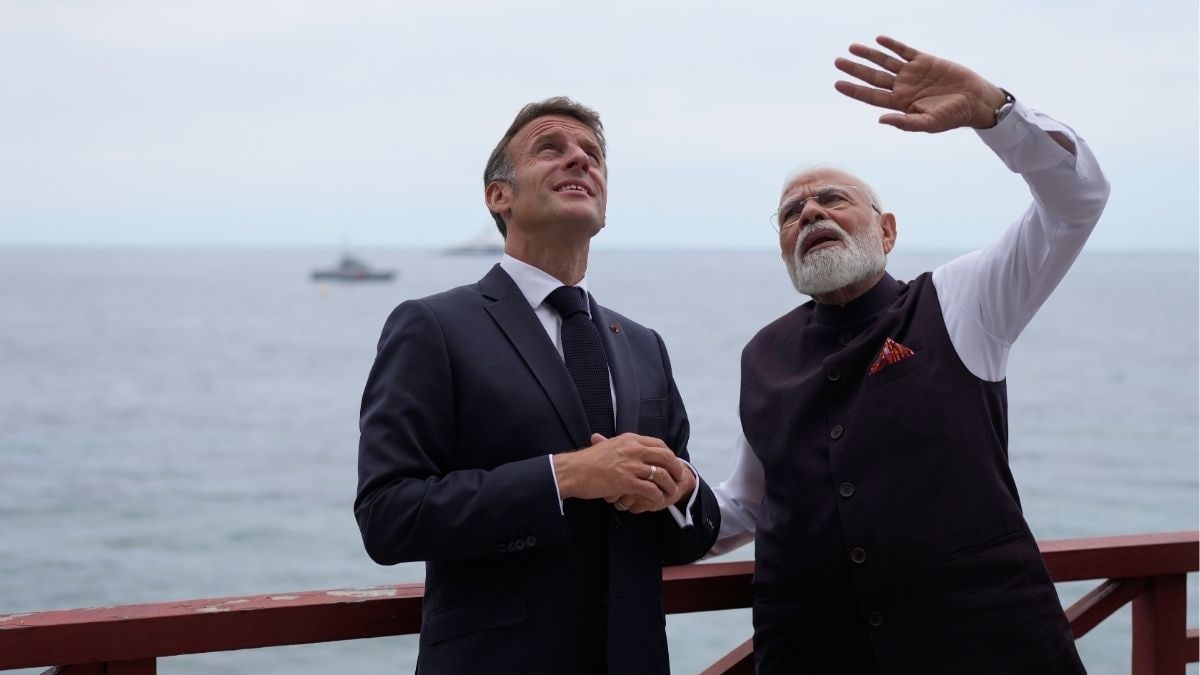
Prime Minister Narendra Modi's visit to Nice on June 14 produced one of the most substantive single-day hauls in recent India–France diplomatic history— 3 formal outcomes covering artificial intelligence, digital payments, trade, nuclear energy, railways, and space, capping a visit that both sides have cast as the next chapter of a "Special Global Strategic Partnership" elevated only four months ago.
According to both parties, a high-level mechanism has been set up to double bilateral trade from the current $16 billion to $32 billion within five years, backed by a new Economic Security Dialogue to protect supply chains.
Technology was the centrepiece of Modi's engagements in France, and the two countries formally adopted the India–France Innovation Roadmap 2030, a framework for co-development in critical and emerging technologies built on four pillars: trusted AI, academic mobility, technological sovereignty through industry–academia linkages, and AI-driven healthcare solutions.
A Joint AI Working Group focused on AI governance has also been established, carrying forward the India–France Declaration on Artificial Intelligence of February 2025.
Another important update was on UPI. The instant payments protocol will soon be available at Charles de Gaulle Airport in Paris and at Nice Airport, which many experts say is a tangible expansion of India's digital public infrastructure footprint into Europe.
Ten additional Indian startups will be incubated at Station F, Paris's flagship startup campus, and a Centre of Digital Sciences will be established between India's Department of Science and Technology (DST) and France's INRIA.
The Innovation Roadmap also includes 19 institutional agreements signed between Indian and French universities and research bodies, including IIT Bombay, IIT Delhi, IIT Madras, and IISc Bengaluru, covering everything from AI and energy to aeronautics and space.
India and France are also working together to set up an aeronautical training campus in Kanpur.
At the Bharat Innovates 2026 event, PM Modi, speaking to an audience of over 100–125 Indian startups and European investors at Station F, said India's priority was "Technology for Humanity," a human-centric approach to innovation.
"India innovates with scale and speed. India innovates for a sustainable future. India innovates for the whole world," he said.
