



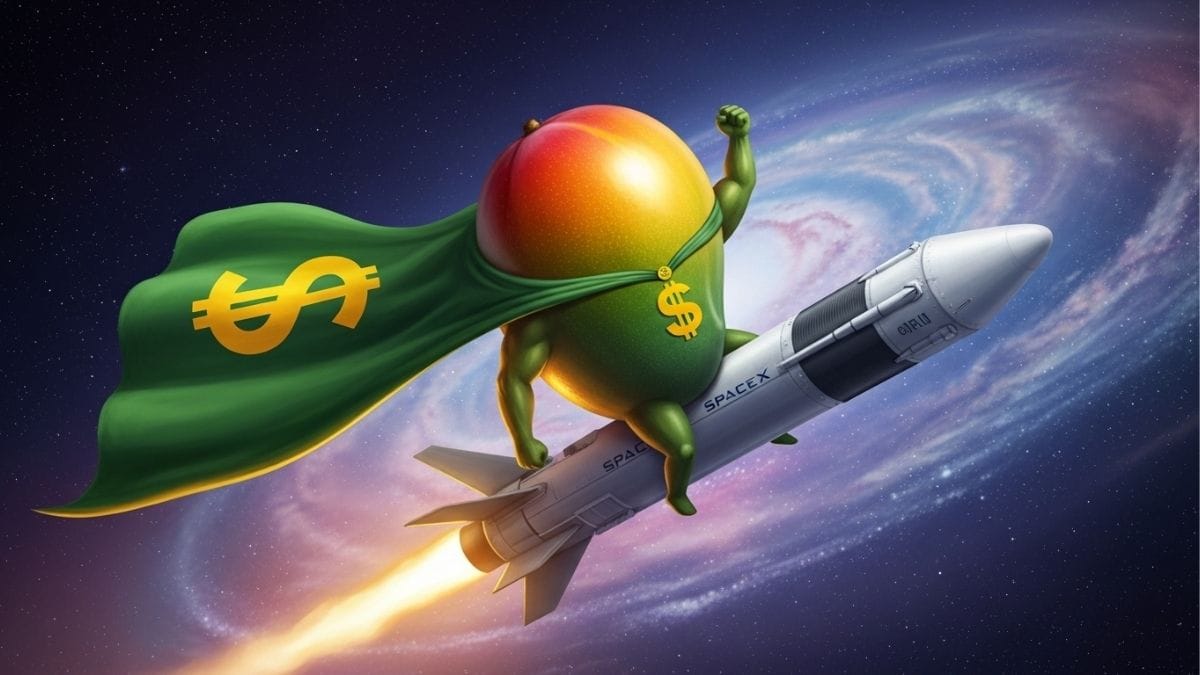
Americans love to give things nicknames. And Wall Street loves a good acronym and labels. Combine both, and you get groups of companies like FAANG and Mag 7. And now, new and upcoming IPOs might lead to the formation of MANGOS.
For years, Indian software engineers and investors have been chasing jobs and stocks at FAANG companies—Facebook (now Meta), Amazon, Apple, Netflix, and Google (now Alphabet). That label, popularised by TV host Jim Cramer in 2013 as FANG, became shorthand not just for market leadership but for career ambition.
It eventually evolved into a broader Magnificent Seven or Mag 7—a term coined by Bank of America strategist Michael Hartnett in May 2023—adding Microsoft, Nvidia, and Tesla while dropping Netflix, as artificial intelligence began to rapidly reshape the tech landscape. And now, the nomenclature is changing again. This time, it is a rocket company.
SpaceX completed what is now the biggest initial public offering in US history this month, raising $75 billion at a share price of $135, giving it a valuation of approximately $1.75 trillion. That vaulted SpaceX above two existing Magnificent Seven members—Tesla and Meta—almost instantly. The arrival of a company of that scale outside the old label has set off a scramble on Wall Street to devise a replacement grouping.
The frontrunner gaining traction in social media and among analysts is MANGOS, standing for Meta, Anthropic, Nvidia, Google (Alphabet), OpenAI, and SpaceX.
It bundles the two largest AI model companies, Anthropic and OpenAI, both of which are still building towards their own IPOs, alongside the hardware giant Nvidia, the two tech platforms Meta and Alphabet, and the newly listed SpaceX. The acronym is not yet standardised: some swap the "A" for Apple, which remains the third most-valuable US-listed company by market capitalisation.
Bank of America has also been pushing its own alternative. In a note dated May 22, it introduced the "AI Big 10". These were the original Mag 7 expanded with Broadcom, Micron Technology, and Advanced Micro Devices, factoring in the semiconductor boom of the past two years. That group alone accounted for more than 40 per cent of the S&P 500's total weight.
Back in India, tech professionals and retail investors have long tracked FAANG stocks as a benchmark for the global technology industry's health. And right off the summer in the country, it looks like MANGOS would become the signal of where the next decade of wealth creation is expected to happen. Now the only question, in the long run, is: Will it stay ripe or will it rot away?
Here is a comprehensive timeline of the most notable US tech-stock grouping acronyms that Wall Street has coined over the years — from the earliest cluster labels to today's MANGOS buzz.
Wall Street's tech acronym-label evolution
The Early Eras (1960s–1990s)
Nifty 50 (1960s–1970s): Before the Nifty 50 in India, sixties Wall Street knew it as a well-known label for the 50 most popular large-cap stocks on the NYSE, with blue-chip growth companies like IBM, Xerox, and Coca-Cola that institutional investors bought and held unconditionally. They were called "one-decision" stocks.
Four Horsemen (late 1990s) referred to the four dominant tech stocks of the dot-com boom: Cisco, Dell, Intel, and Microsoft. These companies were seen as the unstoppable engines of the internet age.
The Social Media & Streaming Era (2010s)
FANG (coined around 2013) was popularised by CNBC's Jim Cramer and stood for Facebook, Amazon, Netflix, and Google, the four high-growth internet companies that were reshaping consumer behaviour and delivering outsized stock returns.
FAANG (mid-2010s) added Apple to the group, recognising its trillion-dollar scale and the iPhone's dominance as a platform. This became the most widely used shorthand in Indian tech circles. "Getting a FAANG job" became a career aspiration for software engineers across the country.
FAAMG was a variant used by Goldman Sachs that swapped Netflix for Microsoft when it remerged as a cloud computing giant under Satya Nadella.
The AI Era (2023–Present)
Magnificent Seven or Mag 7 (coined May 2023) was introduced by Bank of America's chief investment strategist Michael Hartnett. It dropped Netflix and added Microsoft, Nvidia, and Tesla to the FAANG core, reflecting the AI boom. The seven: Nvidia, Apple, Amazon, Alphabet, Meta, Tesla, and Microsoft.
AI Big 10 (May 2026) was BofA's own expansion: the Magnificent Seven plus Broadcom, Micron Technology, and Advanced Micro Devices (AMD), acknowledging the semiconductor rally. This group accounts for over 40 per cent of the S&P 500's total weight, as per Reuters data.
MANGOS (June 2026) is the newest contender, born after SpaceX's record-breaking IPO. It stands for Meta, Anthropic, Nvidia, Google (Alphabet), OpenAI, and SpaceX. Some swap the "A" for Apple.
