



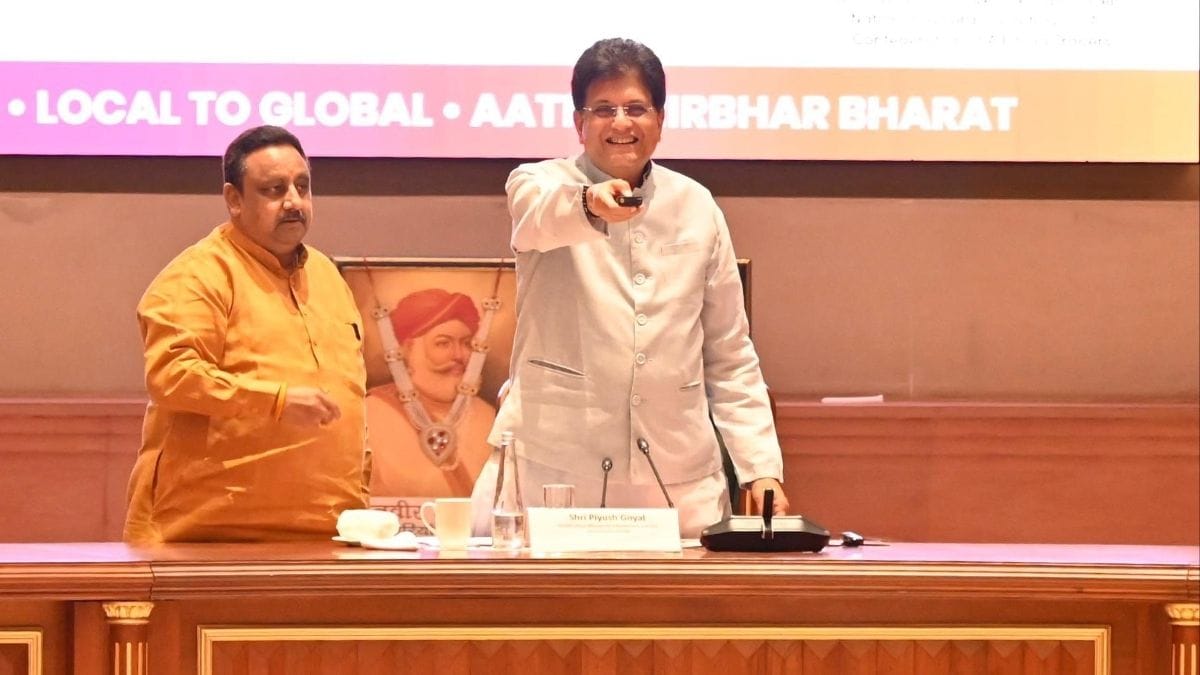
India has never exported more in its history, and the government wants to more than double that achievement going forward. Union Commerce and Industry Minister Piyush Goyal, speaking at the website launch of the Bharatiya Vyapar Mahotsav in New Delhi this week, declared that India aims to reach $1 trillion in exports this year and $2 trillion within the next five years.
The numbers, already, are impressive. But can India pull this off? Let us check the data.
India's combined goods and services exports touched a record $863 billion in FY2025–26, roughly 5 per cent higher than the previous year, according to data from the Directorate General of Commercial Intelligence and Statistics (DGCI&S) and the Reserve Bank of India. Services exports led the charge, surging to $421.32 billion on the back of IT and digital services, while merchandise exports grew more modestly to $441.78 billion.
But what can give India the much-needed lift here? According to Goyal, it is the set of Free Trade Agreements. Over the last three and a half years, India has concluded FTAs with 38 countries, giving Indian exporters preferential access to markets that collectively account for a significant share of global trade. Goyal even stated that the Oman FTA could come into effect from June 1, with others to follow.
The minister also called for an aggressive push on import substitution, singling out industrial hubs such as Rajkot, Jalandhar, Ludhiana, Batala, and Pune to scale up domestic production in capital goods, where India remains heavily import-dependent.
Independent analysts, however, are more cautious about the $1 trillion target in the current year. The Global Trade Research Initiative (GTRI), a think tank, had flagged by late 2025 that achieving the figure would require sustained double-digit export growth, an ambitious ask given weak global demand and stagnant merchandise numbers.
Other analysts state that merchandise exports, even by 2030, are on course to reach only around $720–730 billion under realistic growth assumptions, leaving a substantial gap from the government's target.
The path to $1 trillion can only happen if there is a pivot to high-value, technology-intensive manufacturing, as per these market watchers. And that is precisely the transformation Goyal was calling for.
