



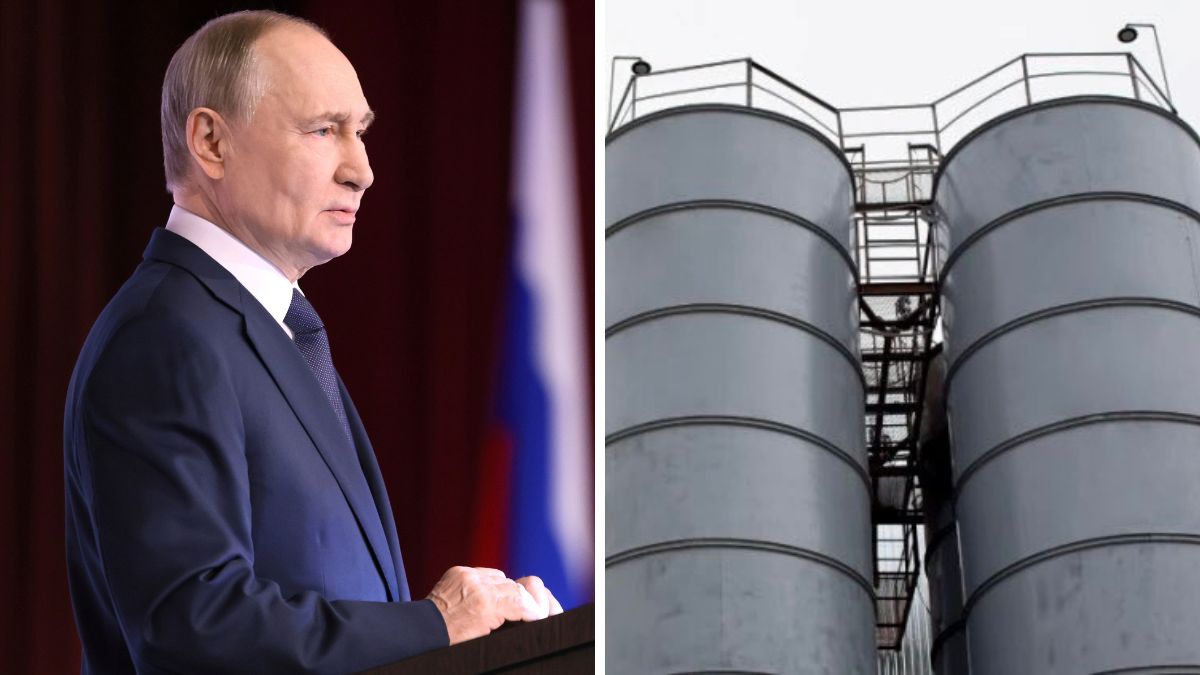
Even as the escalating conflict in the Middle East triggered spike in global energy prices, Russian President Vladimir Putin on Wednesday suggested that Russia could halt energy supplies to Europe “right now”.
Putin’s remarks came in response to the European Union's reported plans to impose a complete ban on Russian pipeline gas imports by late 2027 and prohibit new short-term Russian LNG contracts starting April 2026.
“Now other markets are opening up. And perhaps it would be more profitable for us to stop supplying the European market right now. To move into those markets that are opening up and establish ourselves there,” Putin said in an interview with state television’s Kremlin correspondent Pavel Zarubin.
However, Putin clarified that no final decision has been made and described the remark as just a thought.
“This is not a decision, it is, in this case, what is called thinking out loud. I will definitely instruct the government to work on this issue together with our companies,” he added.
The energy market turbulence follows the ongoing conflict triggered by coordinated airstrikes on Iran by the United States and Israel, and Tehran’s retaliatory attacks on neighbouring Gulf countries. The confrontation has disrupted shipping through the Strait of Hormuz, a major global energy transit route. The war has also led to the closure of Qatar’s LNG production facilities and the shutdown of Saudi Arabia’s largest oil refinery.
Putin’s comments about halting supplies to Europe appears to be aimed at exerting pressure on European buyers. Russia’s pipeline gas exports to Europe have fallen sharply—from about 40% to just 6% last year.
Putin also claimed that the current energy turmoil has created conditions where buyers are willing to pay a premium for gas supplies. “If such premium buyers emerge, then I think—indeed I am certain—some traditional suppliers, such as American companies, will leave the European market for higher-paying destinations,” he said.
Meanwhile, according to a Reuters report, Russia has indicated its willingness to divert vessels carrying Russian crude oil to India in order to offset supply disruptions from the Middle East. Around 9.5 million barrels of Russian crude currently on vessels near Indian waters could arrive within weeks, the report said, citing an industry source.
India is also exploring alternative supply options as its crude stockpiles are estimated to cover only about 25 days of demand. Nearly 40% of India’s crude imports pass through the Strait of Hormuz, making the country vulnerable to disruptions in the region.
The Reuters report also quoted the industry source as saying that Moscow is prepared to help meet up to 40% of India’s crude oil needs. Russia is also reportedly willing to supply liquefied natural gas (LNG) to India after Qatar—one of India’s major suppliers—halted production earlier this week.
