



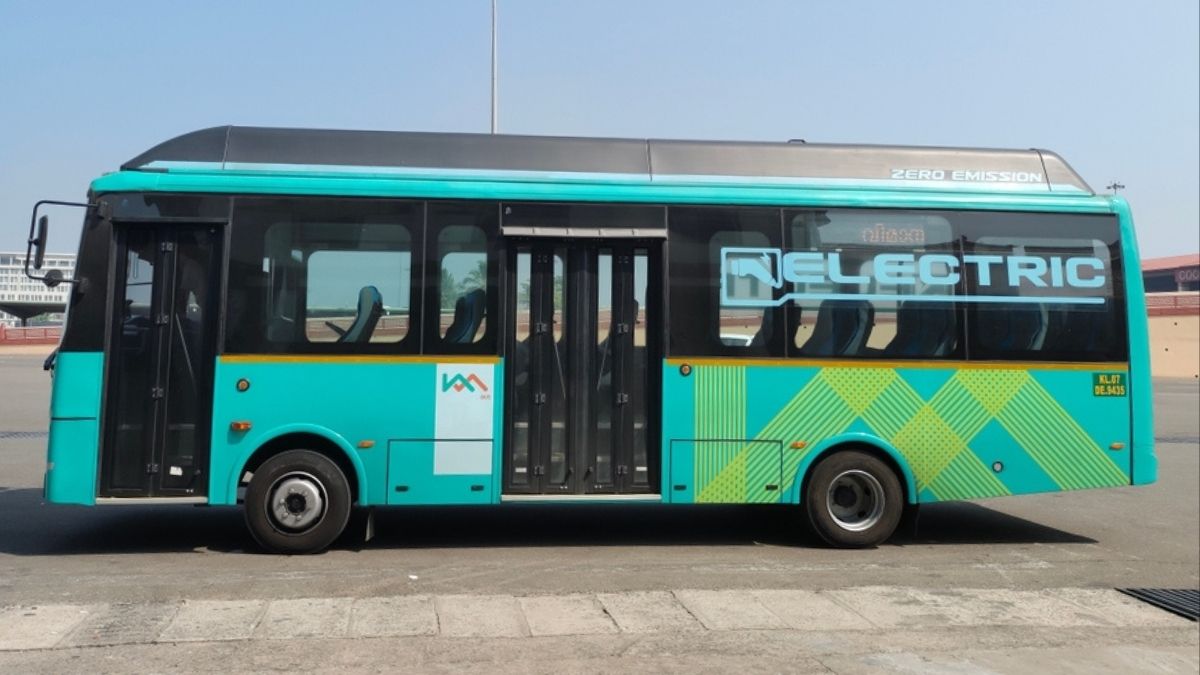
This month, Kochi Metro Rail Limited’s urban feeder bus service “Metro Connect” completed a year of regular operations. Last January, the operator of the Kerala city’s metro and water metro service introduced the transit feeder service with a fleet of 15 air‑conditioned electric buses. Fast forward to now, and the Metro Connect service has moved 14 lakh passengers, slowly transforming the city’s public transport landscape.
Looking ahead, KMRL plans to add GTFS-based live bus tracking and in‑vehicle information systems as Kochi Metro’s Phase II expands the network.
With the average daily ridership hitting more than 4,600 in recent months, KMRL recently announced that around 14 lakh passenger trips have been recorded on the feeder network so far.
The 33‑seater buses run on six key routes, including the high‑demand Aluva–CIAL (airport) corridor and links to Medical College and Kadavanthra–Panampilly Nagar, covering about 2,300km every day and nearly 7 lakh km over the year, the metro operator said.
KMRL attributed the feeder system’s succes to the "adoption of data analytics-driven optimisation".
"Service and charging optimisation initiatives have resulted in a 15 per cent improvement in both ridership and revenue. KMRL has established an advanced analytics platform integrating fare systems, bus telematics and charging infrastructure to continuously track key performance indicators. This initiative was implemented under the Sustainable Mobility and Climate Action Programme, supported by GIZ India and the Ministry of Housing and Urban Affairs," they said in a statement. However, it is the tackling of the last-mile connectivity issue that they truly solved.
Why last‑mile buses matter
Metro systems often struggle because people still find it difficult to get from the station to home or office, a problem transport experts call the "last‑mile penalty".
Multiple studies and academic reviews of Indian cities noted that when last‑mile links are weak, commuters shift to two‑wheelers and cars, increasing congestion, pollution and greenhouse gas emissions despite heavy investment in metros and BRT corridors.
This is where last‑mile options—flexible, low‑emission feeders like e‑buses or shared e‑mobility—expand a metro’s catchment area, raise ridership and cut overall emissions from urban travel.
KMRL Managing Director Loknath Behera said, "The urban feeder bus service is a key pillar of Kochi Metro’s integrated mobility vision. Its first-year success clearly demonstrates how well-planned electric feeder systems can strengthen last-mile connectivity, increase public transport usage, and support sustainable urban growth. Importantly, the feeder service has also helped enhance the ridership and revenue of both Kochi Metro Rail and Water Metro services."
And that is a true win, feeder services boosting the primary services like Kochi Metro and Kochi Water Metro. For Kochi, this was particularly useful on festival and New Year days, when extended feeder services supported record passenger numbers.
"...We have demonstrated the feasibility of running an efficient and financially sustainable electric bus system in Kochi. In a city with high environmental risk indicators, the Urban Feeder Service stands as proof that careful planning, smart operations and responsiveness to commuter needs can deliver zero-loss, people-centric public transport," pitched in Gokul T.G., General Manager (Urban Transport) at KMRL.
The "Metro Connect" is a success story that married the metro service with an electric bus fleet. This, along with the passenger analytics platform, became the magic recipe for a marked upgrade in Kochi’s public transit system. But KMRL is not stopping there. For instance, they are also running road safety and behaviour training for crew with SCMS Institute of Road Safety and Transportation. Soon, live tracking would come to the service.
And the rest of the world has started to take note. Recently, Kochi Water Metro earned global recognition by securing a finalist spot in the prestigious 2026 Global Sustainable Transport Awards, even though it narrowly missed the top prize. The true winners, however, are the public transit passengers of Kochi.
