



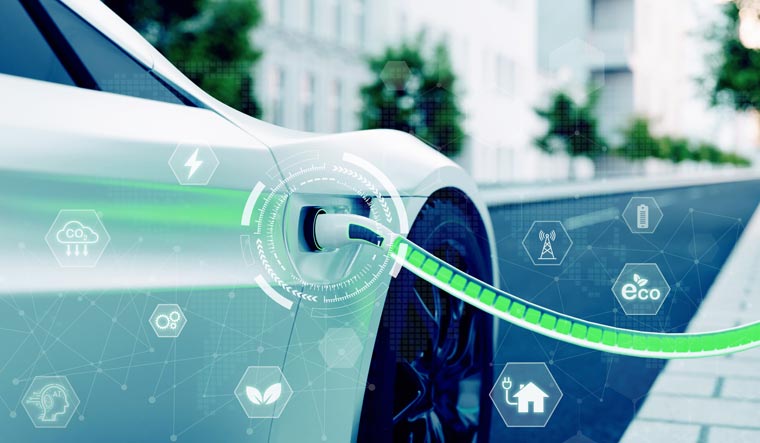
The word design reflects our daily interaction with objects, spaces and environments. We interact with what is around us and each other through designed constructs.
Every designer strives to achieve maximum from minimum. Using creativity and ingenuity, a designer aims to maximise the economy and save the environment. This idea is central to any design.
Whatever the application, a designer follows design methodology and a set of fundamental notions which inform their approach. They approach the solution from the vantage point of the end-user, seeking to optimise for the specific needs and capabilities of that individual or group.
India has built a reputation for cost-effective design and manufacturing, which can help create affordable EV charging solutions crucial for the widespread adoption of electric vehicles.
The design challenge here is to develop a safe, easy-to-install charger suitable for production in relatively large volumes. Another challenge and opportunity is to design a network to deliver large amounts of charging power safely, robustly and easily.
The mechanical design requires strict attention to thermal management constraints involving baseplate and forced air cooling for chargers located in warm climates. Wired connection reliability is an essential aspect of an EV charger's design.
EV will be India's new IT
The rapid growth of the EV market has led to a proliferation of connection and charging strategies, charger designs and charging networks. The electric vehicle market is rapidly growing, and the demand for skilled professionals in this domain is also rising. Due to various geopolitical considerations and a large captive population of talented engineers, India is becoming the destination of choice for major embedded manufacturers.
India has one of the largest pools of young and talented resources skilled in developing and integrating software and hardware components in India. Requirements of firmware engineers, embedded software engineers, hardware engineers and systems engineers will be huge; they work on integrating various ev vehicle subsystems to ensure the vehicle's smooth functioning.
As an engineer, you're at the heart of the drive to rapidly expand EV charging infrastructure. Whether you're designing an advanced DC charging station for public or highway access or looking for modular solutions to build out your commercial system and get to market fast, it is time to reach out to experts who understand your challenges.
Make India a hub of electronic design for EV charging equipment
Faster adoption of EVs, adoption of local designs and their manufacturing plant in Indian territory will help India to become the hub of electronic design for EV charging. There are many ways to make India a hub of electronic design, but a few of them are as follows:
Government Support and Policies:
In terms of Incentives, subsidies, and tax benefits to encourage the development, manufacturing, and adoption of EV charging equipment.
Skill Development:
Support training programmes to enhance the skill set of engineers and technicians in the EV charging electronics domain.
Research and Development (R&D):
Establish technology incubators and innovation centres focusing on EV charging electronics design, as in our premium institutes like IITs.
Market Demand Stimulation:
EV Adoption Incentives: Implement incentives for electric vehicle adoption to increase the demand for EV charging infrastructure, thereby stimulating the demand for charging equipment.
Promotion of Make in India:
Promote Indian-made EV charging equipment in international markets to establish India as a reliable and cost-effective supplier.
Industry Collaboration:
Create industrial clusters or zones for EV charging electronics design and manufacturing, promoting synergy and efficient resource utilization.
The dynamics in cost of electronic design
It depends upon the utilisation of charging equipment, and costs can vary based on the type and quality of components used in the design, such as power electronics, microcontrollers, communication modules, sensors, connectors, etc.
Standardization:
This helps reduce the complexity of design, manufacturing, and testing, leading to cost savings.
Simplified Design:
We need to eliminate unnecessary components or features that add to the cost without significantly improving performance or user experience as per government regulations.
Component Integration:
Integrate components into a single unit to reduce the number of quantity per set and simplify assembly. This can lead to cost savings in terms of both materials and manufacturing.
Cost-effective Components / Raw Material selection:
Avoid parts with additional specifications/capabilities that are not required reducing unnecessary costs.
Research and Development:
Invest in research and development to innovate and discover new cost-effective technologies.
Collaboration and Partnerships:
Collaboration with partners with ready-to-go designs and proven solutions.
Local Partnerships and Collaborations:
India has a strong network of industries, research institutions, and government bodies that can foster collaborations that accelerate the design and deployment of EV charging solutions.
Balancing speed and energy consumption
To achieve the necessary charging speeds, high-voltage rapid and ultra-rapid DC chargers are essential, capable of delivering power at up to 500 or 600 kW and enabling recharge times of under 10 minutes (depending on the battery size).
However, pushing voltages upward for the organisations and engineers responsible for designing these DC EV charge points leads to various challenges.
Significant challenges must be overcome for the engineers designing the high-voltage DC chargers to enable them to achieve the above objective. As a result, careful consideration needs to be given to system design and component choice. Luckily, there are a variety of vendors to help you create your design to achieve the top objectives of balancing safety at high voltage, reliability in all weather conditions, and energy efficiency.
In a country like India, charging options must be designed from a customer's critical question, the effect on EV's 'miles per hour'… "Kitna (mileage) deti hai?”
Suresh Kamath is MD, Avnet India
The opinions expressed in this article are those of the author's and do not purport to reflect the opinions or views of THE WEEK.
