



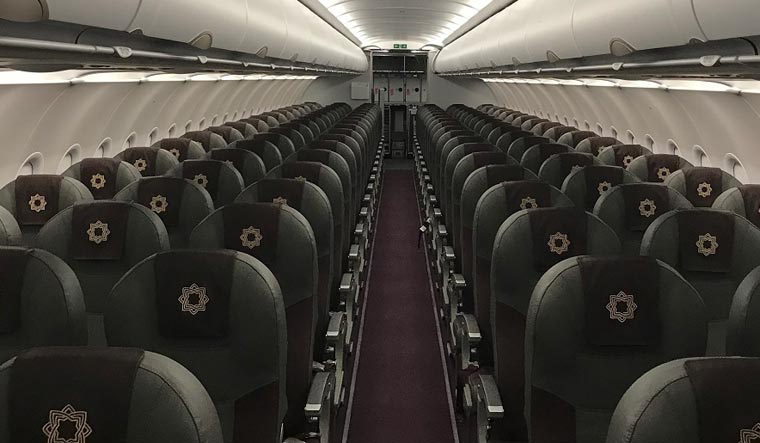
Full-service carrier Vistara has decided to drop the business and premium economy classes and use an 'all-economy' configuration on some of its lower-income routes.
Vistara, which is a joint venture of the Tata group and Singapore Airlines, is one of two full-service carriers in the Indian market, the other being Air India.
Business Standard reported that Vistara has asked Airbus to send around 10 of the 50 A320 and A321 narrow-body aircraft it has ordered in an all-economy configuration.
In 2018, Vistara had placed an order with Airbus for buying 50 A320 and A321 aircraft. An A320 in the 'all-economy' configuration would have "180 seats as opposed to 164" in a three-class cabin (business, premium economy and economy), Business Standard reported.
A Vistara spokesperson told Business Standard, “The all-economy aircraft tends to be deployed on routes with weaker demand for front cabins or on seasonal leisure routes. We may have a few such aircraft in the future to serve these routes... However, aircraft configuration is not to be confused with the business model. Service delivered across our fleet will be full-service, regardless of the configuration.”
Of the 39 aircraft in its fleet, Vistara currently has one in an all-economy configuration.
The move by Vistara comes as full-service carriers struggle to maintain market share. Data from the DGCA for November 2019 showed that about 82 per cent of passengers in India were flying low-cost carriers, with IndiGo the market leader, holding a 47 per cent share. Of the full-service carriers, Air India had a 12.1 per cent market share and Vistara 5.9 per cent.
Vistara completed five years of operations on January 9 and currently operates over 200 daily flights to 34 domestic and international destinations. In addition to the 50 Airbus planes, Vistara has also ordered six Boeing 787-9 Dreamliners for use on long-haul international flights. These aircraft will begin entering service by February.
(With PTI inputs)
