



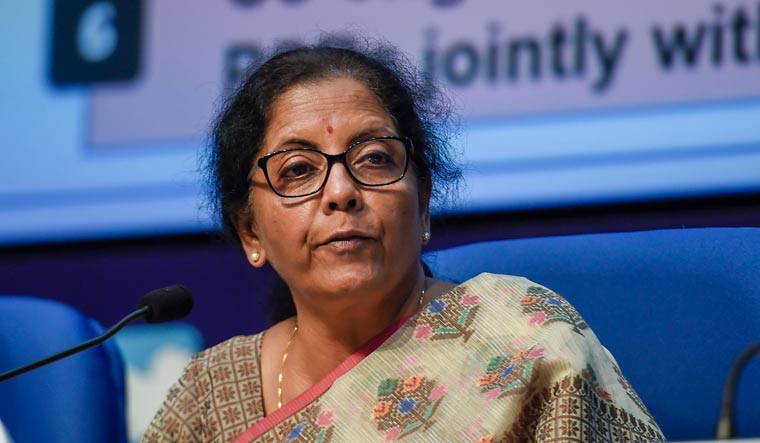
Finance Minister Nirmala Sitharaman on Saturday announced a number of measures in an attempt to provide impetus to the ailing exports and housing sectors amid the general economic slowdown. On expected lines, the finance minsiter announced guidelines for improving exports by extending the foreign exchange credit to exporters at affordable rates.
"The Export Credit Guarantee Corporation (ECGC) will expand scope of ECIS and offer higher insurance cover to banks lending working capital for exports in a move that will cost Rs 1700 crores per annum to the government," Sitharaman told reporters on Saturday. In addition, the finance minister also announced an annual mega shopping festivals, like that in Dubai, across four destinations in the country by March 2020.
The FM also touched upon the housing sector and announced measures to promote affordable housing. The External Commercial Borrowing (ECB) guidelines have been relaxed in an attempt to encouraging government servants to buy houses. With a focus on construction of unfinished housing units, the government announced a special window to provide last-mile funding for housing projects which are non-NPA and non-NCLT and are net worth positive in affordable and middle-income category. The window, to be set up by a fund size of Rs 10,000 crore, will be run by professionals and domain specialists, the FM stated. The move targets middle income and affordable housing schemes.
The following are the schemes announced for boosting of exports:
1. Introduction of scheme for Remission of Duties or Taxes on Export Product (RoTDEP): RoTDEP will replace Merchandise Exports from India Scheme (MEIS), for all goods and services for which coverage was given by textile and commerce ministry. The existing dispensation will continue till december 2019. No MEIS will continue post that. RoTDEP completely replace all meis from January 1. "In effect, RoDTEP will adeqautely incentivise exporters than all schemes put together," Sitharaman said. The government has pegged the revenue foregone for the scheme at Rs 50,000 crore. Labour-intensive sectors will get priority under the new scheme, Sitharaman added.
2. Fully electronic refund module: For automated GST ITC refunds nearing completion. The move, to be implemented by end of September, is expected speed up and monitor all ITC refunds and will aid SME exporters.
3. Export finance: Export Credit Guarantee Corporation by ECGC will offer higher insurance cover to banks lending working capital for exports. The move is targeted at MSMEs. The initiative will cost about Rs 1,700 crore per annum. With the introduction of the scheme, the premium to be paid to ECGC will be lesser. US dollar-based lending might come down by 4 per cent while, for rupee, it might be reduced by 8 per cent. Burden on exporters come down post implementation.
4. Priority sector lending norms: The government also revised the priority sector lending norms for export credit. "This will release an additional Rs 36,000 crore up to Rs 68,000 additional infusion for priority sector lending," the FM said.
5. Data on export finance: In addition, the data on export finance will now be actively and weekly monitored by an interministerial working group located in the department of commerce and tracked through a dashboard reviewed with institutions.
6. Leverage technology to reduce turnaround time: The Centre is working to reduce 'time to export' by leveraging technology further. An action plan to reduce turnaround time at airports and ports bench-marked to international standards to be implemented by December 2019 and an inter-ministerial group will monitor this.
7. Mega shopping festivals: India shall hold annual mega shopping festivals, like that in Dubai, across four destinations in the country by March 2020 covering sectors such as textiles, jewellery, yoga and leather. The move will be a booster dose for artisans and tourism sector.
8. FTA utilisation mission: For optimal utilisation of FTAs, a senior officer from the commerce department will monitor FTA utilisation mission to work with export federations and associations. It is aimed to increase awareness and understanding of using concessional tariffss and maximise utilisation of the same.
9. Mass enrolment of artisans: Enable handicrafts to reach export market through e-commerce—special dispensation for onboarding handicraft artisans to support exports. " The government moves to enable handicrafts industry to effectively harness e-commerce for exports," Sitharaman said.
India's exports dropped by 6.05 per cent to $26.13 billion in August on account of a significant dip in shipments from key sectors such as petroleum, engineering, leather, and gems and jewellery. Imports too declined by 13.45 per cent to $39.58 billion, narrowing trade deficit to $13.45 billion in August.
The growth of eight core industries had dropped to 2.1 per cent in July mainly due to a contraction in coal, crude oil, natural gas and refinery products, according to the government data. The combined index of eight core industries in July was 2.1 per cent higher as compared to July, but saw a huge drop from 7.3 per cent recorded in July last year.
This was the third major press conference by the finance minister after she presented the Union budget in July. The CNBC had reported that Saturday's round of measures have convinced the PMO, which feels that the measures will boost sentiment and current economic situation. India's economic growth hit a six-year low of 5 per cent in the first quarter of the current fiscal. The government has announced a slew of measures to reinvigorate the sagging growth.
Meanwhile, the IMF on Thursday noted that India's economic growth is "much weaker" than expected and attributed the reasons to corporate and environmental regulatory uncertainty and lingering weaknesses in some non-bank financial companies.
In recent weeks, the government has announced a slew of economic measures including the mega bank mergers, withdrawal of higher surcharge on Foreign portfolio investments (FPIs) and domestic investors, sops for infrastructure, revival package for the auto industry and relief for startups.
