



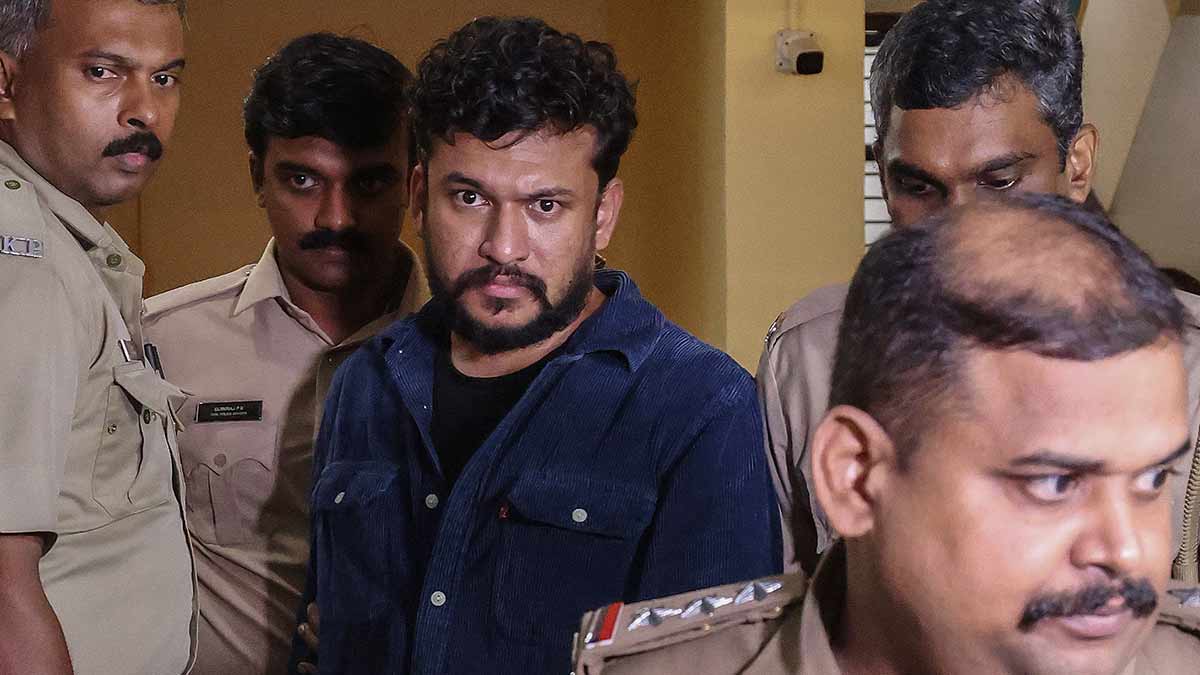
ON THE MUGGY morning of June 21, 2021, over a hundred policemen and customs officers stood waiting at Kozhikode International Airport. Their target: Mohammed Shafeeq, a young man from Malappuram, arriving on an Air India flight from Dubai with about two kilograms of smuggled gold. Yet, Shafeeq was not the figure who would dominate headlines the next day.
Lurking just outside the terminal in a car was another man: Arjun Ayanki from Kannur. He was there to execute a pottikkal—an underworld manoeuvre in Kerala where rival gangs intercept and hijack smuggled gold from carriers.
Though that morning’s heist collapsed when customs intercepted Shafeeq inside the terminal, a high-speed highway chase between rival gangs culminated in a horrific vehicular collision that claimed five lives. From that wreckage, Ayanki emerged as a sensational figure on Kerala’s criminal landscape. Five years later, he has a rap sheet spanning 21 criminal cases, and has found himself back in headlines—and behind bars.
Ayanki’s latest arrest on August 9 stems not from a physical heist, but from digital belligerence. Boasting some 1,29,000 Instagram followers, he unleashed a series of inflammatory videos targeting police officers—specifically inspectors at Kothamangalam and Oonnukal stations—before publishing abusive posts directed at Home Minister Ramesh Chennithala.
Following wide media coverage of his online challenges, police initiated a statewide manhunt. Ayanki evaded police through smart manoeuvres. He and his accomplices switched their mobile devices into flight mode 5km before reaching any safehouse, to avoid cell tower location triangulation. He accessed social media exclusively through virtual private networks via piggybacked Wi-Fi access points. He never revealed stay locations to his own drivers, hopping vehicles mid-transit to break police tailing.
A breakthrough came when intelligence officers mapped the last known active tower points of his associates around Taliparamba town in Kannur. Intercepting a local auto-rickshaw driver who had unknowingly transported Ayanki during a late-night run, the police nabbed him in a raid.
Ayanki’s backstory is rooted in the political heartland of Kannur. A native of Kappakkadav in Azhikode, he served as the unit secretary for the CPI(M)-affiliated Democratic Youth Federation of India (DYFI) in Kappakkadav before being quietly removed due to inactivity. Local political operatives recall his penchant for melodrama over actual cadre work.
Despite his formal separation from party cadre roles, Ayanki re-engineered himself on social media. Capitalising on aggressive rhetoric and firebrand posturing, he built a cult following among cyber cadres as an unofficial CPI(M) cyber warrior.
A few years ago, local residents noticed a sudden transformation in his fortunes. Without any visible source of revenue, Ayanki acquired luxury vehicles and constructed a new floor on his house. His online persona shielded him from scrutiny, until the CPI(M) Kannur district leadership publicly disowned him in 2021 following the accident which killed five on the highway.
Despite the myths surrounding his name, investigators and former associates present a starkly different reality about Ayanki. “He does not possess the profile of a criminal don,” said a senior officer. “His entire brand rests on social media posturing, digital threats and getting others to take real physical risks on his behalf.”
As Ayanki sits in judicial custody facing 21 separate prosecutions, the digital bravado that built his brand stands exposed—a stark reminder of how social media algorithms can inflate minor highway thugs into dangerous public myths.
