



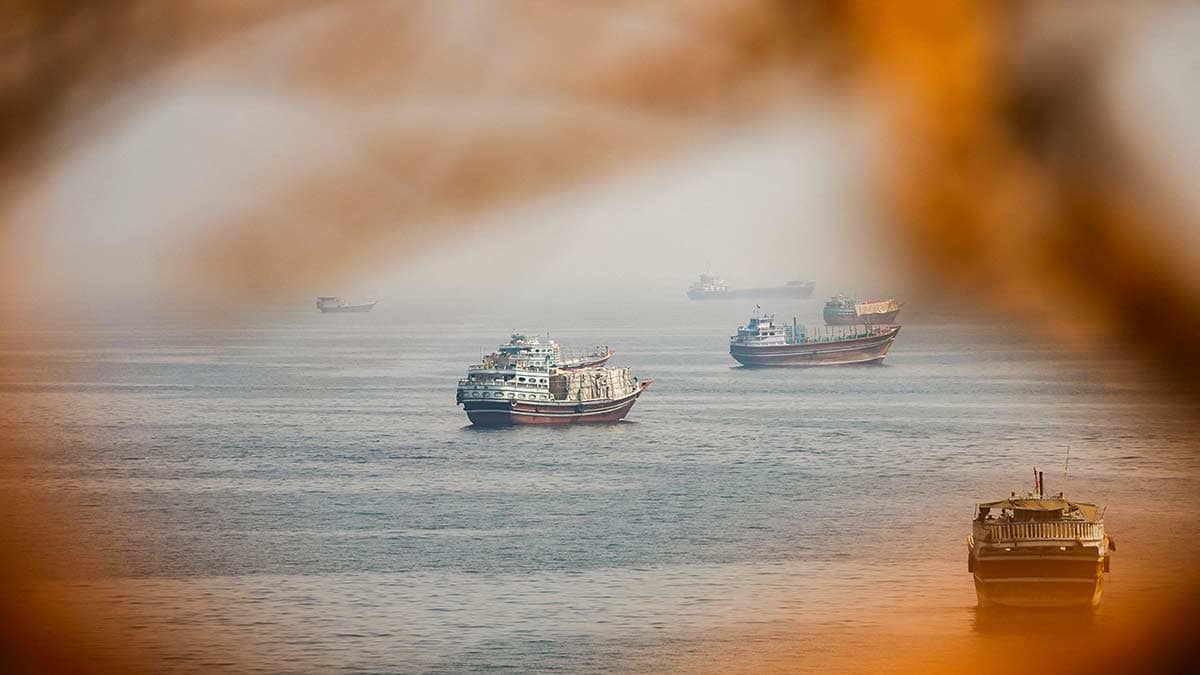
THE STRAIT OF Hormuz has become the Gordian knot of the world, a narrow waterway that continues to decide the fate of global energy supplies, commercial shipping and safety of seafarers. Can India, drawing upon its distinguished United Nations peacekeeping record and its aspirations for permanent membership of the Security Council, help untie this through a UN-led maritime security support mission?

The agreement between Iran and Oman on a seven-mile-wide temporary navigational corridor, announced on August 26, represents an attempted breakthrough. This bilateral arrangement, while limited in scope, demonstrates that regional actors can find common ground when the framework is technical, non-confrontational and focused on civilian shipping rather than on an expansive, indefinite geopolitical competition. India's leadership, following the positive bilateral discussions with presidents Masoud Pezeshkian of Iran and Vladimir Putin of Russia during the recent Shanghai Cooperation Organization summit in Bishkek, possesses the diplomatic capital to elevate this regional understanding into a broader, UN-endorsed mechanism.
India's credentials for such leadership are notable among middle powers. With over 2,90,000 peacekeepers deployed across more than 50 UN missions since the 1950s, India remains the second-largest contributor of uniformed personnel to UN peacekeeping operations. Indian troops currently serve with distinction in nine active missions, including the critical UN Mission in South Sudan, where over 200 Indian peacekeepers were honoured with UN medals in August alone. This operational experience, combined with India's robust naval capabilities and its extensive anti-piracy operations in the Arabian Sea, positions New Delhi as a credible security partner for both western and non-aligned nations.
India's strategic autonomy provides the diplomatic manoeuvring space that many others lack. The US remains locked in hostility with Iran, while Russia and China have vetoed previous Security Council resolutions on Hormuz citing bias against Iran. India, meanwhile, maintains working relationships with all parties.
The precedent for India taking a leadership role on maritime security issues at the UN already exists. During its August 2021 presidency of the Security Council, Prime Minister Narendra Modi chaired the first-ever high-level debate on maritime security, establishing India's commitment to a free, open and rule-based maritime order. External Affairs Minister S. Jaishankar has since reiterated this priority as part of India's campaign for UNSC membership, explicitly highlighting seafarer safety and maritime commons as issues deserving greater attention. The Hormuz crisis offers India the opportunity to translate stated commitment into concrete institutional action.
Senior Indian diplomats should draw inspiration from the ambitious peace-making traditions of the 1950s and 1960s, when India played a pivotal role in resolving the Suez crisis and facilitating Korean war armistice negotiations. Those were moments when Indian statesmanship, under leaders like Jawaharlal Nehru and diplomats like Benegal Rau, demonstrated that middle powers could help shape global outcomes through principled mediation and institutional creativity.
India could propose a UN maritime security support mission for the Strait of Hormuz through three phases. Phase I could involve an environment assessment commissioned by the secretary-general, examining threats, consent requirements and operational options without requiring Security Council approval. Phase II could establish a maritime coordination and deconfliction cell in Oman or the UAE, focused on incident reporting, mine-risk information, search-and-rescue coordination and technical assistance against maritime crimes. Phase III, contingent upon Security Council authorisation, could deploy an appropriate multinational maritime component for defensive escort and protective presence.
The test of this approach lies in its incrementalism. By beginning with technical assessment and coordination rather than immediate security deployment, India can build consensus among stakeholders who might otherwise veto a comprehensive resolution. A prospective International Maritime Organisation-coordinated corridor model, building upon Oman's existing temporary arrangement, can provide a neutral framework that addresses Iranian sovereignty concerns while ensuring non-discriminatory access for commercial shipping. France's EMASoH (European Maritime Awareness in the Strait of Hormuz) initiative, India's naval capabilities, Japan’s and South Korea’s mine-hunting capabilities and Indonesia's peacekeeping contributions could form the core of a contributor base that reinforces the mission's neutrality.
Critics may argue that consensus among the permanent members of the Security Council remains elusive, that Iranian sovereignty concerns cannot be overcome and that force generation challenges are insurmountable. These are valid concerns, but they counsel consensus building rather than abdication of a larger global responsibility. The Bishkek summit provides a launchpad for New Delhi to take things forward. India's positive discussions create an opening for Moscow and Beijing to signal tacit support for a UN mechanism that does not explicitly blame Tehran. France and the UK, concerned about regional escalation and energy security, can be persuaded to champion the initiative in New York. The US, preferring multilateral burden-sharing to unilateral enforcement, may find a UN-led mechanism acceptable if it preserves defensive operational flexibility.
For India's diplomatic corps, this initiative is a demonstration of the kind of responsible global leadership that permanent UNSC membership requires. It showcases India's ability to bridge divides between competing powers, to translate principle into operational reality and to lead the Global South on issues of collective security. In an era of deepening geopolitical fragmentation, India's strategic autonomy becomes not a constraint but an advantage.
The author was chief of the naval staff.
