



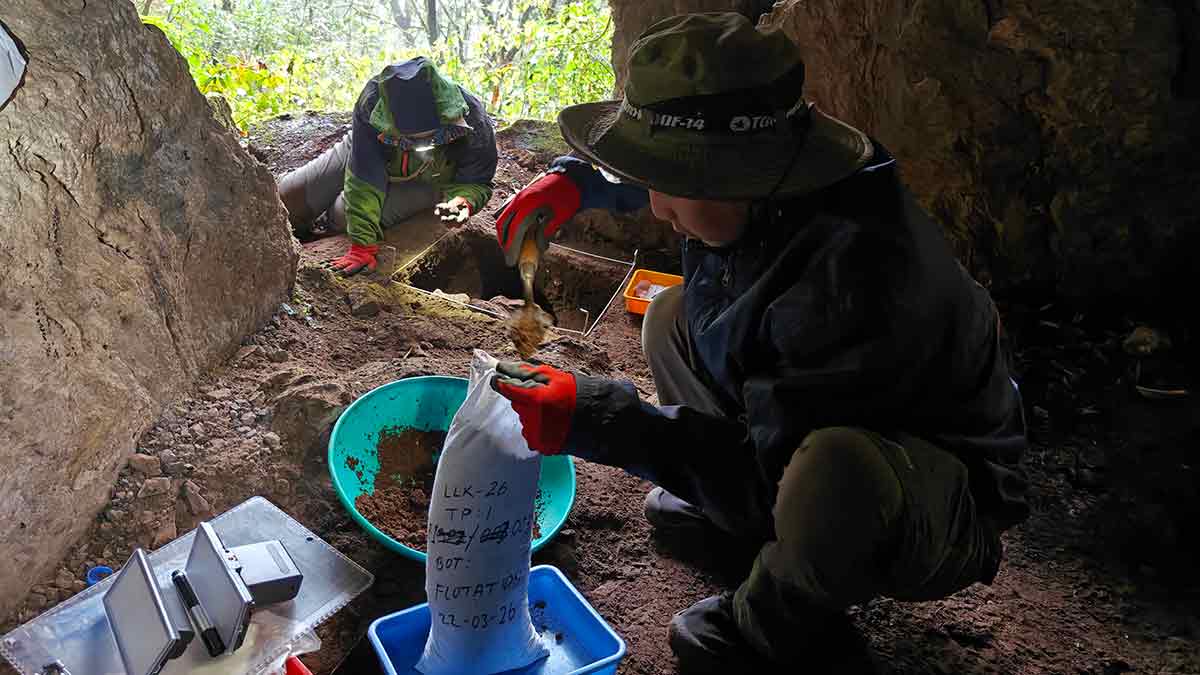
The first clue was almost invisible. Inside Leilo Kaa, a rain-soaked rockshelter in eastern Nagaland’s Noklak district, a fragment of pottery protruded from an exposed wall of earth. The discovery, on March 15, 2026, could have been easily mistaken for another broken stone. For Tiatoshi Jamir, professor of archaeology at Nagaland University and a leading authority on the prehistory of northeast India, it was the moment every archaeologist hopes for and rarely receives.
After nearly two decades exploring caves and rockshelters across Nagaland, Jamir recognised at once that his team had stumbled upon something important. What followed was a careful unearthing of pottery, stone tools, hearths, charred grains and animal bones—traces of prehistoric life that push back the known history of human habitation in Nagaland by nearly 3,500 years. The find has prompted historians to reconsider the northeast’s place in the prehistoric past of the subcontinent.
For decades, that story has been shaped largely by the Indus Valley Civilisation, the rock shelters of central India and the settlements of the Gangetic plains, which left not much room for the northeast. No wonder the region has remained one of the least explored on India’s archaeological map. “The emerging evidence underscores the untapped archaeological potential of northeast India,” says Jamir. “It compels us to rethink long-held assumptions about prehistoric migration, the transition from hunting and gathering to settled life and even the origins of early farming in this part of Asia.”
The implications extend well beyond Nagaland. Archaeologists have long regarded the northeast as a vital corridor linking the Indian subcontinent with China and southeast Asia, yet the absence of systematic research has meant that many theories about ancient migration and cultural exchanges were not based on firm evidence. The caves and rockshelters in Noklak district are beginning to furnish that evidence.

Cord-marked pottery recovered from the site closely resembles ceramic traditions found across east and southeast Asia, while the ground stone tools reveal technologies documented across a considerably wider region than previously assumed. Earlier excavations by Jamir’s team in the Mimi and Hakkomute cave systems located in the Kiphire district had already suggested that pottery technology may have appeared before agriculture became firmly established in the area. It is a sequence that echoes patterns observed among prehistoric hunter-gatherer communities in Japan and Siberia. “While examining the prehistory of the region, it is imperative not to be confined by today’s political boundaries,” says Jamir. “People moved across ecological corridors that connected south Asia with southeast Asia long before modern borders existed, and the evidence points towards shared histories and cultural connections across a much wider geographical region than we have traditionally acknowledged.”
The excavation also offers a rare glimpse into everyday life thousands of years ago. Among the most revealing finds were charred grains of millet and Job’s tears, an ancient cereal still cultivated in parts of the northeast. The finds offer fresh clues about how prehistoric communities adapted to the demands of life in the mountains. The evidence points to hunter-gatherer groups that may have practised a rudimentary form of agriculture, supplemented by hunting, fishing, foraging and the gathering of wild plants from the surrounding forests. Animal bones recovered from the site are being analysed to build a clearer picture of prehistoric diets, while pottery bearing traces of soot and food residue could reveal ancient culinary practices. Even the stone tools retain microscopic wear marks that researchers hope will help reconstruct how these communities hunted, processed food and worked with wood or bamboo.
The Noklak discoveries represent the latest milestone in a research journey that began nearly two decades ago. Since 2009, Jamir and his colleagues have investigated cave systems across eastern Nagaland, uncovering evidence of human occupation dating from the closing phase of the last Ice Age into the Holocene, the geological epoch that began roughly 11,700 years ago. Sites of older antiquity are also expected from these upland cave sites. A considerable portion of that earlier work still awaits publication, which suggests that Noklak may represent only the opening chapter of a larger archaeological narrative.
Uncovering the past in Noklak was no easy task for Jamir and his team. It started with a gruelling seven-hour trek through some of the most rugged terrain in the northeast, braving torrential rain, steep escarpments and dense forest cover. The team was supported by 45 local porters who carried generators, surveying instruments, excavation tools and provisions to a remote base camp.
For four days the researchers searched caves and rockshelters without success. Then came the breakthrough as geoarchaeologist Limasanen Longkumer spotted freshly exposed sediment inside Leilo Kaa. As the team carefully cleaned the section, fragments of pottery and part of a ground stone tool began to emerge. “It was one of those eureka moments,” says Jamir. “Based on our earlier work in Nagaland, I realised we had uncovered a site of exceptional significance.”
Jamir says the most valuable collaborators remain the people who have lived in these landscapes for generations. His research is built around close partnerships with indigenous communities, whose oral traditions and intimate knowledge of the terrain frequently guide the course of archaeological exploration. Village elders have helped identify cave sites, local hunters have led the team through the mountains, and a small number of young members of the Khiamniungan Naga tribe are now being trained in the methods of field archaeology.
“The future of archaeology in Nagaland lies with its communities,” says Jamir. “Conservation cannot succeed through a top-down approach. Local people must become custodians not only of the caves, but also of the landscapes that have preserved this heritage for thousands of years.”
