



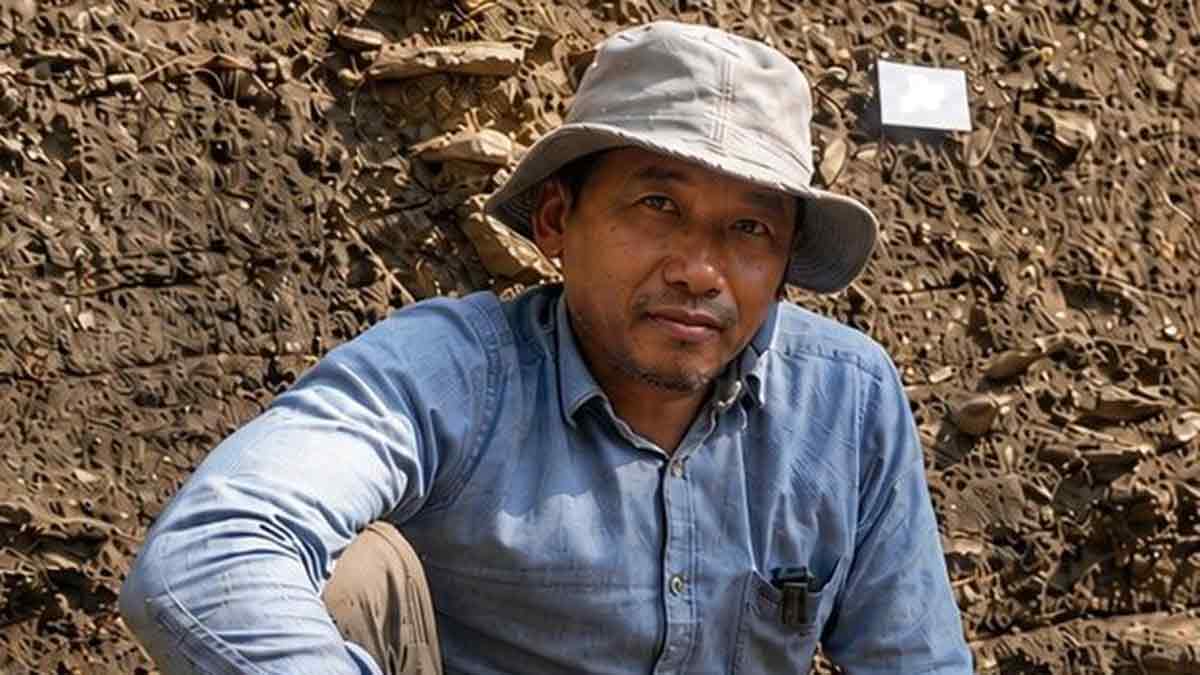
Interview/Tiatoshi Jamir, professor of archaeology, Nagaland University
Tiatoshi Jamir, one of India's leading indigenous archaeologists, has explored the prehistoric landscapes of Nagaland over the past two decades, working closely with local communities to uncover evidence of the region's ancient past. A former Mercator Fellow at Kiel University in Germany and recipient of the 2023 Kalicharan Brahma National Award, he is helping reshape how archaeologists understand northeast India's place in prehistory. Following the discoveries in eastern Nagaland's Noklak district, THE WEEK spoke to him about their wider significance.
Excerpts from the interview:
What do the Noklak discoveries, which push back human habitation in the northeast by nearly 3,500 years, reveal about the region?
They show that northeast India has far greater archaeological potential than previously recognised. The discoveries allow us to ask fresh questions about how hunter-gatherer communities gradually transitioned to settled life and whether climate, changing subsistence strategies or early domestication drove that shift. The evidence remained hidden for decades because of difficult terrain, dense forests, political instability and limited archaeological exploration. We are only beginning to understand the region's prehistoric record.
What do the finds reveal about the people who once lived in these caves?
While it is too early to draw firm conclusions, the evidence points to hunter-gatherer communities that also practised an early form of agriculture. Charred remains of millet and Job's tears suggest the use of resilient mountain crops alongside hunting, fishing, foraging and gathering wild plants. Pottery with remarkably preserved food residues, animal bones and stone tools are now being analysed to better understand their diet, technology and everyday life.
How do the discoveries change our understanding of northeast India's role in ancient human migration?
The prehistory of the region cannot be understood in isolation within today's political borders. The Naga Hills formed part of a much wider landscape that connected south Asia with southeast Asia. Similarities in pottery and stone tool traditions suggest long-distance cultural links and the movement of people and ideas across the region. Our ongoing research is also exploring when agriculture emerged and how communities adapted to changing environments over time.
Was there a moment during the expedition when you realised you had found something exceptional?
After several days of surveying in difficult weather, our geoarchaeologist, Dr Limasanen Longkumer, noticed pottery and part of a ground stone tool exposed in an eroded section of the Leilo Kaa rock shelter. From our earlier work at cave sites elsewhere in Nagaland, I immediately recognised the significance of what we were looking at. That discovery marked the beginning of the excavation.
What makes archaeology in Nagaland different from elsewhere in India?
Most archaeological sites here lie on community- or privately-owned land, so local participation is essential. We work closely with village councils, elders and local hunters, whose knowledge of the landscape often leads us to important sites. The discoveries have also generated tremendous pride within the Khiamniungan community, and we are training young local researchers so they can play an active role in documenting and protecting their own heritage.
What next for your team?
Our immediate priority is to complete the scientific analyses and publish the findings in peer-reviewed journals so they become part of the global archaeological knowledge. We also plan to revisit previously investigated cave sites in Mimi, Hakkomute and Phokhungri using newer techniques such as LiDAR mapping, archaeogenetics and geosciences. Each new excavation helps us build a more complete picture of northeast India's prehistoric past. We believe many more discoveries still lie beneath these landscapes.
