



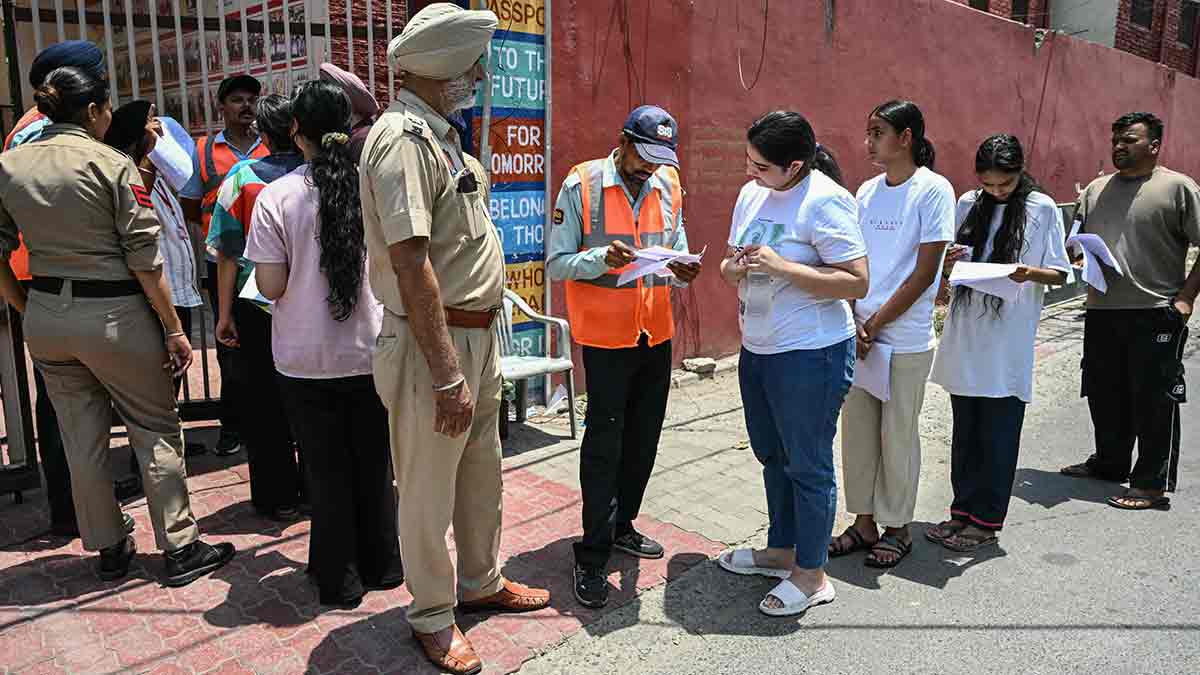
National entrance examinations like NEET, JEE and CUET are a prominent feature of Indian higher education. This can create the impression that most undergraduate admissions take place through these tests. A closer look, however, presents a varied picture. These examinations provide a common route to selected programmes; most undergraduate admissions are conducted through state, university and institutional processes, not national tests.

To understand centralisation, we must look beyond who conducts the examination to who decides eligibility and merit lists, and conducts counselling and admits students. The responsibility for these tasks varies by programme: it may be with national bodies, state governments, universities or individual institutions. A common national examination may centralise testing without centralising the entire admission process.
The size of Indian higher education explains why it uses various admission processes. According to the All India Survey on Higher Education (AISHE) 2023-24, there are 4.5 crore students in higher education, including 3.46 crore undergraduates. Another 5.69 lakh are enrolled in integrated UG-PG programmes. Universities and their units have about 1.09 crore students across UG, PG and PhD levels. Colleges enrol 3.18 crore, standalone institutions another 23 lakh. The AISHE records 1,289 universities or university-level institutions, 48,246 colleges and 15,221 standalone institutions. A system this size needs several routes to admissions.
India does not yet have a consolidated dataset classifying every undergraduate seat by its admission route. Yet state counselling, board marks, university merit lists and institutional procedures remain widely used. These different methods make it difficult to describe the system as completely centralised.
NEET, JEE and CUET do not operate in the same way. NEET, a statutory common entrance examination for undergraduate medical admissions, is used by central, state, private and deemed institutions. The Medical Counselling Committee manages specified national seat pools. State authorities conduct counselling for the state-quota seats and apply the relevant reservation, domicile and eligibility provisions. A NEET score does not by itself allot a state-quota seat.
JEE works differently. IITs use JEE Advanced; JEE Main is used by the NITs, IIITs and other government-funded technical institutions. Seats are allocated through the Joint Seat Allocation Authority (JoSAA). Some states and institutions also use JEE Main scores under their own arrangements. The National Testing Agency does not allot those seats. Neither JEE Main nor Advanced is a universal requirement. The JoSAA serves a specified group of institutions, not all engineering colleges. Institutions outside the Centrally Funded Technical Institutes (CFTI) system admit students through state examinations, JEE Main, Class XII marks, consortium tests, university examinations and institute-level procedures.
For example, Maharashtra uses MHT-CET scores for local candidates. Its Centralised Admission Process gives preference to JEE Main scores for all-India candidates. Karnataka uses KCET and counselling by the Karnataka Examinations Authority for its state share. Andhra Pradesh and Telangana use their respective EAPCET scores. Similarly, West Bengal uses WBJEE scores, and Gujarat uses GUJCET scores. Kerala follows another model—its KEAM engineering rank gives equal weight to the entrance score and standardised qualifying-examination marks. Tamil Nadu, via the TNEA, conducts online counselling based on qualifying-examination marks rather than an entrance test.
Some private and deemed-to-be universities also use JEE Main or state-test scores. Other examinations include BITSAT, VITEEE, MET, SRMJEEE and AEEE. The COMEDK UGET serves a group of private colleges in Karnataka. Outside CFTIs, no single national entrance examination is compulsory for every engineering seat.
CUET again works differently. Introduced in 2022, CUET provides a common test. Participating universities make the admission decisions. State, deemed and private universities often use CUET as one of several admission routes. Central universities may also use additional admission routes when seats remain vacant after CUET-based admissions. They may first conduct a screening test at the university or department level. Remaining seats may then be filled using qualifying-examination marks. The NTA manages registration, the examination, answer keys, results and scorecards. Participating universities prepare merit lists, determine eligibility and conduct counselling. Put simply, the NTA supplies the score while each university decides whom to admit. CUET therefore provides a common score, not a single national admission procedure.
General degree programmes account for the largest share of undergraduate enrolment. According to AISHE 2023-24, BA, BSc and BCom together account for about 66 per cent of undergraduate enrolment. This amounts to nearly 2.28 crore students. Much of this is in state universities and their affiliated colleges. Admissions follow relevant state, university and institutional rules. Some use CUET scores. Others rely on Board marks, university tests or state-level procedures.
What do these diverse admission models tell us? A national examination is especially useful where statutory uniformity, nationwide mobility or competition for a defined pool of seats requires a common reference point. State and institutional routes provide flexibility for different programmes, regions and institutional needs. The two systems can work together. They serve different educational purposes.
The choice is not between one centralised system and a collection of unrelated admission processes. India uses common national tests for selected admissions and decentralised procedures for many others. Improving both will preserve the many routes through which Indian students enter higher education.
The writer is chairman, board of governors, Indian Institute of Management Calcutta, and formerly organising chairman, Graduate Aptitude Test in Engineering, IIT Delhi; vice-chancellor, JNU, and chairman, UGC.
Views are personal.
