



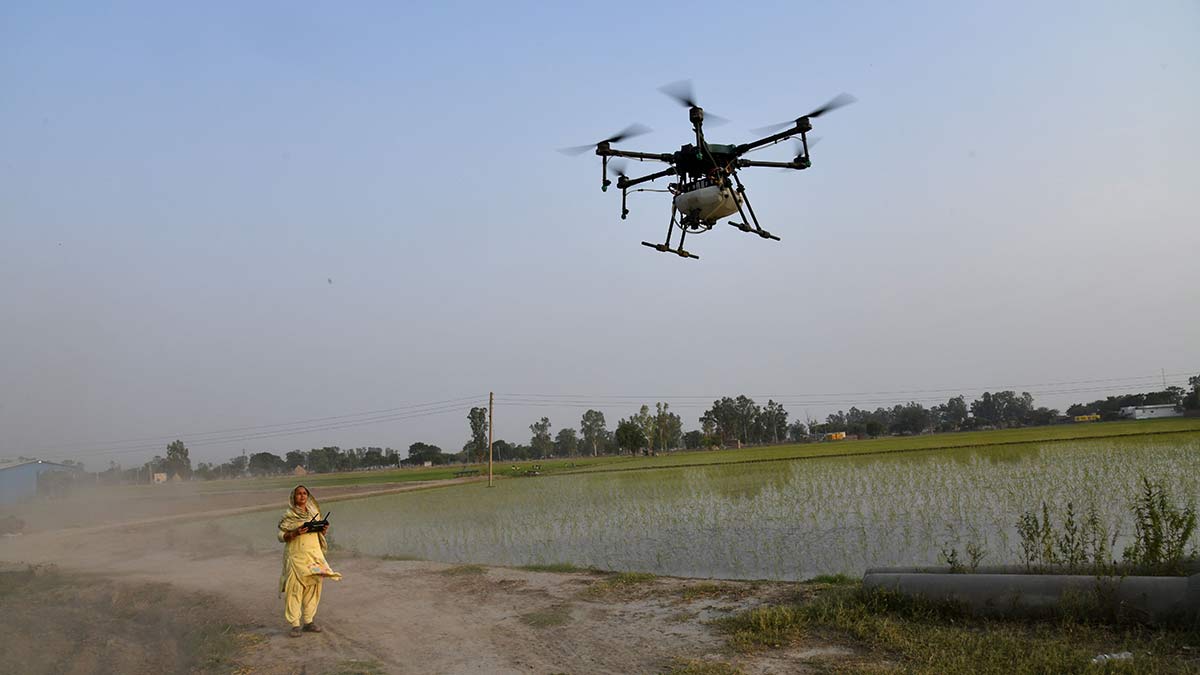
Sita Devi, 39, adjusts her ghoonghat (veil) as she steps out of her electric three-wheeler tempo parked beside a lush paddy field in Haryana’s Karnal district. “In this part of Haryana, women cover their faces with the edge of their sari or dupatta in front of elders as a mark of respect,” she says. Even as she respects that tradition, she challenges a long-held convention—that sophisticated technology belongs only in the hands of men.
Sita opens the side panels of the vehicle and, with the help of her niece, slides out a large storage box. Inside lies a hexacopter agricultural drone. With the confidence of someone who has performed the routine many times, she unfolds the drone’s arms, secures the propellers, fills its 12-litre tank with liquid fertiliser, inserts a fully charged battery, powers up the remote controller and connects the aircraft through a mobile application. Within minutes, the drone lifts smoothly into the morning sky. Hovering a few metres above the rice saplings in perfectly measured rows, it begins spraying fertiliser, covering an acre in barely 15 minutes—a task that would otherwise take hours of labour.
Standing below, remote controller in hand, Sita calmly guides the drone across the field. Only a few years ago, flying a drone would have been a flight of fancy for her. Today, she is one of India’s growing community of Namo Drone Didis—rural women trained to operate agricultural drones. Launched by Prime Minister Narendra Modi in 2023, the scheme’s objective is to create skilled employment for women while encouraging precision farming practices that reduce chemical usage, save labour and improve productivity. The aim is to transform not only lives but also the way rural India thinks about women, technology and agriculture.

Sita lives in Katlaheri village. An arts graduate with a junior basic teacher diploma, she has spent years balancing household responsibilities with raising her two children. Her husband, meanwhile, works in the construction industry, providing shuttering services. The turning point came in late 2023 when she heard about the Drone Didi scheme through the Vishwas Mahila Self Help Group (SHG), of which she was a member. “I applied, attended the interview and was selected,” recalls Sita. “I was the only woman from my village chosen for training.”
Her selection opened the door to a new world. Sita travelled to Manesar for a certified remote pilot course in visual line of sight operations. The course combined classroom instruction, computer-based flight simulation and extensive practical flying sessions. Trainees learned how to assemble drones, calibrate flight systems, understand weather conditions, carry out safety checks, plan spraying operations and respond to emergencies.
By the end of the course, Sita had earned her certification as a professional drone pilot. But instead of just a certificate, she was given an entire mobile agricultural service unit. The package included a electric three-wheeler, specially designed to transport the equipment, a large agricultural drone, an electric generator for charging batteries in the field, a water storage tank, four spare battery sets, an additional propeller set, replacement spray nozzles, a dual-channel fast charger and a battery charging hub. From training to equipment to vehicle, all of it came free from the Indian Farmers Fertiliser Cooperative Limited (IFFCO), one of the world’s largest farmer-owned cooperatives.
For Sita, it represented something even more valuable—financial independence. Her clients include farmers growing paddy, wheat, sugarcane and vegetables across villages surrounding Katlaheri. For paddy and wheat, she gets around Rs400 per acre. Sugarcane fields fetch approximately Rs600 per acre because of the crop’s greater height and spraying requirements. Over the past two years, she has earned more than Rs2 lakh annually.
Winning the confidence of farmers, however, was not immediate. “When I started, many people had never seen an agricultural drone,” says Sita. “I printed pamphlets explaining what the drone could do and distributed them in nearby villages.” Today, most farmers in nearby villages know whom to call when it is time to spray their fields.
And, this is not limited to a village or state. By January 2026, 1,094 drones had been distributed to women-led SHGs across India, as per Minister of State for Rural Development Dr Chandra Sekhar Pemmasani’s reply to a question in Parliament. Karnataka had the highest number of Drone Didis with 145, followed by Uttar Pradesh with 128, Andhra Pradesh with 108, Haryana with 102, while Goa had one.
Behind these numbers are women who are quietly redefining what rural employment can look like. About 20km from Sita’s village, another electric three-wheeler pulls into a field. Its driver is Geeta Devi, 40, from Achala village. She has a bachelor’s degree in education. Her husband works at a nearby rice mill while she manages the family’s cattle and household responsibilities. After completing her remote pilot course in January 2024, she has also been travelling from village to village, spraying crops with her drone.
For Geeta, too, the drone has brought more than just tangible benefits—it has brought opportunities like never before. She smiles as she recalls meeting Modi during an event in Mumbai where he interacted with Drone Didis from across the country. “Because of the drone,” she says, “I got the opportunity to travel in an airplane.” For someone whose life had largely revolved around her village, the journey itself became a symbol of how far the programme had taken her.
She also gained confidence. Today, Geeta accompanies her father-in-law to meetings with fertiliser and pesticide companies. In many rural households, such interactions have traditionally been dominated by men. Now, she walks into those meetings not simply as a farmer’s daughter-in-law, but as a trained drone pilot and agricultural service provider. Her ambitions now stretch beyond agriculture.
“I would like to own another drone,” says Geeta. “One that can shower flower petals during weddings. The drone I have now can only be used for agricultural work.” It is an entrepreneurial idea born from experience.
More than 250km away, across the state border in western Uttar Pradesh, another drone rises over a patchwork of green fields. Standing below it is Hemlata Singh, 36, from Satoha village in Bulandshahr district. She watches the aircraft trace neat, parallel lines over the crop, releasing a fine mist of fertiliser with remarkable precision. Every movement is controlled through the remote in her hands. There was a time, she says with a laugh, when even riding a bicycle felt like an impossible task.
Hemlata completed her drone pilot training at Phulpur in 2023. Unlike Sita and Geeta, she had to pay Rs16,000 for home training and installation of the drone. But that investment seems to have paid off—during peak farming season, demand is so high that she says she can earn as much as Rs3,000 in a single day. Her husband drives the electric vehicle from village to village, helping load and unload the drone, while Hemlata pilots it over fields of paddy, wheat, vegetables and other crops. Together, they have built a small family enterprise around precision farming.
Yet the journey is far from complete. As the programme expands, the Drone Didis are thinking about what comes next. Their drone licence is valid up to 10 years for now. Many worry about the long-term maintenance of the equipment. Agricultural drones operate in demanding conditions—heat, dust, moisture—and are used continuously. Repairs can be expensive, and technical support is not always close at hand. Sita hopes the government will introduce specialised maintenance courses so that Drone Didis can diagnose and repair routine problems themselves. “That will make us more independent,” she says.
Many also hope that access to finance will improve, allowing successful operators to purchase additional drones, expand into neighbouring districts and diversify into other commercial drone services. For women who have already mastered one technology, new possibilities seem limitless.
As the afternoon sun begins to soften over Haryana’s paddy fields, Sita packs away her equipment with the same care she showed while assembling it. The batteries are removed and placed on charge. The spray tank is cleaned. The drone’s folding arms are secured before it is returned to its protective case inside the electric three-wheeler. Soon she is back on the dusty village road, heading towards another farm. Only a few years ago, this journey would have been unimaginable.
The hum of a drone over a field may sound like the arrival of a new farming tool. In reality, it is the sound of a quiet social revolution.
