



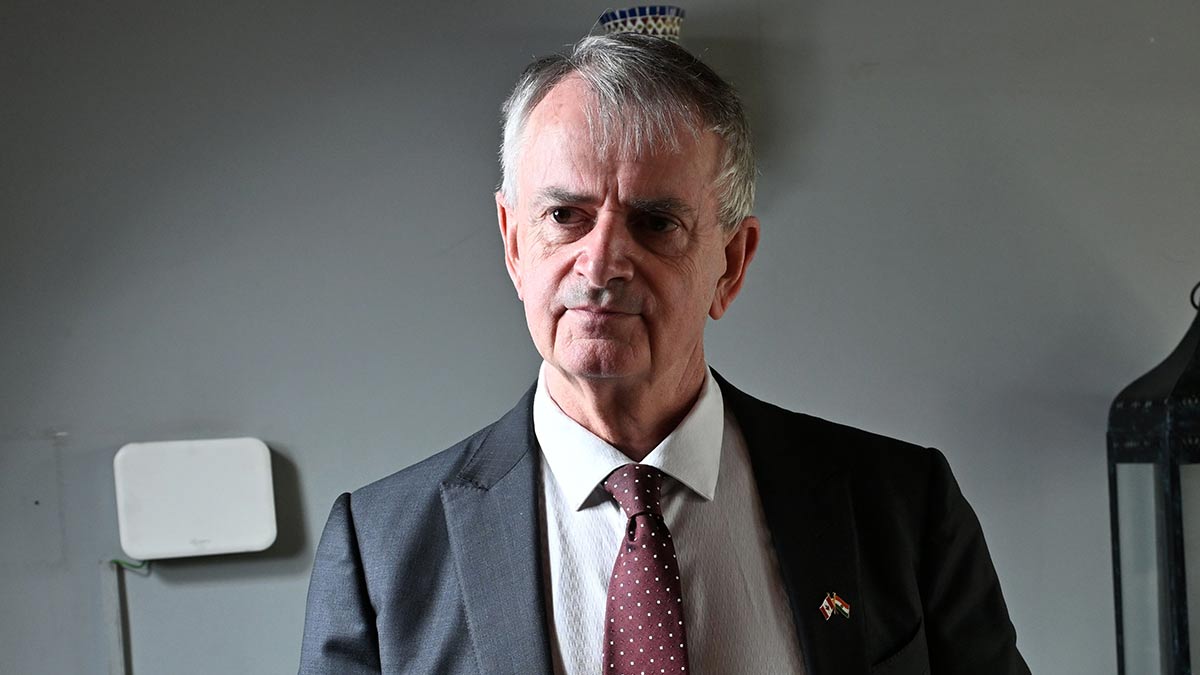
Interview/ Christopher Cooter, high commissioner of Canada to India
We have seen a remarkable reset in India-Canada relations over the past year. How do you see the way forward?
We are well beyond the reset now. India’s economic requirements happen to match what Canada is able to do and wants to do. If you look at energy, we have had no energy relationship except refining, which is only one small part of what we produce in Canada. We are the fourth-largest producer of oil and the fifth-largest producer of LNG and LPG. We have never sold that to you. Carbon capture is another area where we are one of the world leaders, but there has been almost no relationship. We have a foothold in aerospace and space. In almost every area—AI, aeronautics, space, defence and critical minerals—we have things that India needs or could partner with us on.
We have a new nuclear policy. Eighteen of India’s existing nuclear reactors are based on Canadian reactors. If you [plan to] go from about nine gigawatts to 100 gigawatts, there is no more logical partner than Canada for the fuel, technology, engineering and skills. Our agriculture sector is also strong. We export about $110 billion worth of agricultural products and are already here with companies doing processing, science and seeding technologies.
We had an investment summit about two weeks ago that attracted half a trillion dollars in new investment in infrastructure, critical minerals, energy production and clean energy. We expect an additional $500 billion to be invested in defence by 2035. This creates immense opportunities to work with the Indian private sector and parastatals, not only to sell things but also to work together in joint ventures.
The two prime ministers have met four times in the last year, and our foreign ministers have met 10 times. The trade ministers have also been meeting frequently because they are negotiating the Comprehensive Economic Partnership Agreement. The next phase is the private sector. We really hope that kicks off with Prime Minister Narendra Modi’s visit to Canada in mid-December.
Given the changing geopolitical and economic circumstances, particularly Canada’s relations with the United States, do you also see a strategic reset in foreign policy?
Our foreign ministers just met at the United Nations a few days ago. India and Canada are now part of something called the partnership for multilateralism. This recognises that countries like ours need to work together on common interests -secure supply chains, protecting maritime security against choke points, and making sure we don’t find ourselves in the kind of stranglehold we found ourselves in during Covid. It is also about reforming institutions so that they better reflect today’s realities. These institutions were largely created in the wake of World War II. We have to move on.
I think our prime minister, and I think yours as well, are very practical. They want to get things done for people. That does not mean we have abandoned support for human rights, but we can combine that with the realism that allows us to make progress on things that matter to the Global South and not just the western world.
What strategic role does India now play in Canada’s foreign-policy priorities?
Our prime minister was very careful when he said that we don’t consider you a middle power. He recognises that you are above and beyond that. We see you as a key player and key partner. That is bilateral on one level, but global on another. There is room to work together on UN reform, climate, COP31 (climate initiative), the Indo-Pacific and the Indian Ocean Rim Association. Our Indo-Pacific strategy has been more oriented towards the Western Pacific than towards India up until now. We have got to put more India into the Indo-Pacific strategy. We have got a defence dialogue shortly and security discussions going on.
With Canada recalibrating immigration, where do you see the future for skilled professionals?
We have scaled back immigration targets for the last couple of years, partly because we did not have enough housing and partly because we were not providing for students properly. We are cleaning that part up.
At the same time, we are doing an enormous scaling-up of our economy. The electricity expansion alone is supposed to require 130,000 jobs. I have heard that in mining we would need a million more people, and they have to be trained people. India is an excellent candidate as a partner because we speak English, have similar systems and shared history, and there is already a large population in Canada. One model could be to have a couple of years of training with an institution in India, then go to Canada to finish the training and come back. Some will stay, of course, and some will return, bringing that repository of skills into India as well.
With the Comprehensive Economic Partnership Agreement negotiations progressing, how would you compare the current talks with previous attempts?
The obstacles were probably the same—tariff negotiations. The difference is the pressure. In the past, we did not feel the pressure to conclude a good deal. Now we do, and both sides are committed to doing that. I was sitting in a negotiation a few days ago. I am confident that they are moving forward at a good pace. Getting it done this year would be ideal. There are two benefits. One is tariffs. The other is the public statement that both countries are open for business. Companies that would not have thought of dealing with Canada or India before may now look at what they could do.
What is the scope for deeper cooperation on organised crime, narcotics and counter-terrorism? How closely are the security agencies working together, and where can this cooperation improve?
These are very delicate relationships. A lot of the information is confidential, but over the last few months our security agencies have worked together to build a relationship of trust. They have done a lot of practical work and agreed that there should be no surprises. If a problem is emerging, pick up the phone, let us talk about it and see how we can resolve it. We have seen progress in areas such as the declaration of the Bishnoi gang as a terrorist organisation, high-level deportations and action on extortion and financial task forces. The next phase is looking at cooperation beyond the two countries—things like fentanyl precursors, scam centres, transnational crime and terrorism. Security cooperation is essential for other cooperation. We don’t intend to reduce it; we intend to continue or even increase it.
From critical minerals to energy security needs, which areas of partnership do you see moving fastest?
On critical minerals, it is not just about availability. There are choke points—the price, processing or concentration of processing in China or elsewhere. We are working with the G7 to build resilience and develop not just new mines but processing facilities. In Saskatchewan, starting January, there will be the first rare-earth processing facility in North America. We are also developing graphite, uranium, potash and tungsten. We have 20 per cent of the world’s tungsten, but no mines, so we are starting to develop those mines. We have reduced the time for the federal regulatory process to about a year. We have added new incentives for investment in critical minerals and lower corporate tax rates.
The infrastructure is also being built—ports, rail and connections from east to west. The very first shipping line establishing a trade link between India and Canada’s east coast has started.
On energy, we had a sale from Cameco of $2.6 billion of uranium fuel. We are the second-largest producer of uranium in the world, and India is going to [scale up to] 100 gigawatts. On oil, LNG and LPG, there is also significant room to grow. Our first LNG shipments from the west coast only began last year, and our first-ever direct oil shipment to India was made last year. We expect to quadruple our LPG capacity in the next two or three years. LNG will go from 14 million tonnes last year to about 50 million by 2030 and then 100 million by 2040.
Clean-energy technology is another opportunity. Carbon capture, hydrogen, fuel cells and batteries could involve technology transfers, training or joint ventures. We will be able to produce by 2028 one and a half million EV batteries. We will have a major trade mission here [this month], and clean tech and clean energy will be a major part of that mission.
Both countries have a complementary relationship in earth observation and satellite technology. Beyond traditional cooperation, how do you assess the potential in space and Arctic exploration?
We are both physically large countries, with huge marine areas, and we have a longstanding relationship between the Indian Space Research Organisation and the Canadian Space Agency. They are to agree to an implementation agreement sometime in the next couple of weeks, and the fundamental difference this time is bringing in the private sector. We are looking at quantum computing for communications and space robotics. Maritime surveillance is another area where Canada has strengths.
We also have cooperation between India’s Arctic Centre in Goa and Canadian researchers on polar dimensions. For us, it is the Arctic; for India, it’s the Himalayas and the Antarctic.
We are spending more and more time looking at the Arctic because the ice is melting, with implications for people, flora and fauna and security. There is also new public money for research, so there is scope for our top researchers to work together more fully.
Finally, we have seen visa services resuming and diplomatic strength being restored. How soon can we see visa services being speeded up and how can greater cultural cooperation help the two countries understand each other beyond existing stereotypes?
Our bench strength is much greater than it was. We added 24-25 staff just last month, with a few more to come, including visa and immigration officers. We also expect to deploy them across India more than in the past, into Mumbai and Bengaluru probably by next year. We recognise that we could do better on visas. The process can be too slow and can feel arbitrary. We want it to be smooth, easy and predictable.
Tourism is another area where there is surprisingly little between us. Just in the last few weeks, we have had the very first MICE tourism in Canada—meetings, incentives, conferences and exhibitions. The trips were very successful, with no problems with the visas, and went very smoothly.
We would very much like to see tourism grow. As India’s wealth grows and interest in travelling abroad grows, there is an existing connection and a good reputation in each country. Cultural cooperation is another area where we do very little. We have some music cooperation, and film is another area. The film from Nagaland that went to the Toronto International Film Festival is now going to the Oscars.
There is a vast scope. Canadians don’t know India that well, and I would say the same about Indians vis-à-vis Canada. But we need to make the process of going back and forth smooth, easy and predictable. That applies to business as well.
