



ON THE NIGHT of June 3, 1989, tanks were clanking into Tiananmen Square in Beijing, starting the brutal crackdown on peaceful Chinese youth demanding democratic freedoms. Just then, Iran’s announcement that Ayatollah Khomeini, the supreme leader had died, turned world attention sharply westward—to the transition in another giant, ancient nation.
While chancelleries of the world speculated on what might follow, within Iran the death of their “Imam” led to an outpouring of grief from the Iranian people. Commercial activity was at a standstill the following morning, and millions of people stopped work and began gathering in the capital. The Assembly of Experts, constitutionally designated for choosing the successor, declared on June 4 itself that president Khamenei would be the next supreme leader. The government then announced that the funeral of the former leader was set for June 6.
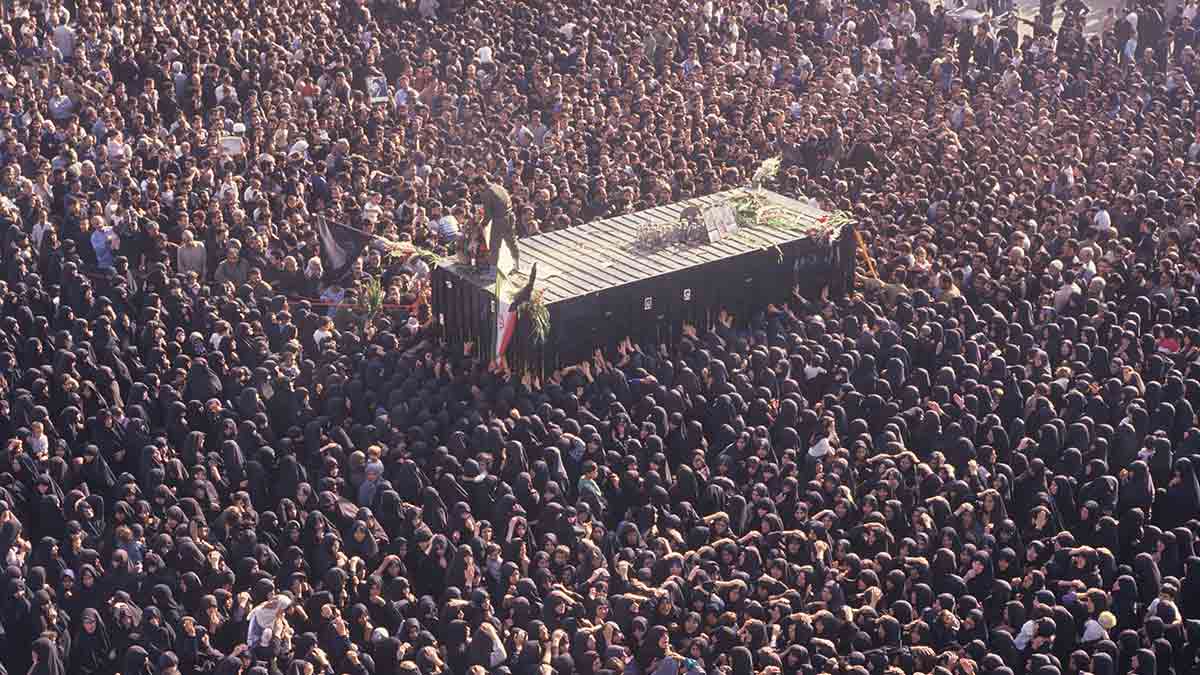
A bit later, news that the external affairs minister P.V. Narasimha Rao would lead the Indian delegation at the funeral got us at the Indian embassy out of dispatching reports and into frantic preparations for aircraft clearances, protocol and hotels. The delegation arrived the following day amid scenes of chaos. Tehran’s streets seemed like a sea of black—the colour of mourning worn by some six million people (about 10 per cent of the population) who gathered in the capital, trying to get a last glimpse of their deceased leader.

The Ayatollah’s body had been brought to a large prayer ground—the Mosalla—in north Tehran, which was the viewing area for people to pay their last respects. After funeral prayers there, it was to be transported to the Behesht Zahra burial site in the south of the city.
Despite starting early in the morning of June 6, our party led by Rao experienced some complex arrangements, a long walk and longer delays, before getting into the area where prayers were held. Getting out proved harder, as frenzy had taken over among the massive crowds. At one point, minister of state C.K. Jaffer Sharief, a member of our delegation, briefly lost his footwear in the scrum. Finally, the Islamic Revolutionary Guard Corps (IRGC) escort linked arms, in a double cordon of troops around the delegation, and manoeuvred us to safety!
Our departure was timely, as there was a stampede later that killed many people when the effort began to transport the body for burial. The Ayatollah’s son Ahmad Khomeini collapsed and had to be passed over the heads of a crowd to an ambulance. The IRGC even resorted to caning of mourners’ hands as the coffin was placed in an army helicopter for transport to the burial site. There was even greater chaos there, and at one point the great leader’s coffin fell to the ground. The interment eventually took place much later amidst great grief and greater confusion.
Despite the turbulence of the occasion, the Iranian authorities demonstrated that Rao’s presence at the funeral was deeply appreciated. Foreign minister Ali Akbar Velayati freed himself to hold a formal bilateral meeting with him, and pointedly noted that India was the only non-Islamic country which sent its foreign minister for the funeral. Velayati affirmed that cooperation with India would remain a key policy of the new leadership.
The funeral of Ayatollah Khamenei last week came at a time when Iran is still in conflict mode, with future political evolution uncertain. The turnout of millions of mourners (with better crowd control this time!) revealed national resilience amidst serious internal tensions. Iran’s strategic location and enormous economic potential make it a permanently significant neighbour. India’s representation at the ceremony seemed to reflect immediate calculations of realpolitik, as much as our multi-faceted ties. History will judge whether it did adequately reflect the extraordinary historical relationship between our countries.
