



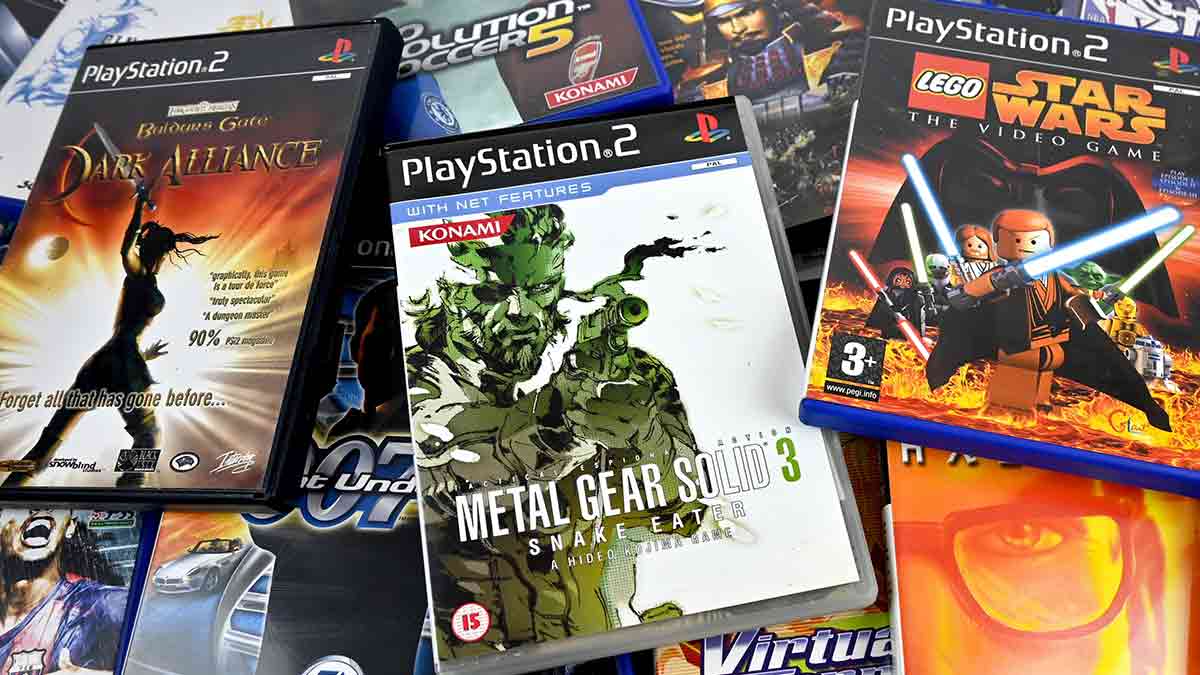
The world of video games recently took a violent step backwards.
In July, Sony announced that it would stop manufacturing physical game discs for all new PlayStation games from January 2028. After that, new games would be sold only as digital products through the PlayStation store or retailers. The news came just days after Rockstar Games said Grand Theft Auto 6, the newest entry in the world's most popular game series, would ship as a digital-only product. Inside a physical box, apparently, buyers will find a download code instead of a disc.
The death of the disc comes with a promise of progress. Sony says consumer behaviour has decisively shifted: digital sales of games, where buyers are given account-based access to gaming servers and platforms, now account for around 80 per cent of total sales. The disc has long been on the deathbed, it would seem.
Except, that is not quite the truth.
Video games have long resided in a variety of media—from floppies, memory cards and cartridges to bootleg CDs. Many of us grew up collecting and tinkering with these objects, each a portal into the game worlds imprinted upon it. For us, it is not just a matter of nostalgic harkening; what dies with the disc is a vital principle—that once you have bought a game, you may resell, lend or gift it. Communities have been built around this principle.
The digital-only shift is, therefore, a violent one. It not just kills the disc, but also strangles the sense of ownership.
THOSE OF US lucky to have grown up with game-consoles have often played with the aid of bootleg copies, knock-off devices and hand-me-down machines. The only ways to the medium for many of us were informal lending libraries, internet cafes or networks of friends pooling together to buy a game. I vividly remember playing the initial levels of games over and over again, because I was playing on a borrowed device and was forbidden from overwriting the owner's save files.

Game hardware has long been the preserve of the elite. For a while, though, the boost in computing power mirrored the proliferation of gaming hardware, attracting more and more people into the video-game world. Moore's law seemed to be in full swing—smaller transistors and microchips continued to make computing cheaper and faster.
The result was that games started to open up as a democratic medium of expression. There are now open-source game-creation tools such as Blender and Godot, which has made game developers less reliant on expensive technology and large teams. Now individuals and groups from even the margins can create and distribute games. An example is Dys4ia by Anna Anthropy, an American game designer who created the game based on her experiences of gender dysphoria and hormone replacement therapy.
Anthropy's concept of “video-game zinester” has been influential. She said the medium, which had become trapped in an industrial model of big companies and large teams creating big-budget games, can evolve into a democratic space where ordinary people could make small, personal or idiosyncratic work—much as anyone can write a story, draw a comic or publish a zine.
For India, this democratisation has meant real opportunities for small studios to thrive. People are translating their experiences into games—from diaspora stories and oddball adventures to games about belonging, identity, politics and gender.
But this largely software-driven democratisation is now coming into conflict with the realities of the hardware shifts over the past decade. Graphics processing units (GPUs), once almost exclusively used to render visuals in games, began to be used for cryptomining and artificial intelligence. AI, especially, has exponentially increased GPU demand. So much so that Moore's law now appears dysfunctional—the chips are now better and faster, but not necessarily cheaper. The gaming hardware, in turn, has become prohibitively expensive.
This is fundamentally reshaping gaming in two ways. One, the space for playing games on open-systems like the PC, where you have different forms of game distribution and ownership such as physical discs, is radically shrinking. Two, consoles like PlayStation by their economies of scale, become the default choice for players.
Killing discs puts immense pressure on a gamer to either subscribe to a relatively cheaper games-as-subscription service, or hold on to a handful of games and extract as much value from them as possible. Rather than spending Rs5,000 or more on a purchase that you can never defray by reselling, lending or donating, you come to prefer the incremental cost of refreshing a game you are comfortable playing.
This forced preference is the cornerstone of the live-service game: a title that stays online, is periodically refreshed and you subscribe to indefinitely. These massive and continuously updated online games are technologically intricate, but oddly bereft of cultural insight or contribution. They are also expensive to build and run, sometimes resulting in spectacular failures—like in the case of Concord, an online game that forced Sony to close a studio that had worked for years to develop it.
Moreover, these games-as-services come at great infrastructural costs, which would push towards eventually making your devices just streaming boxes, incapable of running games on their own, and useless without a networked service.
With such a shift comes two perils. One, large complex infrastructures can be volatile—as a widespread Xbox outage soon after Sony's announcement in July showed. The nearly day-long crash prevented users from signing in, accessing their libraries and launching games. Two, with the dependence on these infrastructures come a corresponding loss of control over what you can play and for how long—as evident from Nvidia's recent decision to put a playtime limit on subscriptions to its cloud gaming service.
The situation has not just weakened the control of users over their game libraries, but has also created a shield for publishers from facing the plural, cultural questions and negotiations that gamers are only just beginning to demand from the medium.
TO THE GAMING culture, the demise of the disc is detrimental to a great extent. It automatically leaves public libraries, game archives and preservation efforts completely out of the loop. Such libraries, including bootleg centres, are often the first sites where local communities have a chance to gently intervene in the kinds of games being built and distributed. By curating specific collections of games and creating communities around them, these communities build the much needed game literacy that teaches how to play, read and challenge specific works.
Generations of game developers have been trained on ecosystems like game cafes, which had a brief but influential heyday in India. While they were not usually treated as portals to fantastical otherworlds, and were sometimes considered dubious crawlspaces into the forbidden, they did become places that fostered modern gaming cultures. They also spawned the culture of modding—modifying existing works and delving into code to try and get cracked games to work on underpowered systems.
What is happening now is catastrophic for India. In a country where a console costs thrice the monthly median income, most gaming activities are already restricted to mobile phones. Forcing our nascent gaming communities out of the ecosystem will stifle an enormous amount of experimental work, from live-coding to new-media art that exists at the gaming-world margins.
The artefact that once arrived with guide books, game manuals and player notes will now become a single subscription. There is no longer the possibility of discovering an odd gem at the back of the stockpile, since your library is curated for you by an anonymous megalithic publisher. There is a genuine loss in not preserving works that are a crucial imprint of the time they were made in, an erasure of the crucial transgressive history of the medium.
And of course, all of this is sold as progress. The loss of control as a convenience; the loss of communities as a necessary removal of unnecessary interlocutors. Tepid games filled with generated content become an ideal escape—from the messiness of culture into the undemanding slop of the future.
What big companies have failed to understand is that games are built atop other games, and that game cultures are fragile networks of shared experiences. When the disc is finally made to disappear, all that was built upon its brittle existence may also vanish.
Dhruv Jani is the founder of Studio Oleomingus, an independent game and arts studio in Chala, Gujarat.
