



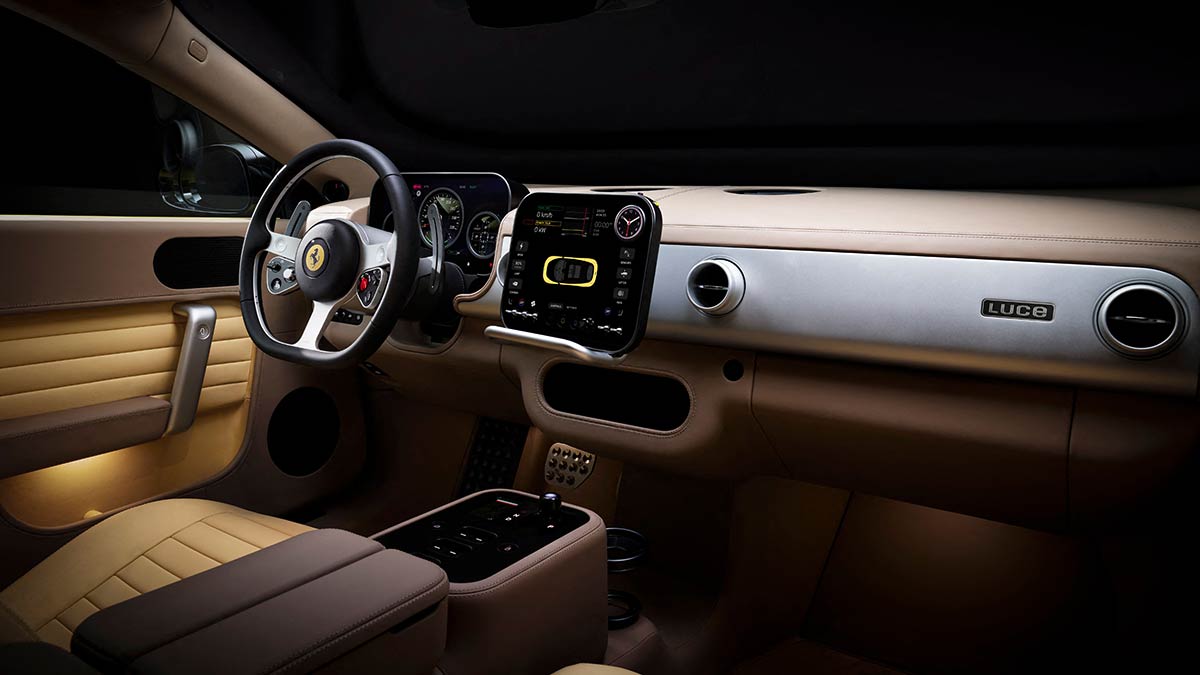
Ferrari recently unveiled the Luce, its first electric car. The world paid attention not just because it was a Ferrari, but because of the man behind its interior. Jony Ive, the designer who gave the world the iPhone, the iMac and the iPad, spent five years working with his creative collective LoveFrom to craft the cabin of this half-a-million-euros machine. The result: precision-machined aluminium controls, a minimalist cockpit of glass and recycled metal and physical buttons and dials. The man who practically invented the touchscreen era, it seems, has decided the car doesn’t need one.
It is an irony. And it tells you everything about where the automobile industry finds itself today: lost in its own technology.

Cars didn’t always feel like computers. For most of the twentieth century, a car’s relationship with technology was simple and mechanical—an engine, a gearbox, four wheels, and a radio if you were lucky. The first hint of change came in the 1980s, when manufacturers began fitting electronic fuel injection and basic onboard diagnostics. By the 1990s, GPS navigation arrived, and suddenly the dashboard had a screen. By the 2000s, Bluetooth connectivity, rear cameras and parking sensors crept in.
Then the smartphone arrived, and everything changed. Consumers, accustomed to carrying pocket-sized computers, began demanding the same from their cars. Automakers responded. Infotainment systems grew larger. Connectivity became standard. The car was on its way to becoming the most expensive gadget most people would own.
No single company reshuffled the deck more dramatically than Tesla. When Elon Musk’s electric car company launched the Model S in 2012, it did something none of the legacy automakers had dared: it treated the car as a gadget. Updates arrived over the air, the way your phone updates overnight. New features were added months after purchase. The massive 17-inch touchscreen at the centre of the dashboard was not just an infotainment system—it was a statement that the old way of building cars was over.
The legacy automakers’ response was, initially, cautious imitation. Larger screens appeared in Volkswagen and Ford. Mercedes introduced its MBUX voice assistant. BMW put a curved widescreen display across its entire dashboard. Audi, Volvo and Hyundai poured resources into their own electric and connected-car platforms. The EV race was on.
But it was the Chinese manufacturers who took the tech-first philosophy furthest. Companies like BYD, NIO, Li Auto and Xiaomi (yes, the smartphone maker) approached car design the way Apple approached a phone launch. Xiaomi’s SU7, launched in 2024, was designed from the ground up to integrate with its broader device ecosystem, right down to the way your phone pairs with the car’s operating system. These are not cars that happen to have technology inside them. They are technology products that happen to have wheels.
Chinese EVs now compete on equal footing with European and American rivals in almost every category, and frequently surpass them on the number of features packed into the price.
The genuine benefits of automotive technology are significant. Advanced driver assistance systems—lane-keeping, automatic emergency braking, adaptive cruise control—have reduced accidents. Blind-spot monitoring has prevented countless collisions. Over-the-air updates mean safety fixes and improvements reach every car without a trip to the workshop. Navigation that integrates real-time traffic data saves time and fuel. Electric powertrains, enabled by sophisticated battery management software, have made cars quieter, cleaner and cheaper to run. Technology, in the truest sense, has made cars safer and more efficient.
Somewhere between the useful and the indispensable, manufacturers crossed a line into the overwhelming. Controls that once lived on a physical dial—volume, temperature—migrated into touchscreen menus that require eyes off the road and several taps to operate. Some cars today bury their hazard light button inside a software menu. Porsche’s designers, long resistant to the touchscreen wave, have spoken openly about prioritising driving feel over digital complexity. Gordon Murray, the legendary engineer behind the McLaren F1, built his T.50 hypercar with an aggressively minimal cockpit, on the principle that a driver’s car should not distract its driver.
The Ferrari Luce is the most recent statement of this philosophy—that tactile, immediate, eyes-free controls are not a nostalgic indulgence but a safety virtue. The irony of the man who popularised the touchscreen designing a car interior built around knobs and dials is not lost on anyone. It may, in fact, be the point.
