



KOLKATA
Amid the growing US-China rivalry and a rapidly changing geopolitical landscape, the Indo-Pacific is becoming a new geostrategic arena. This has led to a growing presence and heightened activity of naval vessels and submarines in the Bay of Bengal and the Indian Ocean. It has also enhanced the strategic prominence of India’s east coast, which lies close to the deep waters where the world’s major navies increasingly conduct exercises and manoeuvres.
Yet, much like the “silent service” it is known to be, the Indian Navy’s own strategic shift has been subtle. If the eight decades since 1947 were about India’s western focus, the Navy is now, in what may prove to be a transformative moment, looking east.
For decades, India’s naval gaze was fixed on the Arabian Sea: West Asia, Europe and the Gulf oil lanes. It made sense. That was where the threats were, and trade interests too.
But stand at Syama Prasad Mookerjee Port in Kolkata, feel the Hooghly breeze and watch the grey hulls move into the Bay of Bengal, and the eastward shift becomes visible. India’s growing Indo-Pacific focus is also opening new opportunities in exports and international maritime partnerships.
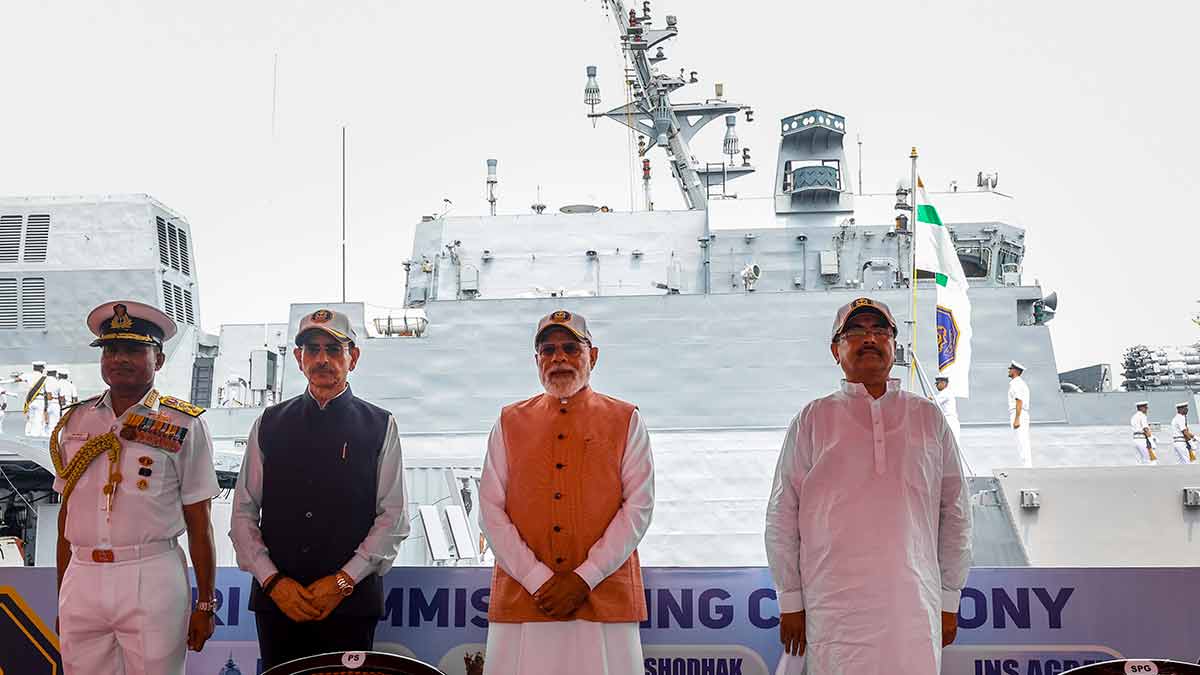
On June 21, Prime Minister Narendra Modi commissioned three warships—a rarity for the Indian Navy in Kolkata, a city where India’s maritime history, geography and contemporary geopolitics converge. Modi made the new focus amply clear when he spoke of Kolkata, where Rabindranath Tagore wrote his poetry and Subhas Chandra Bose plotted against the British: “This is the land that gave new direction to the ideas that accelerated India’s renaissance, and for centuries connected India to the world through the sea,” Modi said. “Today, on this very soil, an important programme linked to Atmanirbhar Bharat, Surakshit Bharat and Viksit Bharat is taking place.”
From Syama Prasad Mookerjee Port—named after the country’s first industries minister—Modi outlined the new direction India’s maritime sector was taking. “The time has come for India to enter the next phase of maritime power,” he said. “Therefore, India has begun to move forward with a new vision for the shipbuilding sector…. Shipbuilding and ship maintenance, repair and overhaul are now being seen as part of a major national mission.”

Kolkata and India’s eastern seaboard are now commissioning the Navy’s future. The east coast is no longer the “other coast”; it has become mission central.
The three warships commissioned on June 21 were INS Dunagiri, INS Sanshodhak and INS Agray.
Dunagiri was designed by the Navy’s Warship Design Bureau and built by the Kolkata-based Garden Reach Shipbuilders and Engineers Ltd (GRSE). Sanshodhak and Agray were both designed and built by GRSE, which is one of India’s three premier state-owned shipbuilders. The other two are Mazagon Dock Shipbuilders Ltd (MDL) in Maharashtra and Cochin Shipyard Ltd (CSL) in Kerala.
“The Indo-Pacific has emerged as one of the world’s most consequential geopolitical and economic regions,” GRSE chairman and managing director Commodore P.R. Hari (retd) told THE WEEK. “As global trade, maritime security, supply-chain resilience and naval deployments increasingly converge in this region, India’s eastern seaboard is acquiring enhanced strategic significance.”
GRSE has, over the decades, built more than 800 platforms, including 118 warships. “India’s eastern coastline provides direct access to the Bay of Bengal and the wider Indo-Pacific, while also being geographically proximate to key maritime chokepoints such as the Malacca Strait, through which a substantial portion of global trade and energy flows,” Hari said. “This geography naturally places greater emphasis on maritime infrastructure, shipbuilding capabilities, logistics networks and naval preparedness along the eastern seaboard. As India advances towards becoming a leading maritime nation, the eastern seaboard is poised to play a pivotal role in both strategic and commercial maritime activities.”
On June 17, GRSE was conferred Navaratna status—a designation given to top-performing public sector undertakings. It gives the company greater autonomy and operational agility. With MDL already a Navaratna and GRSE now joining that group, CSL could be next in line.
Dunagiri, which will be equipped with the BrahMos missile, carries advanced weapons and sensors. Sanshodhak, built for seabed exploration for military and civilian applications, will be equipped with autonomous underwater vehicles and remotely operated vehicles. Agray, fitted with lightweight torpedoes and rockets, will add to the Navy’s growing anti-submarine capabilities. Also, two more indigenous platforms—INS Mahendragiri (Project 17A stealth frigate) and INS Malwan (anti-submarine shallow-water craft)—are expected to be commissioned soon.
A highly placed source told THE WEEK that the Navy has a massive capital acquisition pipeline worth approximately Rs3.4 lakh crore that is expected to be formally contracted. The objective is to build a 200-ship fleet by 2035, with a heavy emphasis on domestic shipbuilding under the Atmanirbhar Bharat initiative.
The eastern coast is central to that plan, with GRSE serving as a key pivot. The Kolkata-based shipbuilder is understood to be in advanced stages of securing a contract to construct five next-generation corvettes, for which it has emerged as the lowest bidder. GRSE and CSL are also building 16 anti-submarine warfare shallow-water crafts.
A Rs70,000-crore follow-on order under the Project 17B frigate programme is expected to succeed the current Project 17A series. The new frigates are expected to feature improved structural stealth, integrated electric propulsion and enhanced vertical-launch missile capability. Four of the 11 indigenously designed next-generation offshore patrol vessels—valued at Rs9,781 crore—are being built at GRSE; the remaining seven are under construction at Goa Shipyard Ltd.
“For GRSE,” said Hari, “these developments reinforce the long-term relevance of our capabilities in warship construction, commercial shipbuilding, ship repair, engineering solutions and exports.”
Compared with much of the Arabian Sea, the Bay of Bengal has deeper and quieter waters. This is operationally better suited for India’s growing nuclear submarine force and its second-strike deterrence capabilities. From Visakhapatnam, India’s ballistic missile submarines can enter these waters and disappear.
The growing focus on the eastern seaboard is reinforced by India’s Act East policy, which seeks deeper engagement with East Asian and ASEAN countries, extending to Japan and South Korea.
The government’s renewed emphasis on the blue economy, the development of the Krishna-Godavari Basin, offshore wind projects and the exploration of deep-sea minerals off the Odisha-Andhra coast all add to the case for a stronger Navy. From the standpoint of the landlocked northeast, the future of the Kaladan project—a multi-modal transit corridor linking Kolkata, Myanmar and Mizoram—also makes robust maritime security on the eastern coast imperative.
If the western coast helped make India a regional power, the eastern seaboard could help make it an Indo-Pacific power. The needle of the compass is swinging east.
