



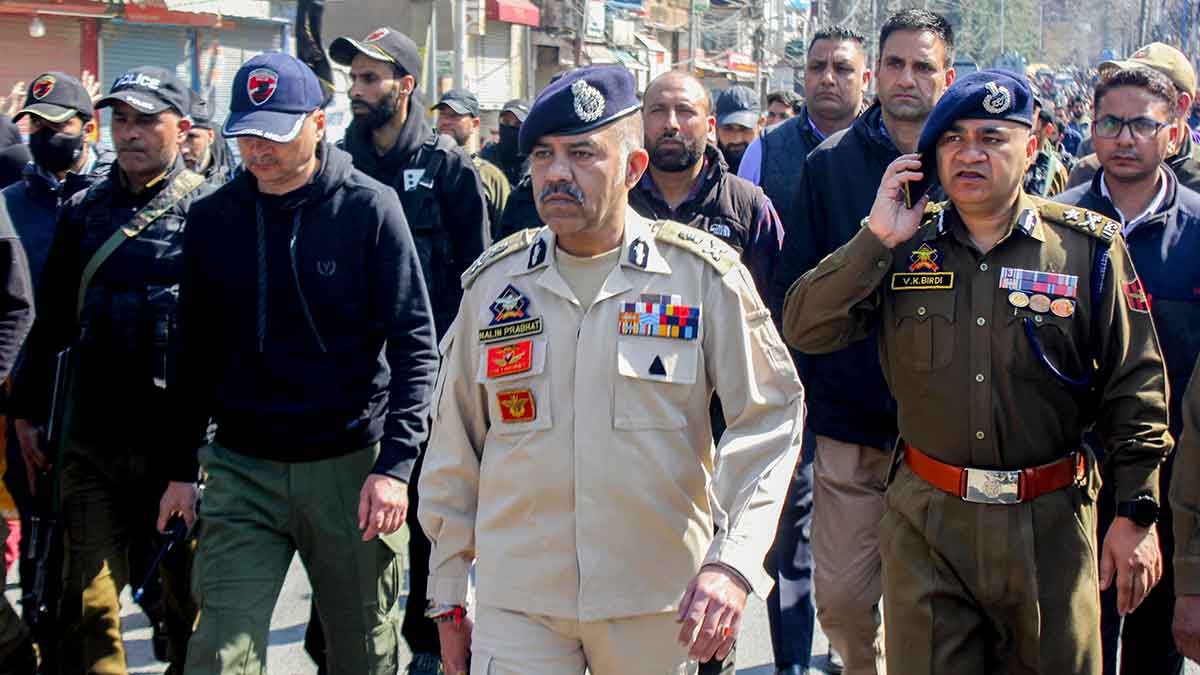
A 1992-BATCH IPS officer, Nalin Prabhat is as well known for his vast experience in counter-terrorism operations as he is for shunning the limelight. From leading the elite Greyhounds anti-Naxal force to heading the National Security Guard, Prabhat also served multiple postings in Jammu and Kashmir before he was chosen to lead the Union territory’s police force.
Since taking charge as director general of police in October 2024, he has intensified operations against terror modules. In a rare interview, Prabhat spoke about the strategies being deployed to counter security challenges. Excerpts:
Q/ How big is the threat from Pakistan, and to what extent are terror outfits getting help from there?
Pakistan’s deep involvement is evident through its extensive terror networks and terror entities. The first schedule of the Unlawful Activities (Prevention) Act lists 45 terrorist organisations, of which 18 have ramifications for J&K. Similarly, there are almost 8,000 JKNOP (Jammu and Kashmir Natives Operating from Pakistan), who are exploited by the Inter-Services Intelligence to orchestrate terror attacks. Pakistani missions across the west mobilise protests by Kashmiri diaspora and spread propaganda via social media, besides leveraging encrypted platforms. Jaish-e-Mohammed and Lashkar-e-Taiba have floated proxy groups, at ISI’s behest, claiming them to be indigenous.
Q/ Has Pakistan shifted focus geographically after 2019?
Yes. After the anti-infiltration grid became stronger, especially in the Kashmir Valley, Pakistan shifted its focus south of Pir Panjal, through the rugged terrain of Rajouri and Poonch, and also through the riverine belt of Kathua and Samba.
The LoC in Kashmir, is almost entirely high altitude, while the terrain in Jammu province, comparatively, offers advantage. In Jammu province, the network involving Shahzad Bhatti and others based in Belgium, Turkey and Punjab is heavily profit driven, with multiple stakeholders, united by separatist and radical objectives. However, in Kashmir, a much larger proportion of proceeds from narcotics is funnelled into terrorism.
Q/ What has changed in narco-terrorism since the abrogation of Article 370 in 2019?
Prior to 2019, narco-terrorism was more of a secondary method of generating funds. Till 2019, drugs came terrestrially, though the Line of Control or the IB (International Border). Drone sightings were a rarity, an exception.
Post 2019, cross-border drone smuggling increased exponentially, with combo payloads of drugs, weapons and explosives. Pakistan further diversified these smuggling operations by using highly coordinated international networks involving people in Europe, Turkey, the Middle East and the UK.
Q/ Are too many agencies involved in curbing narco-terrorism? How is the coordination maintained?
Along the International Border, the BSF is the first responder. Along the LoC, it is the Indian Army. J&K Police handles the hinterland and investigations. At the national level, there is the Narcotics Control Bureau. [There is also] NCORD, which is a coordination mechanism involving all stakeholders.
J&K Police coordinates with neighbouring state police forces and national agencies. At the end of the day, most narcotics cases get busted through human intelligence.
Both the [Special Operations Group] and the Anti-Narcotics Task Force are equal stakeholders in this campaign, as narcotics and terrorism are two sides of the same coin. With Punjab Police, especially, coordination is superlative. Many accused have been apprehended from Amritsar, Gurdaspur and Pathankot. The relationship is based on mutual respect and operational cooperation.
Q/ Terror attacks have reduced sharply. What about local youth joining terror groups?
There has been about a 98 per cent fall in terrorist incidents since 2020. Recruitment has also fallen sharply. In 2020, around 194 locals were recruited into terrorism. In 2025, the number dropped to a single digit, just one single local recruit, and in 2026, so far, none.
At present, only five local terrorists are operating in the UT of J&K. This drop from three digits to finally a single digit is most encouraging and heartening. The rest are all Pakistanis.
This has punctured Pakistan’s propaganda that terrorism in J&K is indigenous. Most terrorists killed in encounters, last year, were Pakistanis and this year all those killed were Pakistanis.
Q/ How was this achieved?
This turnaround has been achieved by ‘Whole of Government Approach’ and dedicated work by J&K Police, in tandem with Army, CAPF and other government agencies.
For those involved in terrorism, the costs have risen significantly. Properties belonging to handlers, top ideologues and commanders, sitting across the border, have been attached at record levels. Our message is loud, clear and unmistakeable: investing in peace is better than investing in terrorism. People, especially the youth, have realised the fallacy of terrorism.
Q/ After last year’s Pahalgam attack, what measures have been taken to secure tourists in Kashmir?
All tourist destinations and religious sites in J&K have a security cover. J&K Police, supported by sister forces, dominate and secure these locations. All such locations are subjected to periodic Joint Security Reviews, and deployment is done based on operational assessment, to secure both domestic and foreign visitors. Lastly, Operation Sindoor has demonstrated India’s resolve, making it clear that if our people are harmed, there would be costs.
