



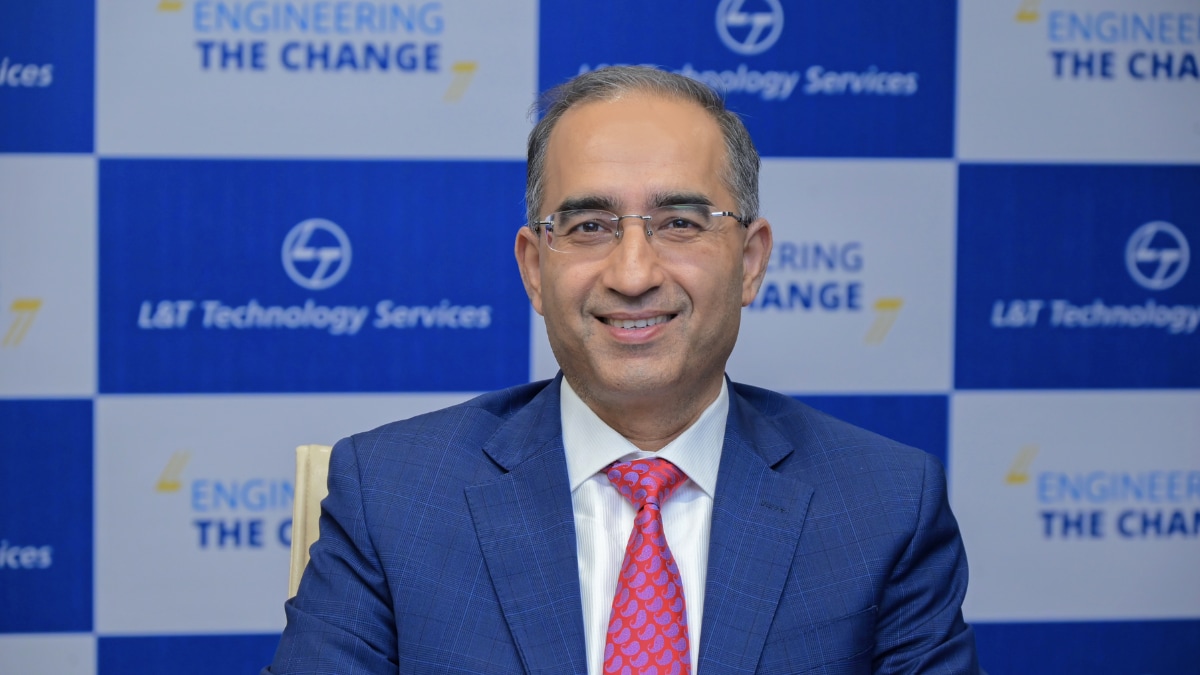
Is Artificial Intelligence (AI) a threat or an opportunity for the IT sector? While many fear disruption, the reality is far more nuanced. In an exclusive interview with THE WEEK, L&T Technology Services (LTTS) CEO and MD Amit Chadha explained why AI is expanding the scope of engineering rather than reducing it.
Based in Washington, D.C., Chadha was instrumental in driving the company through its Initial Public Offering (IPO) in India and successfully listing it on the National Stock Exchange and the Bombay Stock Exchange in 2016. An electrical and electronics engineer from BIT Mesra, Chadha has written extensively on technology, leadership and sustainable development.
In the interview, Chadha talks about the current state of the Indian IT services segment, how AI disruptions are going to shape the IT services industry, and the skills needed for the future. Excerpts:
What kind of challenges are Indian IT services companies facing due to AI-led disruption?
AI is certainly reshaping parts of the technology services landscape, particularly in areas that have traditionally been effort-driven. However, from an Engineering Research and Development (ER&D) perspective, the shift is far more opportunity-led. What we are seeing is that AI is fundamentally expanding the scope of engineering itself - embedding intelligence directly into products, platforms, and industrial processes. This is driving demand for more integrated, cross-disciplinary engineering capabilities that combine software, hardware, and AI.
At LTTS, this is translating into a pivot toward full-stack Engineering Intelligence (EI) solutions, where we integrate physical and digital AI to enable smarter, connected, and autonomous systems. Whether it is software-defined mobility, intelligent manufacturing, or AI-led healthcare diagnostics, the focus is increasingly on building next-generation products rather than just optimising existing systems. So, while AI is driving change across the broader ecosystem, in ER&D the momentum is clearly toward higher-value innovation, deeper client partnerships, and new demand creation.
How have deal sizes shaped up? Is AI the main disruptor for upcoming deals?
AI is certainly a defining theme right now, but its impact varies depending on the nature of the business. In ER&D, we are seeing deals becoming more strategic and transformation-led, rather than purely efficiency-driven. A large part of our deal pipeline today has AI embedded in it— either directly or as an enabling layer. In fact, nearly 40 per cent of our deal wins over the last two quarters have been AI-led or AI-influenced.
At the same time, there is a clear trend toward consolidation and platform-led engagements, where clients are looking for partners who can take end-to-end ownership of engineering programmes. The EI-led approach for clients is that AI is not just a disruptor; it is also accelerating the shift toward higher-value, long-term engagements. EI marks the convergence of AI, engineering data, and domain expertise to create systems that can sense, decide, and act across the engineering lifecycle, benefiting our customers.
What kind of pricing pressures are you witnessing?
There is some degree of pricing pressure in more commoditised areas, which is understandable given the productivity gains AI can deliver. However, in ER&D, pricing is increasingly linked to outcomes, innovation, and domain expertise, rather than just effort. In fact, we have taken conscious steps to move away from non-strategic businesses to stay aligned with higher-value opportunities. So, rather than broad-based pricing pressure, we see a rebalancing toward value-led engagement models.
Has AI reduced the need for people due to faster execution?
AI is definitely improving productivity and enabling faster execution cycles. But in ER&D, that tends to have a multiplying effect rather than a reduction effect. When product development cycles become shorter, clients typically respond by increasing the number of iterations, adding more features, and accelerating time-to-market. So, the overall demand for engineering tends to expand.
This is also reflected in our own hiring outlook: we have already added to our headcount and expect to add around 1,000 people over the year. So, while the nature of work is evolving, the demand for engineering talent continues to remain strong.
Is the workforce shifting from pyramid to a diamond model where AI and automation replace entry-level tasks?
The workforce structure is definitely evolving, but it’s not a simple shift from a pyramid to a diamond. Internally, we think of it more as an “Eiffel Tower” model - where you still retain a strong base of engineering talent, build a deeper and more capable middle layer, and sharpen the top with high-end architects and domain specialists. AI is increasing the need for multi-disciplinary skills and deeper expertise, particularly in areas like system design, integration, and domain-led engineering. At the same time, engineering continues to require scale, especially as products become more software-defined and complex.
So, rather than narrowing at the base, the workforce is becoming more capability-driven - balancing scale with specialisation. The real shift is toward higher-quality talent across all layers, with greater emphasis on adaptability, cross-functional skills, and the ability to work at the intersection of physical and digital systems.
How is AI services growth shaping up versus traditional services?
AI today is less of a standalone service and more of an embedded capability across engineering programmes. Almost every large deal we are working on has some AI component, whether in design, manufacturing, or lifecycle management. At the same time, traditional services are not disappearing; they are being re-architected with AI at the core.
Even in the current environment, our continuing business has shown steady growth, and in a more normalised environment, we see potential for stronger momentum. Therefore, growth is not separate but rather a convergence of traditional engineering with AI-led innovation.
After carefully assessing the futuristic technologies and evolving market needs, LTTS has defined its course for the next 5 years. The company is doubling down across technology, manufacturing and industrial domains, with a focus on AI-led forward-looking technologies such as Multisensory Intelligence, Signal Kinetics and Personal Robotics.
What AI-related skillsets will be important for freshers?
Going forward, the emphasis will be on convergence skillsets rather than standalone expertise. The most in-demand engineers will be those who can bring together strong core engineering fundamentals, AI and data capabilities, and domain knowledge across areas such as mobility, industrial systems, and energy. The role of an engineer is also evolving. It’s no longer enough to build models in isolation, but engineers need to understand how systems behave in real-world environments and how AI integrates into larger product and platform ecosystems. This means developing the ability to design, deploy and scale AI solutions that solve tangible business problems.
In that context, familiarity with areas such as Retrieval Augmented Generation (RAG), model evaluation, and prompt engineering for LLM workflows will become increasingly important. At the same time, there is a growing need for expertise in Physical AI and edge computing where software directly interacts with the physical world.
Ultimately, the future engineer will be inherently multi-disciplinary, operating at the intersection of physical and digital systems, with domain depth becoming just as critical as technical breadth.
How are geopolitics and macro conditions impacting the industry?
There are certainly regional variations in how macroeconomic and geopolitical factors are playing out. The US continues to show relative stability, while parts of Europe remain more cautious given energy dynamics and broader economic uncertainty. That said, in ER&D, the impact tends to be more measured. Engineering investments are closely tied to long-term product roadmaps, regulatory requirements, and technology transitions - whether it’s electrification, software-defined systems, or sustainability. These are not easily deferred without affecting competitiveness.
What we are seeing is not so much a pullback, but a recalibration. Clients are prioritising fewer, high-impact programmes, accelerating time-to-market, and looking for partners who can deliver integrated, end-to-end solutions. While there may be short-term fluctuations driven by macro factors, the underlying demand drivers for ER&D remain strong, anchored in innovation, product evolution, and long-term transformation agendas.
Has client spending reduced? Are there challenges in moving up the value chain?
Client spending has not reduced in a structural sense; it has become more selective. What we are seeing is a clear shift from broad-based discretionary spends to more focused investments in high-impact, innovation-led areas that directly influence competitiveness and long-term value creation.
There are five clear industry themes where spending continues to remain strong: engineering intelligence, software-defined systems, data centre and AI-led CAPEX, re-industrialisation, and consolidation-led engagements. These are not cost-driven decisions but strategic priorities, which naturally require deeper engineering expertise and tighter integration across the value chain.
In that context, moving up the value chain is less of a challenge and more of a market pull. Clients are increasingly looking for partners who can deliver end-to-end, platform-led, and outcome-driven solutions rather than isolated services.
Aligned with this shift, under its 5-year strategic Lakshya Plan, LTTS is sharpening its focus through six large technology bets designed to accelerate growth across its mobility, sustainability & tech segments, while reinforcing its positioning as a global engineering Intelligence partner. These include: Software Defined Mobility (SDM), Plant Buildout & Modernisation, Energy & Industrial Automation and Digital Manufacturing, Next-Gen Compute and AI Infrastructure, Software Platforms & EI, and MedTech. Together, these bets are closely aligned with the areas where client investments are scaling, further enabling LTTS to participate in higher-value, transformation-led engagements.
Has there been value erosion in your stock?
Market movements can sometimes reflect short-term sentiment and global factors more than underlying business fundamentals. From an operational standpoint, we have continued to focus on market share gains and consistent growth, with a 12.4 per cent Compound Annual Growth Rate (CAGR) over five years. This is compared to an industry growth of around 8.8 per cent. Looking ahead, as part of our 5-year strategic plan, we aspire to deliver 13 to 15 per cent CAGR over the next 5 years.
Over the long term, value creation will be driven by how well companies align to engineering innovation and AI-led transformation, and that remains our focus.
What is your outlook? When will things improve?
The current phase is best seen as a transition rather than a downturn. There are both headwinds and tailwinds at play, and it’s important to look at them together. From an ER&D perspective, we are already seeing signs of stabilisation, with expectations of growth in the coming quarters. More importantly, the industry is moving toward innovation-led and platform-driven models, and that shift will define the next phase of growth.
