


 Add as a preferred source on Google

The drive from the foothills of Tirumala in Tirupati to Aragonda traces a gradual transition from the bustle of a temple town to the quiet rhythm of rural Andhra Pradesh. Pilgrim traffic and crowded streets give way to buses, two-wheelers, tractors and farmers at work. Across the semi-arid terrain are rocky outcrops, scattered hillocks, cultivated fields and patches of greenery. Small towns, roadside shops and villages sustain the local economy. Away from the bustle of larger towns lies Aragonda, a village near Thavanampalle in Chittoor district.
On a hot, sunny day, a few elderly men and women sit on a wooden bench under a banyan tree as a van arrives carrying doctors and nurses. The team sets up medical equipment on a table and begins checking the vital signs of the elderly in batches. “The doctors visit us once in a month,” says Padmavathi Bangarappa, one of the elderly. “They monitor our health and give us medicines. If there are complications, they refer us to hospitals and even take us there.”
A few hundred metres away, screening is underway at a tuberculosis diagnostic centre. “TB cases have declined in this region because of continuous screening and monitoring,” says a nurse. Run by the government in collaboration with Apollo Total Health, the centre has become a pillar of support for local residents. For Aragonda’s 5,000-odd residents, quality health care is now within reach.
Here, the measure of a hospital is not just the number of beds it has or the sophistication of its operating theatres. Equally important are the distance patients travel, the cost of treatment and the possibility of detecting disease before it becomes life-threatening.
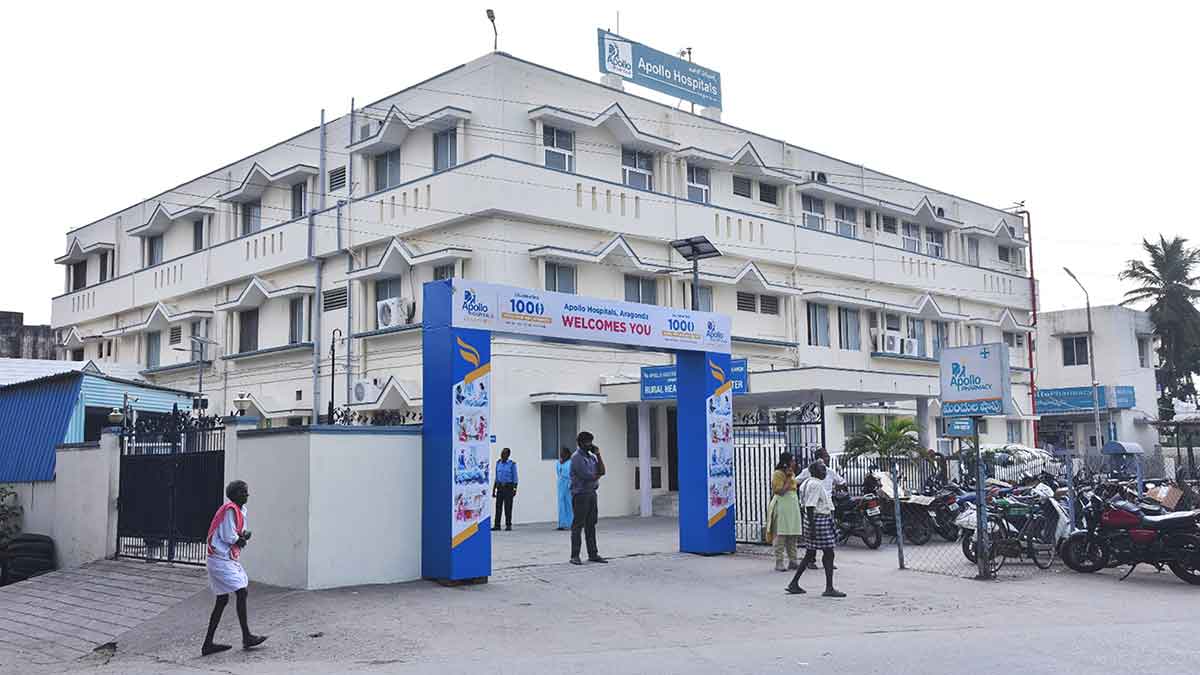
For Dr Prathap C. Reddy, founder chairman of Apollo Hospitals Group, Aragonda is where this larger health care philosophy took shape. In 2000, he established a 50-bed hospital in his native village, challenging the conventional belief that advanced medical treatment belonged exclusively to metropolitan hospitals.
Twenty-six years later, Apollo Hospitals, Aragonda, has treated more than 1.67 lakh patients and performed over 12,000 surgeries. Its latest milestone—1,000 total knee replacement surgeries—shows how specialised orthopaedic care can reach beyond urban hospitals.
The hospital is only one part of Reddy’s experiment. The larger ambition is reflected in Apollo’s Total Health programme, launched in Aragonda in 2013 to take health care beyond hospital walls and address the social and economic conditions shaping people’s health.
“Aragonda is where my journey began and it has always strengthened my belief that quality, affordable health care must reach every Indian, regardless of where they live. We began by bringing modern medicine to the village. But the true promise of health care lies beyond treating disease—increasing conditions for people to flourish,” says Reddy.
The idea is simple: instead of waiting for patients to come to hospitals, health care must reach people where they live. “The transformation we have witnessed here demonstrates how integrated, community-led health care models can create sustainable change and serve as a blueprint for other states and underserved regions,” says Upasana Kamineni Konidela, vice chairperson (CSR) and director (projects), at Apollo Hospitals Enterprises Ltd.
In Aragonda, Apollo’s knee replacement programme grew from 100 procedures in 2019 to 500 in 2022 and 1,000 in 2026. The hospital has also performed 19 knee replacements in a day. Its orthopaedic team includes Dr Madan Mohan Reddy, Dr Vijay Kishore Kondreddy and Dr Kunal Patel.
The achievement goes beyond numbers. Knee replacement requires specialist surgeons, anaesthesia, operating theatres, postoperative monitoring and rehabilitation. Sustaining such a programme in a 50-bed rural hospital demonstrates that sophisticated surgical services need not be confined to cities. The larger question is whether such treatment can be made affordable to the poorest rural households. Nevertheless, Aragonda has shown that geography need not determine access to specialised treatment.
Total Health reflects Reddy’s vision of preventive health care. Beginning with a household survey in 2013 to assess the health and economic circumstances of residents, the programme has turned into an integrated approach encompassing primary health care, nutrition, safe drinking water, sanitation, education, mental wellbeing and livelihoods. Mobile clinics began visiting villages in Thavanampalle in 2014. More than a decade later, Total Health approaches health care as a lifelong continuum, from pregnancy and childhood to adulthood and old age.
“This is an important departure from the conventional rural health care model, which often concentrates on treating common ailments through primary health centres and referring complicated cases to district hospitals,” says Preetha Reddy, executive vice chairperson, Apollo Hospitals Enterprise Ltd.
Apollo’s data says its mobile clinics have improved 1,02,373 lives. Its satellite clinics in Aragonda, Thavanampalle, Irala and Amrabad provide continuing care for diabetes, hypertension, seasonal ailments and nutritional deficiencies.
For Reddy, Aragonda is an attempt to demonstrate that health care must move from treating illness to preventing it, from metropolitan centres to village communities and from isolated medical interventions to a system that supports lifelong wellbeing.
“Health care revolution will not be measured merely by how many hospitals India builds,” says Reddy. “It will also depend on how many people are able to avoid illness, receive timely treatment and live healthier lives without having to travel hundreds of kilometres to find a doctor.”
