



Kishanganj, Gaya & Patna
Khurkhuriya announces itself in shades of yellow, blue and taupe.
Blue tarpaulins with drying corn kernels line the sides of the roads leading to it, as do thatched houses. At every turn, poverty reveals itself—in the people we pass, in the weathered homes along its narrow roads. The village sits on the edge of many things—of Bihar, of maps, of opportunity. Ratua, a tributary of the Kankai river, glides past its fields and sandbanks, indifferent to the departures it witnesses. This is the sort of place from where the young leave early, drawn by distant cities and greener pastures.
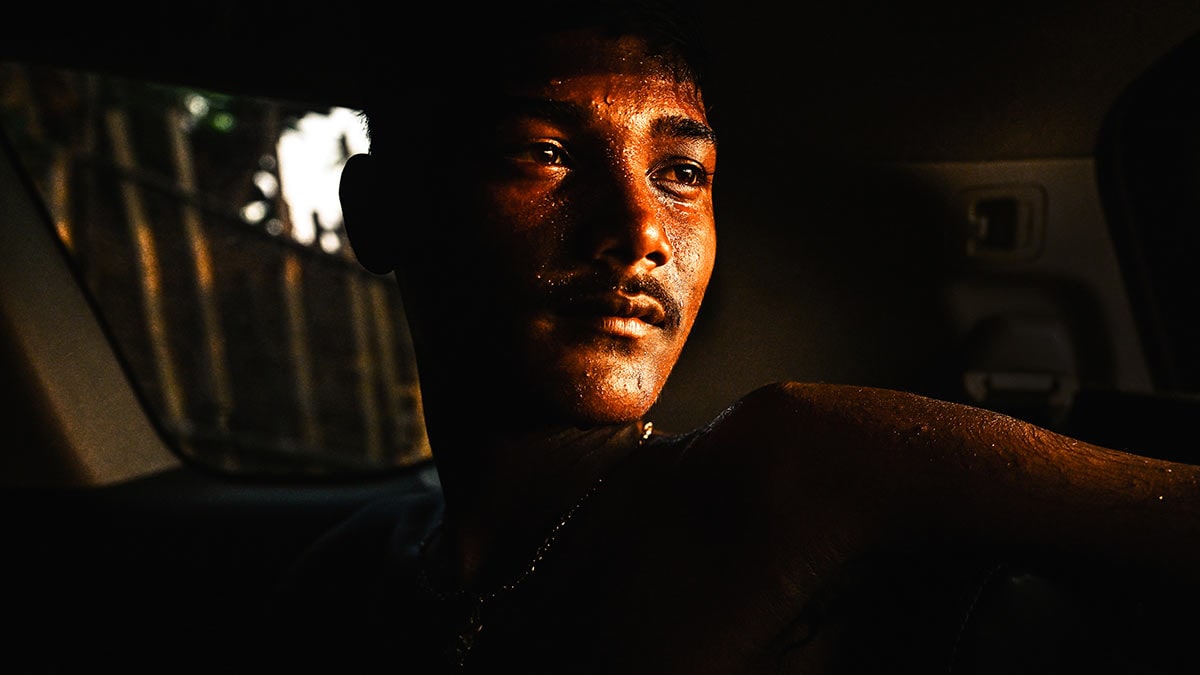
Among them, 16-year-old mahadalit Santosh Rishidev almost never made it back. Beyond a swept courtyard stands his house, one of several turquoise-blue mud-walled huts enclosed by a fence of woven reeds stiffened with bamboo. When we arrive, Santosh decides to welcome us with a treat.

Moments later, he is halfway up a mango tree. He shakes the branches and mangoes fall to the ground—for us and for the children who have gathered to watch the strangers.
With the ease of someone who has spent his childhood climbing trees, Santosh pulls himself upward, branch by branch. A shawl draped over his left shoulder conceals the stump where his arm ends above the elbow. He moves carefully, compensating for the missing limb. Yet there is no hesitation. For a moment, it is difficult not to stare and admire.
Less than a year earlier, that missing arm had been claimed by a fodder-cutting machine on a dairy farm hundreds of kilometres away in Haryana. At the time, Santosh was a bonded child labourer who had tried to escape, only to be recaptured and brutally beaten. The scars still mark his body.
Half a century after India outlawed bonded labour through the Bonded Labour System (Abolition) Act (BLSA), 1976, the system survives in farms and factories, brick kilns, workshops and other workplaces where debt becomes a leash, not always physical, and freedom a rumour. Millions remain trapped within it—in conditions akin to modern slavery. Santosh was one of the few who got out. But escape, he would learn, is not the same as freedom, or justice. The farm took his arm. What followed would test almost everything else.
Like many young men from Khurkhuriya in Kishanganj district, Santosh travelled north with a group of older boys, hoping to find the sort of work available to a poor, barely educated migrant. When the search failed, his father tried to bring him home. But near the Bahadurgarh railway station in Haryana, the two became separated.
His family searched frantically, filing a missing person complaint and chasing leads across railway stations in Haryana and Delhi. By then, a trafficker had lured Santosh with the promise of a job that would help him return home and had already delivered him into the hands of a feudal landlord and dairy farm owner named Anil Kumar.
Eight to ten labourers worked at the farm. Some had arrived as children and never left. By day, they laboured at cattle sheds and fodder fields; by night, they slept in rooms bolted from the outside. “Some have been here for five years, some for 10 years,” an older worker had told him.
Santosh arrived believing he would earn enough to return home. Hearing stories of boys grow into men behind locked doors, he realised that would not be easy.
The days settled into a punishing rhythm of labour and hunger. “We would get only two or three rotis a day,” Santosh recalled. “They wouldn’t even let us drink enough water.”
He knew his brother’s phone number, but every request to call home brought beatings. “If I could have made even one phone call to my brother, that would have been enough for me,” he said.
Months passed without wages. When an opportunity finally came, Santosh ran. Slipping away while cutting fodder outside the farm gates, he sprinted across fields and plunged into a rain-swollen canal. He somehow made it across, nearly drowning in the process. The owner commandeered a passing motorcycle and gave chase. Santosh fled through thorn-filled scrub until he was tracked down beneath a tree, beaten and dragged back.
The owner boasted that no one could touch him. “I am a gangster. I have the police, inspectors and lawyers under my control. Everyone trembles before me,” Santosh remembered him saying.
At one point, the owner allegedly placed a gun in the boy’s hands and offered him Rs50,000 and a train ticket home if he would kill a business rival. Santosh refused. That refusal brought more violence, but it was also one of the few choices he could still call his own.
It was two weeks after the failed escape attempt that Santosh lost his arm. He was ordered to operate a fodder-cutting machine he had never been trained to use. As he fed grass into it, his left hand was pulled inside.
“I shouted to another boy, ‘My hand is caught! Turn the machine off’,” he recalled.
By the time the machine stopped, the damage was done—half his arm was almost severed. A small strip of flesh still connected the mangled limb to his arm. According to Santosh, the owner arrived with a knife and cut through the remaining tissue. Blood poured from the wound. The boy begged for water, and “they wouldn’t even give me water”.
What followed, said Santosh, was as horrifying as the injury itself. No one bandaged the wound. No one called a doctor. With no help forthcoming, Santosh tore his shirt into strips and wrapped the stump himself. Santosh searched frantically through piles of freshly cut fodder for his severed arm. He never found it.
Hours passed. Only towards late evening, after bleeding for much of the day, was he put into a vehicle. They drove through remote areas of Haryana for nearly two hours, before abandoning him by the roadside. Not ready to die, Santosh walked. Two schoolteachers spotted him barefoot in the rain, in Nuh district. “Santosh is the bravest among my children—that is why my child survived,” said his mother Rekha Devi.
Santosh’s story briefly made headlines in August 2025, prompting the Haryana Human Rights Commission to take suo motu cognisance of the case. Yet the investigation moved slowly, forcing the commission to repeatedly seek explanations from the police and district administration and press for the arrest of the accused.
The breakthrough came only this January—prime accused Anil Kumar was arrested from the GautamBuddha Nagar region of Uttar Pradesh. After the arrest, intermediaries acting on his behalf allegedly approached Santosh’s family with offers of a settlement.
The mere mention of those overtures cause Santosh to suddenly break down. His body trembles with a mixture of anger and trauma. “He beat me everywhere,” he said through tears. “Even now my whole body aches. The pain is still inside me.” Then he raises his remaining hand. “Do you know what it means to lose a hand? This hand was like a lion’s hand—strong and powerful. This isn’t something we can simply forget or let go of. I won’t settle for anything. Even if someone offered us Rs10 crore, I wouldn’t compromise. I want justice. I want to see him punished.”
The interview came to an abrupt halt. Overwhelmed by emotion, Santosh wept uncontrollably. We sat with him in silence, hoping that he would gradually regain his composure.
In 2016, the Union government revamped the rehabilitation framework for bonded labourers—it replaced the Centrally Sponsored Plan Scheme for Rehabilitation of Bonded Labour, in place since 1978, with the Central Sector Scheme for Rehabilitation of Bonded Labourers. Under the new scheme, psychosocial and mental health counselling became a mandatory component of the official rehabilitation package, particularly for rescued child labourers, women and persons with disabilities.
In practice, however, social workers say that, like Santosh, most rescued bonded labourers never receive the psychosocial support they are entitled to. More fundamentally, many are never even recognised by the state as rescued bonded labourers in the first place, denying them access to the rehabilitation framework, including financial assistance, housing, livelihood support, skill development and educational opportunities.
Santosh’s case itself is a prime example of that failure. More than a year after his rescue—and despite intervention by the National Human Rights Commission and the Haryana State Human Rights Commission—he is still waiting for a Bonded Labour Release Certificate, the document that legally recognises a person as a rescued bonded labourer and unlocks rehabilitation benefits, starting with initial financial assistance of Rs30,000. His case is not an aberration.
“Evidence gathering is inadequate, especially in inter-state trafficking cases, where coordination between agencies becomes more complex,” noted Tina Kuriakose, a development sector practitioner specialising in migration, bonded labour and human trafficking. “The Supreme Court has repeatedly emphasised, across multiple cases, that timely and effective rehabilitation is just as important as rescue. If victims do not receive immediate assistance, they may not even be able to return home, buy food, support their children or even think about rebuilding their lives.”
Santosh’s ordeal drew attention because he survived with a missing arm. Most rescued bonded labourers bear no such visible reminders. Their stories disappear into official statistics, and rarely do they shock the system. In November 2024, when the Supreme Court was considering the issue of timely rehabilitation of bonded labourers, an alarming statistic came before it: between 2017 and March 2024, about 11,057 children had been rescued from bonded labour in 19 states, with most of them yet to get any form of rehabilitation. Noting the seriousness of the situation, the bench then asked the Centre to come up with a uniform formula to be followed by all states.
Nonetheless, victims like Santosh remain. Even worse, there are instances of deliberate under-reporting. On March 17, acting on a tip-off, the Gaya district administration raided a brick kiln at Purni Bathan, where generations of bonded labourers were allegedly being held. A team constituted by the district magistrate, accompanied by police personnel and members of the local NGO Adithi, carried out the rescue. Many of those rescued came from remote, drought-prone villages like Sarvodayapuri and Bapugram in the Bodh Gaya block. The villages are predominantly inhabited by Musahars, a mahadalit community whose chronic deprivation has long been symbolised by the fact that many survived by catching and eating rats. Others had been brought from neighbouring Nawada district.
According to the survivors, the kiln belonged to Dilip Yadav, who, they alleged, had been trafficking indebted labourers to brick kilns across Aligarh, Ayodhya and other parts of Uttar Pradesh for more than two decades. After setting up his own kiln in Bihar around a decade ago, he allegedly brought many of the same families back, turning migration into a closed circuit of captivity.
“It all started when Dilip Yadav opened a grocery shop near our village,” recalled Rajkumar Manjhi, a survivor from Sarvodayapuri. “We bought commodities on credit because we had no money. We are illiterate. We had no way to verify his accounts. One day he told us the debt had become too large and took us to Uttar Pradesh to work in a brick kiln.”
Wages existed only on paper, they alleged, endlessly adjusted against a debt that only grew. Even subsidised food became an instrument of control. Survivors alleged that ration rice was entered into their accounts at inflated prices, ensuring the debt could never be cleared. During monsoon, when brick kilns shut down in Uttar Pradesh, they were sent to work in Dilip’s agricultural fields. Back in Bihar, they lived in makeshift huts beside the kiln, making any return to their villages almost impossible.
Violence enforced the system. Those who resisted, tried to leave or refused to work were allegedly beaten, abused with caste slurs and, at times, dragged back to the kiln. Survivors also alleged that multiple murders resulting from violence at the brick kiln—including that of 16-year-old Sajan Kumar—occurred, yet the owner, who belongs to a powerful caste, never faced any consequences.
Debt passed from father to son. Marriage drew new women into bondage. Children entered the workforce almost as soon as they could walk.
A young survivor, Khushboo Kumari, for instance, said bondage had become an inheritance. Unsure of her age, she said she had married into a family already trapped by a debt her father-in-law had spent years trying, and failing, to repay. “My father-in-law worked and died at the brick kiln. Ever since I got married, I have worked alongside my husband to repay his debt,” she said. All three of her children were born at the kiln.
“We thought this was how our lives would end,” said Lalita Devi, who spent more than a decade at the kiln. “We believed the next generation would spend their lives the same way.” They were ultimately rescued.
Yet, rescue means nothing without follow-up. According to Rohit Singh, programme manager at Adithi, the danger of survivors slipping back into bondage remains acute because of the administration’s half-hearted measures. “Nearly 140 people were rescued from the brick kiln, but fewer than 62 have so far received release certificates,” he said. “That happened because the standard operating procedures were not followed.”
Officials are required to record statements from every rescued worker before issuing release certificates. “Of nearly 140 people present during the rescue, statements were recorded from only 62 individuals,” said Rohit. “That was a clear violation.”
Rohit, who was present during the operation, said he repeatedly urged the additional district magistrate to record every survivor’s statement. He was told that it was getting late and that it was not possible to record statements from everyone that night. According to Rohit, the ADM assured those present that everyone rescued would be recognised as bonded labourers and the paperwork would be completed later. “That assurance was never honoured,” he said. Even the 62 certificates were issued following media attention, alleged Rohit.
The BLSA empowers executive magistrates to exercise powers of judicial magistrate of first or second class for trial of offences. Nevertheless, more than three months after the rescue, survivors and activists say the kiln owner has still not been arrested. Rohit alleged that Dilip had, in fact, resumed contacting former labourers, insisting they still owe him money and ordering them to return. “Those who do not have release certificates remain the most vulnerable,” said Rohit.
The administration’s reluctance to recognise all the rescued workers stems from a desire to minimise the official count, said Rohit. “Lower numbers mean less embarrassment for the administration,” he said. Based on the cases he had handled, he alleged that authorities often avoid officially recognising victims as bonded labourers, instead recasting the cases as routine wage or labour disputes. “The provisions of the BLSA may remain in the FIR, but the victims are frequently denied release certificates,” he said. As THE WEEK continued interviewing survivors in Sarvodayapuri, a team of labour department officials arrived at the remote hamlet and began asking villagers about our whereabouts. It was difficult to ignore the timing or the obvious question it raised: who had informed them of our visit?
THE WEEK made repeated attempts to contact the district magistrate in person, by telephone and by email, but there was no response till the time of publication.
The reluctance to officially acknowledge the scale of the bonded labour problem sits uneasily with the Centre’s stated ambitions. In 2016, alongside a revamped rehabilitation framework, the first government of Prime Minister Narendra Modi set a target of rescuing an estimated 1.84 crore bonded labourers by 2030 to achieve the “total abolition” of the practice. A decade later, government data shows that fewer than 5,000 bonded labourers have been released annually on average. At that pace, by 2030, the government would have achieved less than 2 per cent of its stated target.
The contradiction was visible even then. Replying in Parliament in 2016, the government acknowledged that the “root of the problem” lay in entrenched social customs and economic compulsions—forces that had “yet to change in the desired direction”. Ten years later, the numbers suggest they scarcely have.
Under the BLSA, identifying, releasing and rehabilitating bonded labourers is the responsibility of state governments. To support this, the 2016 rehabilitation scheme provides dedicated funds for proactive identification. The scheme also mandates every district to maintain a Bonded Labour Rehabilitation Fund with a permanent corpus of at least Rs10 lakh to provide immediate assistance to rescued workers, with the Centre reimbursing the expenditure. Activists, however, say proactive identification and maintaining an adequately funded rehabilitation corpus is yet to be a common practice.
Experts argue that the law itself reflects the limitations of the era in which it was enacted. “The BLSA was framed around the understanding of bonded labour that prevailed in the 1970s, when debt bondage and hereditary servitude among socio-economically marginalised communities were its most visible forms,” said Kuriakose.
While the act acknowledges the historical relationship between caste and bonded labour, it offers no specific protections based on caste, gender or age. Those safeguards are scattered across other legislations. Forcing a member of a Scheduled Caste or Scheduled Tribe into bonded labour is punishable under the SC/ST (Prevention of Atrocities) Act. Child bonded labour also attracts provisions of the Juvenile Justice Act and child labour laws. Increasingly, cases are prosecuted as human trafficking under the Bharatiya Nyaya Sanhita when they involve coercion, deception or other forms of exploitation.
But on ground, these overlapping laws often collapse into a single absence: protection. That absence lingers in Sunita Devi’s memories. A resident of Koriyama, an agrarian village in Gaya district, she spent seven months trapped in a brick kiln in Paliganj with her husband, his brothers and their wives, their children and her mother-in-law, Lalti Devi. The family had accepted an advance that turned into bondage.
Even the most intimate acts were supervised. “Even when we went to the bathroom, they would send a man behind us to make sure we didn’t run away,” recalled Sunita. The family was forced to relieve themselves in the open, within sight of the owner’s office, and bathe under the watch of male supervisors. “We had no dignity at all,” she said.
The humiliation was accompanied by fear. There was an alleged sexual assault attempt by a superviser on a 15-year-old girl from the family. “He grabbed her, covered her mouth and dragged her away,” said Sunita. “She screamed, and everyone ran towards her, so he fled.”
When the family complained to the kiln owner, they said they were met with violence. “He sided with the man,” said Sunita. “He raised his hand to beat us and started abusing us in filthy language. He called us whores and other insults. Then he slapped us and kept saying, ‘Keep quiet. Shut up.’”
The women of the Koriyama family—whose husbands now work as migrant labourers in Mumbai—say the indifference they encountered from the authorities after their rescue was barely any different from what they had endured at the brick kiln. They are yet to receive their release certificates.
Kuriakose argued that this indifference permeates every stage of the justice system. Bonded labour trials often drag on for years. By then, survivors would lose wages attending hearings, memories would fade, and many would be too exhausted to continue.
The rehabilitation framework further entrenches this imbalance. While survivors are entitled to financial assistance ranging from Rs1 lakh to Rs3 lakh, the bulk of the compensation has historically been contingent on securing a conviction. But convictions remain rare. Many survivors, facing threats and intimidation, are unable to pursue the case to its conclusion.
“Without adequate police protection and support systems, victims may be unwilling or unable to testify,” said Kuriakose. “That is why timely rehabilitation is critical. Only when survivors are economically and socially secure are they in a position to pursue justice.”
Some survivors, once given the chance to reclaim their lives, go on to become community advocates, helping others escape the same trap. One of them is Thenmoyi. She lives in Andhra Pradesh’s Chittoor district with her husband Kannayya and two sons, running a small fruit and vegetable stall. When word of a bonded labour case spreads, she is often the first person victims or activists call.
Thenmoyi was in class 7 when debt dragged her family into bondage. After her father defaulted on a loan, they were taken to work in a brick kiln near Bengaluru. In 2005, when she was 15, social workers noticed children working at the kiln and rescued the family. They were taken to court the same day and issued release certificates without delay.
That timely rehabilitation altered the trajectory of her life. She returned to school, completed class 10, married and built a modest livelihood. But freedom had also taught her what debt could do. Slowly, she began helping others.
One of the most emotionally overwhelming cases Thenmoyi encountered came last year. It was that of Ankamma, a Yanadi tribal woman who, along with her three children, was held in bonded labour at a duck farm in Andhra Pradesh after her husband borrowed Rs25,000 from the owner. Even after her husband died, the family remained trapped. When Ankamma finally arranged the money to repay the debt—with steep interest added—the owner told her that the interest had increased further, and demanded that she leave behind her nine-year-old son as collateral. Months later, when she returned to reclaim him, he claimed the boy had run away. It later emerged, after police questioning, that the owner had killed the child and secretly buried his body across the border in Tamil Nadu. A post-mortem revealed that the boy had not died of illness, as claimed, but from severe injuries.
Thenmoyi entered the story only after the boy’s body was exhumed. As Ankamma returned from Tamil Nadu after performing her son’s last rites, Thenmoyi and another activist met her on the journey home. From then on, she rarely left Ankamma’s side—travelling with her, checking on her regularly, helping pursue the criminal case, securing her recognition as a bonded labour survivor, initiating rehabilitation under the BLSA and helping her obtain compensation under the Scheduled Castes and Scheduled Tribes (Prevention of Atrocities) Act.
When Thenmoyi first began taking up cases, officials dismissed her. “They would tell me bonded labour no longer existed—that it had been abolished and belonged to history,” she recalled. “Every time I brought a case, they questioned me.” She kept returning, case after case, carrying evidence instead of arguments. Gradually, disbelief gave way to trust. “Now, when I take a case to them, they know I have lived through bonded labour,” she said. “They trust that I understand what I am talking about. They know I have experienced this reality. That makes them believe the cases I bring are genuine.”
If Thenmoyi’s story reveals what timely rehabilitation can make possible, Pursala Lingamma’s points to a harder truth: ending bonded labour also means confronting the social order that sustains it.
A Chenchu tribal woman from Amaragiri village in Telangana’s Nagarkurnool district, Lingamma spent more than three decades living under inherited debt before government officials rescued 62 bonded labour families from the village in 2016 and initiated their rehabilitation.
Rescue, she realised, did not dissolve hierarchy that caused the bondage. The debt was gone, but the same dominant castes still controlled the village, occupied elected offices and decided whose voices mattered. “Why should we always go to them?” she asked. “Why don’t we take leadership ourselves?”
The question led her into politics. In December 2025, the woman who had once lived as a bonded labourer became the elected sarpanch of Amaragiri.
Today, Lingamma says bonded labour has disappeared from her village. Whenever labour contractors arrive in neighbouring villages with advances and false promises, she intervenes before another family can be drawn into debt.
Stories like Lingamma’s suggest that the fight against bonded labour is not won in raids or courtrooms alone. It is also fought in village councils. What she achieved in Amaragiri points to a larger truth: bonded labour endures where old hierarchies endure, and recedes only when those hierarchies begin to crack.
Rescue SOP
In May, the SOP for identifying and rescuing bonded labourers was updated. Here are the key changes:
• “Prima-facie finding” (an official’s initial finding that someone is a bonded labourer) now triggers rehabilitation—victims don’t have to wait for the employer’s trial to conclude
• Immediate financial assistance is paid directly into Aadhaar-linked bank accounts
• Every district magistrate must maintain a database of rehabilitated bonded labourers
• Rescue teams are led by an executive magistrate-rank official, with a vigilance committee involved
• Recovery of unpaid wages from employers is now explicitly part of the process
• Financial coordination across state lines has been clarified
• The SOP is now aligned with BNSS, 2023 (the new criminal procedure code) and the 2021 rehabilitation scheme
• The window to issue a release certificate has been relaxed from 24 to 48 hours
• Trial now begins within a week of the file opening (was 24 hours)
• The structured questions for inquiry and the criteria for excluding offenders are no longer specified
• Land patta has been dropped from the list of rehabilitation benefits
