



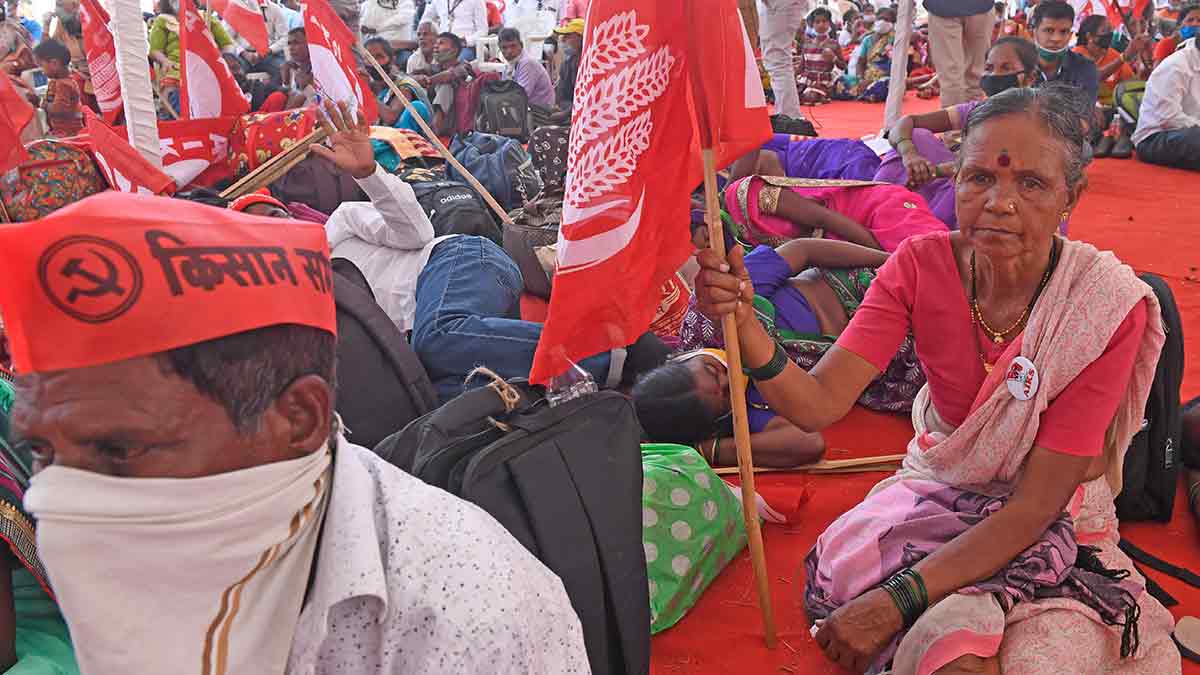
A political cycle that began in Kerala has come full circle. Close to 70 years ago, it was in Kerala that the communists were voted to power for the first time in India. Today, the communists have been voted out of power in the very same land, leaving India with no state where the communists are governing.
Yet it may be premature to write the requiem for communism in India. For, the idea of the Left had been there in the Indian body politic long before structured communist parties took birth. It was there in the minds of the Kanpur plotters who dreamed of overthrowing the imperial government; it was there in the mind of a Bhagat Singh who faced the hangman’s rope for the country’s freedom; it was there in the mind of a Subhas Bose when he disagreed with the non-violence of the Mahatma in his pursuit of national liberation; it was there in the mind of a Jawaharlal Nehru who was impressed by its egalitarian precepts and scientific approaches; it was there in the minds of the many sailors in the Royal Indian Navy who mutinied against the flag that they has sworn to fight for, and risk facing the last bullets of a crumbling empire.
It was there to make its quiet presence in the new republic, embracing its parliamentarism, taking up the cause of the wretched and the damned, and trying to ensure that it didn’t stray dangerously to the Right. It was there to oppose the authoritarianism of regimes, capture power in ideologically fertile provinces like Kerala, West Bengal and Tripura, implement land reforms, ensure decent wages, and guard peasants’ and factory hands’ rights. It will continue to remain as one of the most powerful and verily required course-correctors of political and social conduct in India, even after structured communist parties fade away from the portals of power.
The Left has always had a presence in India's democratic dialectics far disproportionate to their numerical strength. A combination of factors worked behind this—the charismatic personal austerity of a Jyoti Basu or A.K. Gopalan, the tactical realpolitik of an E.M.S. Namboodiripad, Harkishen Singh Surjeet, or Sitaram Yechury, the cerebral doctrinal enterprises of an M.N. Roy, P.C. Joshi or Prakash Karat, the pristine parliamentary skills of a Hiren Mukherjee, Indrajit Gupta or Somnath Chatterjee which surpassed even the best in Westminster, and more. Added to this was an intellectual halo supplied to the movement by some of India's greatest academics, like D.D. Kosambi and Irfan Habib, scientists like Meghnad Saha, artistes from Balraj Sahni to Safdar Hashmi, and writers of K.A. Abbas and Mulk Raj Anand.
The communist galaxy has always stood out in the Indian political firmament with brighter stars, though fewer in number. Communist 'ideology' (Marxian purists, please forgive) does not recognise the significance of the individual; the individual, in the Marxian world view, is a creation of the social forces that are at work in the given situations in history. That, however, does not explain the seminal contribution made by individual communists, with hardly any mass base, to the process of stabilisation of the Indian polity.
The Left had its ideological presence in the freedom movement, but that got largely subsumed into the all-pervading ascetic humanism of the Gandhi-led national movement, as did the largely feudal and the neo-industrial Right. The success of Nehru in the early years of the new republic was that he exhibited in his political conduct an egalitarian Leftism along with a liberal Rightism. This set the course on which the young republic was to travel. He steered its course in such a way that neither the real Left (the communists) nor the real Right (the Jan Sangh) could assert themselves in India.
This was not just an exercise in pragmatism, but a course suggested as much by his Right-leaning heart as by his Left-leaning mind. Even as he was impressed by the progressive strides made by the planned Soviet economy and adapted it for the fledgling Indian economy, he was more comfortable in the company of an Andre Malreaux, Harold Macmillan or John F. Kennedy than with the titans of the global Left like Joseph Stalin or Mao Zedong.
Nehru’s death in 1964 led to a brief assertion of the Rightists under Lal Bahadur Shastri at the Centre. His successor, Indira Gandhi, who had imbibed elements of Nehru’s intellectual Leftism, used the Left as a tool for her pragmatic politics. Embattled by the onslaughts of the Rightists within her party and in Parliament, she sought the help of the Left for survival. Even as she surrounded herself within the PMO (then called PM's Secretariat) with Leftists like D.P. Dhar and P.N. Haksar, who steered her foreign policy towards the Left in the cold war-ridden world, card-holding communists like Mohan Kumaramangalam joined her cabinet and steered her administration to the left. Once she got onto a lane that suited her poise on the left side of the road, she stepped on the accelerator and drove like a race-car driver, cocking a snook at the Rightist syndicate, terminating privy purses of the feudal maharajas, nationalising banks, and finally, in her boldest stroke, splitting the 80-year-old Congress.
Her brilliant electoral victory in 1971 enabled her to free herself from the stranglehold of the Left in domestic politics, but her flirtation with the global Left continued. She ended the ‘English Liberal’ Nehru’s true neutrality and made her strategic policy truly left-leaning. With the global Left aiding or cheering, she scored a brilliant war victory that split India’s hostile neighbour into two, secured the nation’s frontiers, asserted militarily in the South Asian neighbourhood, built steel plants, and even explored space.
Soon, domestic challenges caught up with her. As she imposed Emergency in a blatant misuse of power, and a brat pack of a Rightist lumpen led by her son Sanjay Gandhi deprived her of her ideological sheen, the Left too distanced from her. In a rarely seen reorganisation of forces, the Right and the Left in the opposition line-up – the old syndicate within the Congress, the Jan Sangh, the socialists and the Marxists – came together on the confused socialist Jayaprakash Narayan’s call to defeat Indira’s Congress, which had degenerated into a Rightist lumpen grouping. But their Janata experiment soon collapsed under the weight of its own contradictions. As the Right and the Left pulled in different directions, Indira returned with a campaign which promised a ‘government that works’, an idea that inspired Narendra Modi 35 years later.
The real shift of the polity away from the Left began there. Even on her foreign policy, she became multi-focused. To the surprise of both the Left and the Right, she ordered Jaguar bombers from Britain, invited Japanese technology in consumer industries like car-making, till then a no-go area for all governments which had socialist pretensions. She paid a house call on the Soviet-combating Ronald Regan in his White House, and even whispered in Alexei Kosygin’s ears that the Soviets had erred in invading Afghanistan. In hindsight, it appears she was the only leader who had read the writing on the wall – that the global Left, and the Soviet system itself, was running out of steam.

There was a further shift to economic Rightism under Rajiv Gandhi. Unleashing a new consumer culture, he made the managers of the economy try to manage it from the consumer end rather than the producers’ end. As die-hard Leftists looked with derision, Rajiv whetted the consuming appetite of an emerging middle class by cutting duty on video players and seeking foreign technology even to make stationery.
Rajiv’s progressive Rightism didn’t last long. Soon, he got trapped in the claws of a regressive religious Rightism. The man who used his brute parliamentary majority to legislate against the mediaeval practice of sati also used it to legislate against the civil rights of Muslim women. Next, he let the religious Right lay a temple stone on the premises of a historic mosque.
By now, a new social Leftism (as distinct from the political and economic Leftism of the communist parties) was striking root in northern India. V.P. Singh, who had emerged on the political scene as a darling of the Rightist middle classes with his campaign against corruption, suddenly shifted to the social Left, initially as a reaction to the assertion by the Rightist peasantry led by rebelling cabinet colleague Devi Lal.
Singh took to social Leftism with the fanatic passion of a neo-convert, and announced a long-forgotten proposal made by the Mandal commission to reserve jobs for backward classes. This caused a political churning in the vast political landscape of north India, with the old Lohia socialists now asserting as the new Mandalites.
The Right reacted violently. Mandal backwardism, they realised, would split the Hindu community as forwards and backwards, thus undermining their social base. With the deftness of a shrewd general who can quickly adapt to the changing battlefields, the BJP’s LK Advani adopted the Ram temple movement and made a bold attempt at Hindu consolidation.
Though the English-speaking entrenched elite mocked at those two movements as mandal and kamandal, they found the society being divided along caste and communal faultlines, leading to the fall of the second Janata experiment. After that, the old Right and the old Left never came together.
The Congress, though badly mauled in the Left-Right or the mandal-kamandal brawl, came to power in the 1991 election under an uncharismatic Narasimha Rao, an ageing scholarly Brahmin from the south. A man with no ideological pretensions of being Left or Right, he, with the help of his greenhorn finance minister Manmohan Singh, attempted to free the economy from all ideological shackles and opened it up to national and global capital.
But caught between the Mandalites on the Left and the kamandalites on the Right, the Congress declined. Initially, the Left asserted politically. They jumped onto the secular bandwagon and occupied the navigator's seat. The sheer intellectual charisma of the Left, coupled with the political acumen of certain leaders like Surjeet and Basu, enabled the Left to exert influence, again, far beyond their electoral strength, on the conduct of the secular polity in India. Even while opposing the centre-Right regimes of Rajiv Gandhi, Narasimha Rao and Manmohan Singh, the Left acted as correctional forces that enabled the regimes to stay their course and prevent them from skidding dangerously to the far Right.
Take the Punjab crisis, for instance. Only an ungrateful country can forget the supreme sacrifices made by communists like Darshan Singh Canadian in the fight against militant separatism. When most political parties virtually abandoned political activity in the militancy-infested Punjab in the 1980s, the communists, led by an ageing Satpal Dang, kept the flag of politics flying. Despite being on the other side of the electoral battlefield, the Congress governments of Indira Gandhi and Rajiv Gandhi received more valuable and more objective advice from Surjeet and Dang than from anyone in the Congress.
Fast forward to the UPA times. Why, even the National Rural Employment Guarantee Act, which is said to have got the UPA more votes in 2009 than in 2004, was originally taken from the Left's agenda. Despite the mutual rancour and recriminations over the nuclear deal, the Congress-communist intellectual camaraderie continued. Even after the 'atomic split' of 2008, Manmohan Singh depended on Sitaram Yechury to help defuse the crises in Nepal and Kashmir and to negotiate with the Green Monsters of the West at Copenhagen. That was in continuation of the seminal role that the communists have been playing, especially in giving cerebral doctrinal inputs to matters of governance.
All that is past. With the centrist forces also having been defeated, and the Right asserting itself in the mandirised India, the Left is finding itself at a loss. It has been wiped out of the political map of eastern India, which it had ruled for long, and is now facing an existential crisis in Kerala, where it was first voted to power.
What has gone wrong for the Left? As the Leftists and centrists were getting caught up in the governance dialectics of Deve Gowda, I.K. Gujral, A.B. Vajpayee and Manmohan Singh, a new class, born in the liberalised India, was growing into voting age by the second decade of the 21st century. It created its own elite, one that is different from all the elites that India had seen till then. It drew from religion—not from its great eclectic philosophies, but from the dogmas of faith. Its understanding of religious epithets is restricted to the adoption of superficial iconography and mass-practised yoga. Its approach to Sanskrit is with a wide-mouthed awe; its understanding of history is basically derived from Amar Chitrakatha. But it is prevailing.
But where did the Left go wrong? How could a political formation, which has based its philosophy on the most scientific precepts, a set of parties which have more internal democracy than any other political dispensation in India, come to such a fate? Indeed, the biggest blow suffered by the communist movement has been the break-up of the Soviet Union, but internally, too, the movement has been facing the prospect of ossification. Despite the party's incredibly high intellectual traditions (after all, Marxism was a politico-economic synthesis of the finest scientific thought streams that had emerged in Europe since the Renaissance till the 19th century, including Newtonian physics and Cartesian philosophy), the Marxist political thought in India came to be most static and at most times rigid. There was also a refusal to accept, or even recognise the existence of, new ideas and new thinking, something that goes against the very basis of scientific temper.
In the process, the communist parties got ossified like the Catholic Church in mediaeval Europe, Caliphatic Islam in the industrial world and Sanskritic Brahmanism in early mediaeval India. It created its own fundamentalisms, burnt 'heretic' scriptures and inquisitioned Nripen Chakrabortys and Somnath Chatterjees. Intellectual ossification, in every institution and culture, was also accompanied by the rise of individual vainglory, as one has seen in Kerala over the last decade. On the Left, it manifested itself as what is popularly called the big-brother attitude. Coupled with this is the acquisition of pelf and privilege— both for the party and its vainglorious individual leaders, as has happened in Kerala.
Thus, the party of chai-vada proletariat (chai-pakoda in the north) has come to own multi-storey party headquarters, amusement parks and huge media conglomerates, alienating it not only from the poor but also from the middle-class who once worshipped the individual austerity of the communists.
The Left also failed to comprehend, or adjust itself to, the new social realities. Traditionally, the Left survived on three constituencies—the industrial labour class, the marginalised peasantry and the radicalised campus. The old mills are gone, a contract culture has come into the labour market, and the trade unions are getting marginalised in a highly mobile labour market. The sections of peasantry that have prospered have also moved into the new economy, and the marginalised peasants are increasingly turning to the more radical of the Left. Even the campus scene has changed, with the brighter and the better-read youth going for professional courses in politically sanitised campuses which no longer breed Prakash Karats or Sitaram Yechurys.
Then there is the new social dynamics. Marxian sociology had drawn the social diagram as a pyramid with a few capitalists at the top and a large mass of the poor and the toiling at the bottom. The Left has traditionally drawn its cadre, support and sympathy from the bottom segment of the pyramid. But in the new economy, where a white-collar middle class is getting larger and larger, the society, too, is increasingly taking the shape of a rhombus or diamond, with fewer rich at the top, fewer poor at the bottom and a large middle class in the middle. Such a development, which completely negates the basic axioms of Marxian social thought and action, has also caught the Leftist thinkers unawares.
Yet, the Left will continue as a political conglomeration for some time, and as an idea, for much longer. To improvise on Voltaire's famous statement on God, if there is no Left, India will have to invent one. Rightist social sciences in India to date have not evolved any further than being a sham alchemy indulged in by a set of charlatans. The republic's secular intellectual space, especially in the realms of historiography, sociology, cultural studies and even aesthetics, continues to draw its sustenance from the Leftist school. It will continue to remain so for the foreseeable future, if not till kingdom and commune come.
