



UNDERSTANDING TODAY’S transformations in West Asia can no longer be reduced to the simple language of interstate rivalry or classical military calculations. What is emerging is a profound reconfiguration of meaning, legitimacy and regional order, in which foreign policy, security and civilisational identity have become deeply intertwined. This has two competing narratives of the region’s future in direct confrontation with one another. The contest unfolds simultaneously on the battlefield, in discourse, and within historical memory.
On the one side stands Iran, which is not just a modern state but also an enduring civilisation whose culture, society and historical experience have evolved over centuries. Concepts such as independence, self-reliance, justice and resistance to external domination are, in this view, not situational slogans, but foundational elements of Iran’s political-civilisational identity.

Within this framework, power derives legitimacy from its capacity to preserve society, safeguard sovereign decision-making, and prevent external domination. Accordingly, Iran’s regional conduct should not be interpreted as a project of expansionist influence, but rather as a mechanism of deterrence against instability and foreign intervention.
On the other side, Israel is often viewed by critics as an actor whose security doctrine is grounded in military superiority, the management of its surrounding environment and the stabilisation of power balances through continuous hard-power engagement. In this framework, military strikes are not merely episodic reactions, but part of a sustained pattern aimed at shaping a desired security order. In competing narratives, however, this is interpreted as generating recurring cycles of instability, occupation and violence.
At the discursive level, this competing perspectives reflect a fundamental divide in defining the legitimacy of power. In one narrative, power derives legitimacy from society, history and national will; in the other, it is sustained through military capability, security superiority and external support. This divergence is not merely political; it concerns the very nature of the regional order itself.
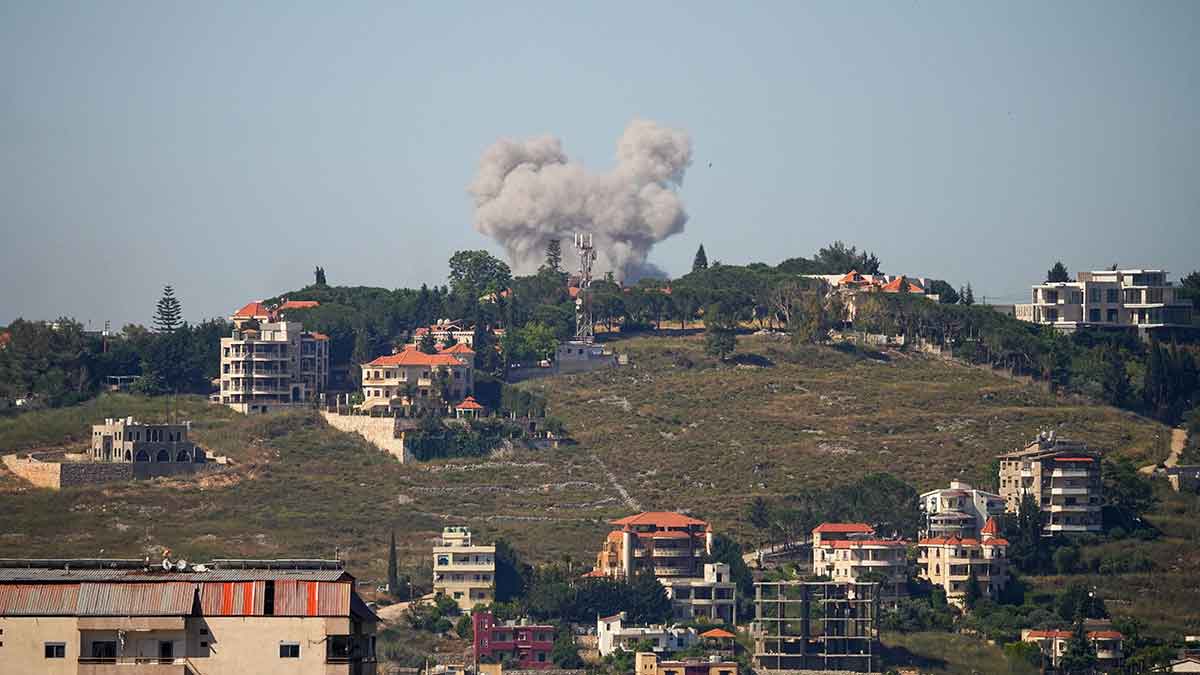
Within this context, Lebanon—particularly the forces of popular resistance—occupies a central position. Southern Lebanon has become one of the main arenas of regional confrontation, subjected simultaneous to military, humanitarian and geopolitical pressures. Combined with these, large-scale displacement and infrastructural damage have produced a complex and exhausting condition.
In such circumstances, the question goes beyond war or peace. It becomes a question of the right to exist in the face of imposed order. Resistance, in this interpretation, is not a temporary act but a structural response to enduring pressures.
Within this framework, a key axis of confrontation lies in the definition of “military action”. On one side, Iran’s actions and those of its regional partners are framed as “legitimate defence”; actions aimed at halting cycles of violence and restoring a minimum level of security balance. On the other side, the same actions are interpreted as part of a power-driven strategy aimed at reshaping the regional balance.
Metaphors from allegorical literature can be invoked here. In La Fontaine’s The Tamed Lion, a powerful force, in order to be accepted into a new order, is stripped of its deterrent capacity. But the reality is ultimately revealed: security promises without guarantees are not sustainable. In critical interpretations of international politics, this allegory serves as a warning against disarmament without corresponding behavioural change from the opposing side.
In the Iranian narrative, however, this logic is inverted: maintaining deterrent capability is not understood as a tool of threat, but as a condition for preventing the repetition of historical patterns of domination, occupation and instability. In this sense, deterrence is part of a logic of survival and regional balance, rather than a mechanism for expanding crisis.
Ultimately, within this conceptual structure, Iran is consolidating a distinct role in the emerging regional order: the role of the “Restraining Hero”. In Iranian tradition (particularly in the epic poem ‘Shahnameh’) the hero is not merely a warrior, but a figure who embodies the link between power and ethics; an actor who enters moments of systemic collapse to restore balance, not for domination, but to prevent disorder.
This image resonates with other epic traditions as well. In the Ramayan, Rama intervenes to restore dharma against chaos. In the Mahabharat, heroic action ultimately serves the reconstruction of cosmic and moral order. The Iranian reading similarly frames the hero as a bearer of responsibility for restoring equilibrium in the face of systemic breakdown.
From this perspective, Iran’s connection to the geography of crises—from Lebanon to other regional conflict zones—is not a collection of fragmented events, but part of a unified semantic structure. Within this structure, Iran, Israel and popular resistance forces in Lebanon are embedded in a broader struggle over the definition of a “legitimate order”.
Ultimately, today’s West Asia is less a stage of mere power competition and more a theatre of competing narratives: a narrative in which power is an instrument of domination and hegemony; and another in which power is responsibility, deterrence and the protection of society against systemic collapse.
In this context, the “hero” is not a literary metaphor alone, but an analytical language for understanding politics in a world in transition; a world in which the boundaries between civilisation, security and power are being fundamentally redefined.
The author is the India representative of Iran’s leading think-tank, Institute for Political and International Studies.
