



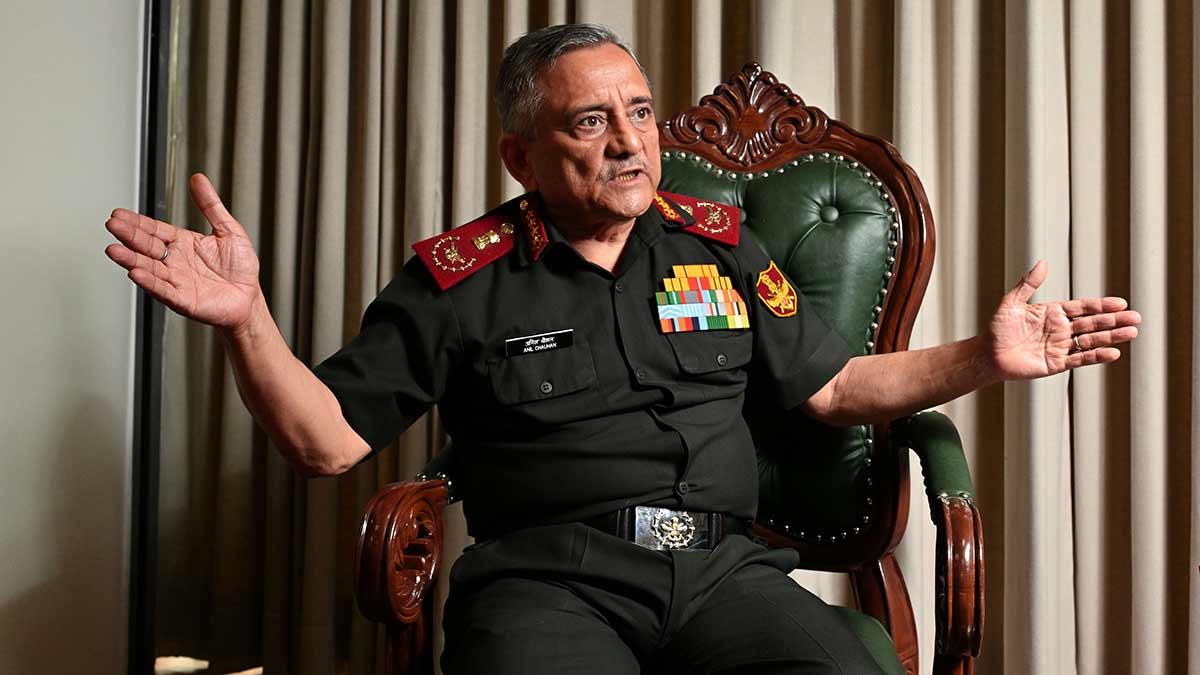
Exclusive Interview/ General Anil Chauhan, chief of defence staff
Having seen through an eventful and turbulent phase of India’s military history, Chief of Defence Staff General Anil Chauhan will now return to his world of intellectual and academic rigour. And, of course, his favourite topic—Tibetology—and perhaps a bit of golf. He retires on May 30, and Lieutenant General N.S. Raja Subramani takes over.
Before he became CDS, General Chauhan had led from the front during the Balakot air strike in 2019 as DGMO and against northeast insurgents along the India-Myanmar border as general officer commanding-in-chief Eastern Command. But the biggest achievement, as CDS, was to helm the historic transformation of the military in the progress towards theaterisation and, of course, Operation Sindoor. Looking back, it would be considered a job well done.
In an exclusive interview with THE WEEK, his first, the outgoing CDS talks about a range of topics, including lessons from Operation Sindoor, the future of warfare, and the ongoing theaterisation efforts. Excerpts:
Q/ One year after Operation Sindoor, what are the key lessons?
Sindoor was different from all the wars we have fought. It lasted only 88 hours—roughly four days. At the strategic level, the most important lesson is about exit management, when do you stop a conflict. Else, there is an increasing propensity to engage in conflicts across the globe.
At the operational level, the key lesson is integration. It gives you situational awareness—what is happening on the ground, what the enemy is doing—and that helps you manage escalation and make the call to stop at the right moment.
Q/ You mentioned on the first day of Operation Sindoor that some mistakes were made. Can you elaborate?
There is no war without mistakes. What matters is that we do not repeat them. Anyone who can adapt faster will always win. You see what happened, you understand it, you adapt to it and you go back in. Nothing should constrain your offensive spirit. Morale should not get affected. The ability to take risk, to go after the enemy again—that is what is important. Escalation control must remain in our hands, and that, too, is tied to situational awareness. We knew within minutes of our strikes what we had hit. The adversary, by contrast, did not know what it had hit until around May 14 or 15. That is why, at every level of escalation, we were on top due to the right information, which helped us control escalation.

Q/ The secrecy with which the operation was conducted was remarkable. How was it achieved, and what directions went out to those in the know?
There is a service ethos—if something is classified, it stays classified. But beyond that, we took a number of specific measures between April 22 (Pahalgam attack) and May 7. We had to mobilise partly; that had to stay secret. We had to position our air defence resources correctly. Naval assets, Army assets, Air Force assets—all had to be moved with enormous secrecy. Most critically, we maintained secrecy not just about the targets, but about the timing and the date of the operation itself.
Even the logistics of how we moved around reflected this—officials who needed to attend meetings in South Block did not use their official cars. We used different routes, different vehicles, even keeping it from our own households. Secrecy is maintained at multiple levels: the operational secrets of time and date, the mobilisation, and the human routines around it.
Q/ Can you elaborate on the role the Navy played? There was talk of naval forces being 15 minutes from action.
The Navy had a very important role to play. In the maritime domain, the asymmetry between India and Pakistan is at its greatest. For us, Exercise TROPEX (maritime drill) had just concluded, which meant 100 per cent of the Navy was fully serviceable—ships had come back to port, loaded actual ammunition and sailed out. We were able to deploy a large number of surface and underwater combatants. I believe Pakistan had four or five surface combatants and one submarine, and those were kept close to their own coast.
The sea control the Navy established and the deterrence it imposed were decisive. We expected the operation to last longer. They folded in eight hours—so, in a sense, the Navy missed the opportunity to engage directly. Had it lasted longer, they would certainly have received a hammering from the Navy, too.
Q/ When exactly did Pakistan seek talks, and what was the US role in it?
At approximately 1am Pakistan Standard Time on May 10, they were still claiming they would continue for 48 hours and bring India down on its knees. But they folded up by 9:15am; they had picked up the phone to say they needed to talk. The formal talks happened at 3pm. We continued with some operations that were already on the cards until about 12:30pm, after which talks commenced.
It is difficult to comment on the role of the US, as it lies in a different domain altogether. What I can say is that on the military side, no one from our end would have sought this ceasefire. Whatever would have happened must have been on the Pakistani side, because they were aware of what was coming. How that became public knowledge, I cannot say.
Q/ Was there genuine concern that Pakistan might resort to tactical nuclear weapons? If they had, would India have crossed the nuclear threshold?
That is a purely hypothetical question. Nuclear weapons are not toys. The last time they were used in a war-fighting context was in August 1945—and there were specific reasons for it. Within hours of conventional operations, you do not use a nuclear weapon. We have a stated doctrine of no-first-use, and we also have a stated doctrine of massive retaliation. The threshold for nuclear use remains very high globally. There is a large space for conventional operations before that threshold is ever reached.
Pakistan’s posture has its own complications—their missiles are configured for both conventional and nuclear roles, which is why they established an Army Rocket Force later to separate the two. They recognised that ambiguity as a mistake. But no, I don’t believe that the nuclear threshold was anywhere near being crossed.
Q/ China is flying sixth-generation aircraft while India is yet to fully operationalise the Tejas Mk-1A. How do you reconcile this asymmetry?
You are right to some extent that we are behind, and that is precisely why we are attempting to pursue all programmes simultaneously rather than sequentially. We cannot afford to wait for AMCA (Advanced Medium Combat Aircraft) to be developed before pursuing a sixth-generation fighter. The LCA (Light Combat Aircraft) Mk-1A programme has 97 additional aircraft ordered on top of the original 83. LCA Mk-2 will be operational in the first half of the next decade and shall be powered by the GE414 engine. AMCA will initially also use the GE414, with a domestically developed engine later. For sixth generation, we are in discussions with consortia—both the British-led and French-led programmes. We are looking to join one of them. HAL is also working on the CATS (Combat Air Teaming Systems) unmanned combat programme. All of this is being processed in parallel.
Q/ How serious is the concern about the depleting IAF squadron numbers? Does the benchmark of 42 need to be revised?
It is a serious concern, and yes, I think those numbers need to be revisited. And going forward, it has to account for manned and unmanned platforms together.
Q/ What was the most memorable moment of your tenure as CDS?
Operation Sindoor, without question. The defence forces are a profession you do not practise in the true sense—you only train for it. A surgeon practises surgery every day; a lawyer is at the bar every day. Most of us in uniform spend our entire careers training for a contingency that may never come. I was fortunate. Everything I had worked towards—integration, jointness, building that architecture—came into practice during Operation Sindoor, and was successfully demonstrated. That gives you a kind of satisfaction that nothing else can.
Q/ What is the current status of the theatre commands reform? What were the divergent views and how were they reconciled?
When we started, the model being discussed was entirely different from what it became. I chose a different approach—top-down, with a degree of quiet deliberation rather than open controversy. We worked through the differences gradually, took the consensus to the chiefs and then to the government.
The key challenge is that every service is designed, structured and motivated around its own primacy—and there is nothing wrong in that. But when you frame the conversation around multi-domain warfare as the future, the question of service primacy becomes less central. The acceptability of integration is higher when everyone understands that this is about building capability for multi-domain operations, not diminishing any one service.
I have built consensus across six chiefs and three chiefs of integrated defence staff. We have submitted our final report to the government. Once the government approves it, I estimate 18 to 24 months for full operationalisation—setting up the headquarters, posting personnel, reorganising structures, setting up communications and rewriting operational orders.
Q/ What is the roadmap for preparing the military for multi-domain conflict?
We have a vision document in the public domain—Vision 2047—which articulates the goal of an integrated, all-domain force capable of operating across the broader spectrum of conflict in concert with all elements of national power.
The roadmap begins with integration at the defensive level. The air defence architecture is being integrated first: linking communication, counter-UAS and air defence grids so that every layer can speak to every other. We have established rudimentary counter-UAS capability and are reinforcing it. Offensive capabilities come next: joint ISR (Intelligence, Surveillance and Reconnaissance) targeting space, cyber and ultimately cognitive and information warfare. The journey is from network-centric warfare to data-centric, AI-enabled warfare.
Q/ Given the asymmetry in technology and infrastructure between India and China, is our force posture adequate against a potential two-front scenario?
In my opinion, the concept of a two-front war, as classically understood, is not fully applicable in the current scenario. That construct comes from Germany in the world wars: a fast, modern enemy on one side, that is France, and a slow-mobilising far-situated one on the other, that is Russia, requiring sequential defeat. That model of warfare is over.
Even if we are engaged with Pakistan, it may not be in the strategic interests of China to enter a conventional conflict alongside Pakistan. And if we are engaged with China along the LAC in Ladakh or Doklam, why should Pakistan choose that moment to open a second front?
Today when we talk about two front challenge, it would be more likely shared ISR, cyber disruption, information operations and network interference that can be executed covertly. No troops crossing borders, no aircraft, no missiles rolling in from both sides simultaneously. Nations today intend to achieve strategic results without committing to full conventional war.
Q/ How have the Ukraine, Gaza and Iran conflicts influenced Indian military thinking?
Every war teaches us something, and Sindoor is not the only conflict we study. Ukraine war revealed the drones as a true force multiplier—across surface, air and even underwater domains. The proliferation of drones after the Ukraine war was extraordinary; every nation, large or small, began developing them.
The Iran dimension has added a new lesson: missiles. Iran, with a modest navy, air force and army, was able to respond to a superpower using only ballistic and cruise missiles and long-range drones. The lesson every smaller nation has drawn is that missiles are effective. The proliferation of missile capability across the third world is now inevitable, and we must prepare for a threat environment saturated with ballistic and cruise missiles. It is certain that air defence will be central to future warfare.
Q/ Does this mean the relevance of air power, and the Air Force, is increasing?
The Air Force has always been versatile precisely because of its platforms—it can support the Army and the Navy, and conduct its own operations. But I want to be careful about how we frame this. Whenever a new domain opens, it is easier to create asymmetries in that domain—and war tends to be decided in that domain first before shifting to the old domains. We saw this in the Gulf War with air, and now we shall see it in the cyber and space domains.
When I say the air domain is growing in importance, I do not mean only fixed-wing aircraft. I mean the entire vertical dimension: drones, rockets, cruise missiles, hypersonic missiles, ballistic missiles, and manned and unmanned systems. That whole domain is expanding and the war is being executed through the medium of air. The distinction is important.
Q/ For long, the Indian doctrine prepared for short, intensive wars. Is that changing?
Earlier, the wars in older domains like land-centric conflicts—Ukraine, Gaza—have been long and attritional because you have to physically hold and vacate territory. New-domain warfare in cyber and space domains tends to be precise, networked and at depth, which tends to produce shorter, smarter and more decisive results.
But we cannot ignore our disputed land borders. The possibility of a land-centric, long-drawn conflict cannot be ruled out. At the same time, India is not a country that can spend $35 billion in 12 days of conflict the way the Americans did in Iran. We need to fight smarter, shorter wars—and that is possible today. Sindoor demonstrated it. Our orientation should be towards decisive, precise, short operations while maintaining the capacity for prolonged conflict, if necessary.
Q/ The Agnipath scheme continues to face criticism. Any plan to revise it?
The Agnipath system of recruitment is the fairest. Earlier, at least in the Army, we used to recruit through physical rallies where hundreds of candidates participated. First, candidates used to get through physical tests, then written and medical tests were conducted. With Agnipath, recruitment is entirely online. If your documents are verified, you get a chance. You appear for an online test with no human intervention. Merit is determined objectively. That is a significant improvement wherein human intervention has been reduced.
On the concern that trained soldiers return to civilian life after four years with nothing to do, I would ask: how many ex-soldiers from the old system have become threats to society? People leave military training at 16, 17 years old and become better citizens. How many NCC (National Cadet Corps) cadets have proved otherwise? They become better citizens precisely because of the discipline, the uniform and the way of life. The same will hold for Agnipath. Most will be absorbed—CAPF (Central Armed Police Forces), state police forces, and many states have already reserved seats for them. The ones who are technically skilled will find roles in industry and self-employment. The scheme is, in fact, ideally suited to a technology-intensive military where skillsets change every four to five years.
Q/ If you had to name one weapon system as the decisive differentiator during Sindoor, what would it be?
Naming a single weapon system would miss the actual lessons. Platforms do not matter that much today but networks do. If we are able to network S-400, Akash and shoulder-fired weapons, air defence will become robust. Similar is the case for offensive operations. That is why I place more emphasis on integration and networking. Long-range precision strikes were absolutely necessary and well executed. But how did we get the information and situational awareness? It was through integration and networking of ISR assets and the capability of ISR architecture. Platforms are necessary but integration and networking are the battle-winning factors, not any individual system.
Q/ What unfinished agenda would you have liked to resolve, besides the theatre commands reform?
When we started, we did not have a roadmap as to how many initiatives for integration there may be. Today, we have 197 identified initiatives. Tomorrow, there will be more may be 300 or 400. These are just limited by the imagination. Integration is possible even in information warfare, cognitive warfare and cyber security—I would like to integrate even those. Artificial intelligence and data-centric operations are the next frontier. I began a process and I do not see a definitive end state for now. In my opinion, integration will always remain a continuous process.
Q/ Modernisation will increasingly require technically educated soldiers. What steps are being taken on recruitment?
Each service already has technical education thresholds built into its recruitment criteria. For Agnipath, the age eligibility has been extended specifically to allow ITI-qualified (Industrial Training Institutes) candidates—those with vocational technical training—adequate time to apply. The four-year cycle is actually an advantage here. Technology changes every four to five years, sometimes faster. A soldier recruited today is trained on today’s systems. His successor four years later arrives already familiar with what has changed. The faster refresh rate of Agnipath will, in fact, accelerate technology absorption in the system with technically better-trained personnel joining the defence forces year after year.
