



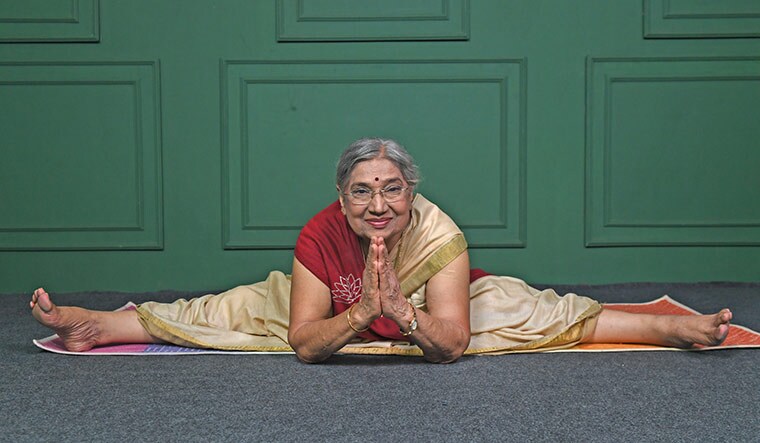
HANSA YOGENDRA―endowed with geniality, flexibility and the ability to motivate people―has been practising yoga from age three. Today, at 76, she is one of the most respected yoga teachers in the world. She has also been at the forefront of the yoga movement in the country.
Hansa Yogendra is the director of The Yoga Institute in Mumbai, which is the oldest yoga centre in the world, founded in 1918 by her father-in-law, Shri Yogendra, who is behind the modern revival of yoga.
Even at her age, Hansa Yogendra is leading yoga classes around the world. The Yoga Institute, till date, has trained more than 50,000 yoga teachers.
Edited excerpts from an interview:
Q/ How has yoga changed you and your perspective of life?
A/ From a very young age, I have realised that through a dedicated and consistent practice, yoga can bring about various positive changes―both physical and mental. Yoga has given me health benefits because this practice has the potential to increase flexibility, strength, and balance in the body. By cultivating mindfulness and self-awareness, yoga has certainly provided a deeper understanding of myself and the world around me.
Over the years, yoga has definitely enriched my life by bringing about a shift in my perspective to see the bigger picture. This has inspired me to spread the light of yoga to enable others to live life with better balance and clarity.
Q/ Do you agree that yoga can be used as an adjunct therapy for various medical treatments?
A/ Yes, yoga can indeed be used as an adjunct therapy for various medical treatments. The therapeutic benefits of yoga have been recognised by medical professionals and researchers worldwide. Here, at The Yoga Institute in Mumbai, over the years, we have observed positive changes in persons suffering from various ailments. Yoga has been found to be beneficial for a range of health conditions, such as stress, anxiety, depression, chronic pain, cardiovascular health, and musculoskeletal disorders. It can complement traditional medical treatments by promoting relaxation, improving physical fitness, and reducing inflammation.
Q/ There are many who believe that yoga transcends religions and they practise it. But there are many who also say that yoga has roots in Hinduism. Your reaction?
A/ Yoga is an ancient practice that originated in India and has its roots in various philosophical and spiritual traditions, including Hinduism.
While yoga's origins are deeply connected to Hindu philosophy, it is essential to recognise that yoga itself is not a religious practice.
Yoga transcends religious boundaries and can be embraced and practised by people of any faith or belief system. It is a practical discipline that focuses on personal growth, self-realisation, and overall good health.
Yoga can be practised and enjoyed by people worldwide, regardless of their religious or cultural backgrounds, as it offers a path towards physical and mental harmony, peace, and self-discovery.
For the full interview, log into www.theweek.in
