



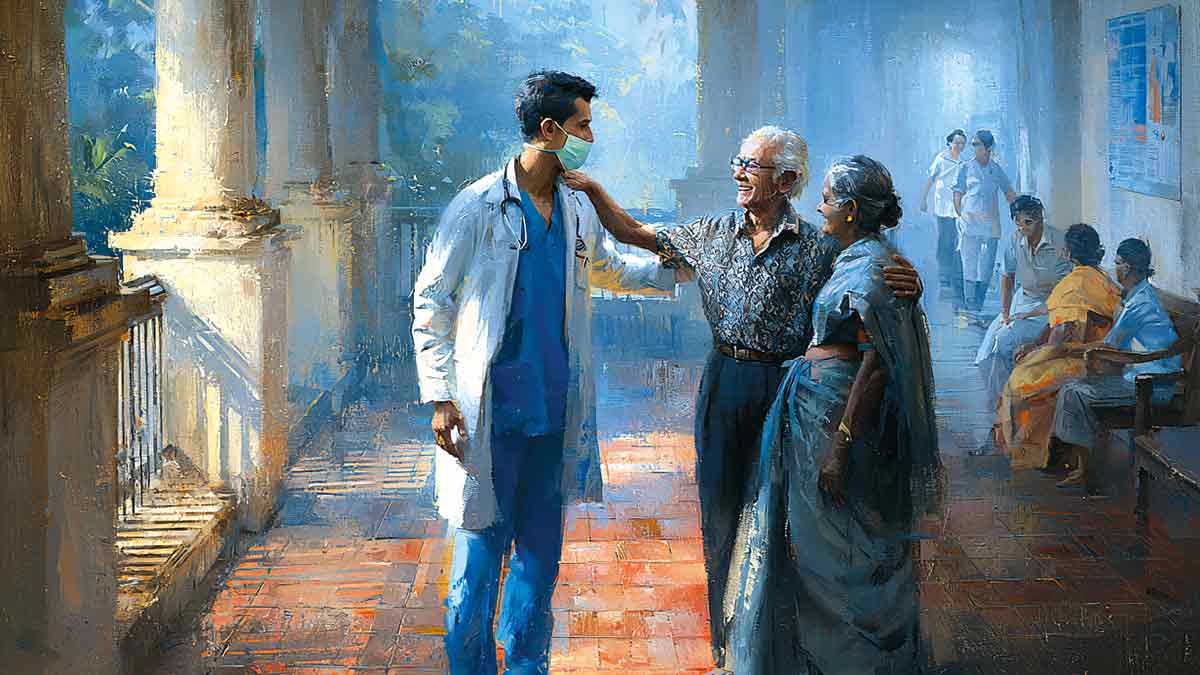
I met Rajan sir again in the corridors of Government Medical College, Kozhikode.
I was barely into medical school then—first year, perhaps second. The exact year has faded. What remains is the vivid clarity of the image: a familiar figure standing quietly in a busy hospital corridor, and with him, memories rushing back.
Rajan sir had been my headmaster in school. More than that, he had been a teacher in the deepest, most authentic sense of the word.
He joined our school when I was in class eight and stayed through class nine and ten. Before that, he had served as headmaster of a government school. After retirement, he came to ours. Teaching was not merely a job for him; he simply could not stop teaching.
He loved children, and he held an almost playful fascination with mathematics. He introduced us to Vedic mathematics, stripping away tedious steps to reveal number patterns, shortcuts and the curious behaviour of equations. He would show us how geometry could become art, and how art, under scrutiny, revealed mathematics. We were spellbound.
I would often go home and revisit the problems he had given us, trying to figure out why the numbers behaved the way they did. Occasionally, I would stumble upon a pattern he hadn’t explicitly shown us and rush back to school to tell him. He would listen, smile and give me a gentle fist-tap to the stomach. “There you are.” It was his way of saying: You found it.
Once, while discussing why students gravitated towards certain subjects and reviled others, he said: “You may like or dislike a subject, but none of these is truly different. Human beings create boundaries to make the world easier to understand, to overcome our limitations. But the boundaries often blur as you go deeper.”
I did not fully understand what he meant then. At that age, I wanted to become a doctor. Yet biology—the subject everyone insisted was closest to medicine—was never something I particularly enjoyed. I studied it out of necessity.
Years later, he told me about his early career in government service, back in the late 1950s or early 1960s, when the state had temporarily reduced teachers’ salaries. “Have you ever heard of that?” he asked. “A government reducing the salary of its teachers?” I stood quiet. “That is the respect society gives teachers,” he said quietly. And yet, after retirement, he had walked right back into the classroom. That was his quiet rebellion.
During our board examinations, he would prepare extra question papers of his own, far beyond his official duties. We would solve them eagerly and bring them back to him. He corrected every sheet himself, detailing alternate methods, minor efficiencies and unexpected ways of arriving at the same answer.
Once, during one of those discussions, he dropped another seed that stayed with me: “You can try to understand others,” he said. “But the greatest lesson is understanding yourself.” I nodded, though the concept felt far out of my reach. He saw confusion cross my face. His smile widened into that familiar, uninhibited laughter, followed by the fist-tap. He never diluted a difficult puzzle by giving away the solution. He would simply plant the question, smile and walk away.
Years passed. Then, one afternoon in medical school, a batchmate told me that Rajan sir was looking for me. He had come to the hospital for treatment. I rushed to meet him. He was waiting in the corridor adjacent to the ward. When he saw me coming, his face brightened instantly. He held me by both shoulders, pulled me close and gave me that same playful fist-tap to the stomach.
“There you are,” he said, smiling.
I couldn’t smile back. I had already read his chart: Advanced gastric cancer.
The words seemed to press physically against my chest. I tried to ask him about his illness, but perhaps my face had already said more than my words could. He could see what I was trying so hard to hide.
“That is all part and parcel of life, boy,” he said. “Don’t worry about it. I just wanted to see you.”
His voice was calm, almost comforting. I found myself unable to meet his eyes. He turned to his wife beside him and said, “There were many good students in Silver Hills. But this one and I had a special connection.”
I looked down, pretending to adjust my surgical mask to hide my face.
The meeting was brief. A few days later, he was gone.
I went to his home. His brother was there; they had lived together as a joint family. Standing beside the urn containing his ashes, for once, there was no question to ask. No answer to find.
Decades have passed since that day. I have walked countless hospital corridors, held thousands of hands, watched people arrive terrified and leave relieved, or arrive hopeful and leave without hope. I have seen courage, fear, resignation, love and grief in every conceivable permutation.
Somewhere along the way, medicine slowly revealed itself as the ultimate book of puzzles—gathering information, making calculations, observing clinical patterns. Treatment decisions emerge from your assessment each time; outcomes are mere probabilities that can support you, but just as easily humble you.
Gradually, the boundaries between medicine, mathematics and art began to blur, just as he said they would. What looks extraordinarily complicated is often built from simple fundamental rules, while that which appears simple can contain vast, terrifying complexity.
Rajan sir has remained with me through these years. Of all the problems he assigned, perhaps the hardest was the one he never wrote on the blackboard—the question of who I was.
It was never a problem with a fixed final answer, but an equation that kept evolving—a lifelong assembly of meaning built from encounters with everything you experience. Each patient added a variable. Each loss subtracted certainty. Each recovery introduced hope. You never solve it completely. You only collect fragments.
Somewhere, in the quiet, empty corridors of the hospital, I can still see him. He looks at me with that old, mischievous grin.
“Did you solve the puzzle yet?”
I stand there, overwhelmed, searching for words. He laughs—that great, uninhibited laugh. Then comes the familiar fist-tap on my belly. He pulls me into a hug and whispers:
“I told you, my boy. There are no shortcuts.”
