



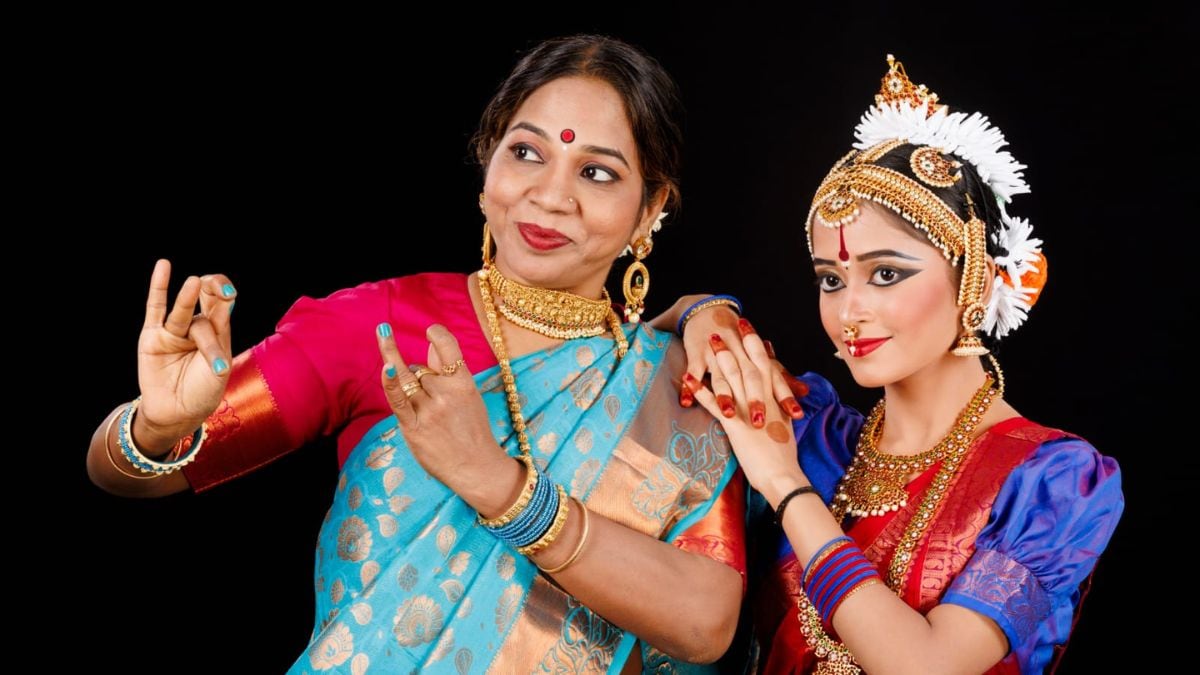
When Daniel Freddy was around sixteen, his first guru, Maya Rao, asked him to change his name. In his early years, it was assumed that only Hindu brahmins or traditionally hereditary artists could perform classical dances. Along with his name and caste, his gender also determined how many stages he could perform on as a Kathak artist.
“We did not need social media to get recognition; everyone knew everyone”, adds Daniel Freddy, now a disciple of Vidushi Vaswati Misra, daughter-in-law of the late Shambhu Maharaj.
As a male artist, it was difficult for Freddy to gain recognition. The rigidity in Indian classical dances often bars innovation and experimentation from the new world.
With the establishment of Sangeet Natak Akademi, various temple dances were officially recognised as classical dances in 1952.
“Legendary artists like Mrinalini Sarabai and Rukmini Devi Arundale accepted the challenge to establish, raise awareness, and eradicate the taboos associated with temple dance forms,” confirms Aparajita Sharma, daughter of Guru Kanaka Sudhakar and a Bharatanatyam artist, to The Week.
She further explains how the government, along with a few Rotary clubs and Hindi Films, also helped in changing the image of dance.
Gurus and their disciples have always carried a sense of pride, but Sharma believes that art is like a river; it needs to move along with the times. “Socio-cultural aesthetics has changed”, confirms Sharma. But some amount of rigidity and access constraints remain.

While the number of students choosing to learn the art increased, those who choose to embrace it as a profession have decreased. Stages and spaces with good visibility have also been reduced.
“When I was a student, there were opportunities in temples. Dance was never for money then”, Sharma said.
Deepak Maharaj, son of the late Birju Maharaj and 8th-generation Kathak artist, said to The Week, “Belonging to a legacy, being Maharaj ji’s son and disciple, I am struggling to get a stage.”
“The Statesman Vintage & Classic Car Rally used to call us for performances, but now there is no space for any classical dance forms”, recalls Nitika Singh, a practising Bharatanatyam dancer for fourteen years. As a disciple of Indira Murgesanam, she adds that since the pandemic, the stages for classical dance forms have been limited to temples or cultural programs.
“Shows give places to fusion artists, and pure classical has vanished”, she said.
Preservation of the purity had made it the topic of contention between visibility and abandonment. Other reasons, such as low attention span, limited time allotted to artists, and fewer festivals and shows, have also contributed to this struggle.
Freddy recalls that there used to be ICCR (Indian Council for Cultural Relations) tours that took classical dance groups to international spaces. “In 1986, my first tour was in Nepal, and then I travelled to several other countries, like Japan and Korea”, he says. With his last foreign venture in New Zealand in 2018, it has been around eight years since he has had any tour opportunities from ICCR.
“Now they prefer Bollywood to represent India”, he said.
Deepak Maharaj also remembers performing for the Sahitya Kala Parishad and visiting several foreign countries with ICCR in his early days. He notes that technological and political factors have diminished the already scarce opportunities.
“The US-Iran war has diminished foreign tours. It's difficult to find sponsorships in India, and no one is willing to pay the artists”, he said.
“Since the war, there have not been many festivals and functions because of its effect on the economy. Before that, we got platforms in Bharat Mandapam, Pragati Maidan, from time to time, but now that too has diminished”, confirms Daniel Freddy.
Low attention span: “I have 10 minutes to prove my legacy”
“Maharaj ji taught me to be patient and take time, but now the demand is for quick performance”, said Deepak Maharaj, recalling his father.
Lately, Indian classical dances have adapted to fast music, and hence, there is no time to create or experiment. His father told him stories about times when performances went overnight, and artists would only experiment with rasas. Before, artists would take two to three hours on stage, but now every artist only gets ten to twenty minutes of stage time, and the expectations are high. “I need to prove my legacy in just ten minutes. How is this fair?” he often wonders.
“In my last academy, which was not that reputed, I got at least 3-4 performances per month because people preferred classical dance, but now it has reduced drastically”, said Swetalina Mohanty, a practising Odissi dancer for twelve years and disciple of Pushpanjali Mohanty.
According to her, the audience doesn't want to decode storytelling, appreciate expression and gestures; it has reduced to showing too many steps in a shorter time frame.
But classical dance in itself has not created space for change. “The people who have made the art set in stone will lead to its fall”, said Aparajita Sharma. Innovation and experimentation are required to make it popular. She suggests that it is important to embrace change while keeping the essence intact under the guidance of Gurus.
Earning and learning: social media is ‘the stage’
“All my foreign and Indian origin students living abroad learn it online”, said Yashaswini Maharaj, Deepak Maharaj’s daughter and 9th generation artist in the family. Her students living abroad have never asked her for shortcuts; they want to learn Kathak from the very basics.
“Classical dance form to gain followers in social media isn’t sustainable”, she says to The Week.
She believes that Indian classical art forms are an ocean in themselves. It needs no clout or fame to make the dance form more interesting. “But the reality remains that with scarcity of stages, several artists have shifted to social media to showcase their art”, she added.
“This is what it is. We as a society have learned to discard things quickly”, said Sharma about the boom of the internet and classical dancers on social media. But she accepts the scarcity of stages and the rise in the number of artists lately.
There is no purity of dance form; every texture added to it is a conversation between the time and the social condition which cradled it.
Confronting the question of purity of the art, Sharma said, “There are only two types of dance, Good Dance and Bad Dance”.
Acceptance and accessibility are the keys to making it popular again. Within the debate of purity and impurity, it withdraws consent to acceptance and access.
“We never got our deserved share”
“Giving no travel and stay allowances has become a new normal”, said Mohanty.
Additionally, the payment for performances is also decreasing.
“We never received what we deserved; now what they provide is not even sayable”, confirmed Yashaswini Maharaj.
Freddy compares classical dance with sports, “It's the same hard work, every day, Riyaz, but no recognition or benefits.” Deepak Maharaj and Freddy have similar thoughts on the lack of promotion of artists and culture.
“Everyone wants to become like Maharaj ji. There are so many artists waiting for solo performances”, said Deepak Maharaj. Because of a lack of stage, he compromises to accept duet dance performances.
"Who gets such benefits?"
Yashaswini Maharaj recalls that around 2011-12, the situation was quite better. Government-run programmes outnumbered the private ones.
“There are shows even now, but the level has degraded in terms of arrangements and remuneration”, she confirms. She believes that everyone talks about promoting culture and tradition, but no one wants to give any facilities to the artists.
The Ministry of Culture offers Financial Assistance for Promotion of Guru-Shishya Parampara (Repertory Grant), which provides funding to eligible performing artists and organisations to train under a Guru.
According to the reports of the Evaluation Committee under Guru Shishya Parampara 2025-26, the number of organisations has considerably reduced. Only 41 ‘freshly-approved’ organisations have been added for assistance compared to 151 in 2024-25. In the case of ‘renewal-approved’ organisations, there are 32 fewer than in 2024. In total, there are only 910 organisations approved for financial aid in 2025 compared to the 1057 in 2024.
The Ministry of Culture also provides scholarships to students, but with so many artists, the government's efforts are futile.
The criteria to select organisations according to Guru-Shishya Parampara (Repertory Grant) guidelines include having staged at least two productions, of which at least one must be a new production, mandatorily organising at least two cultural workshops in any government educational institution and having a social media presence.
“But how will tribes and groups who do not have such a technological advantage ever get such benefits?” Sharma asks.
