



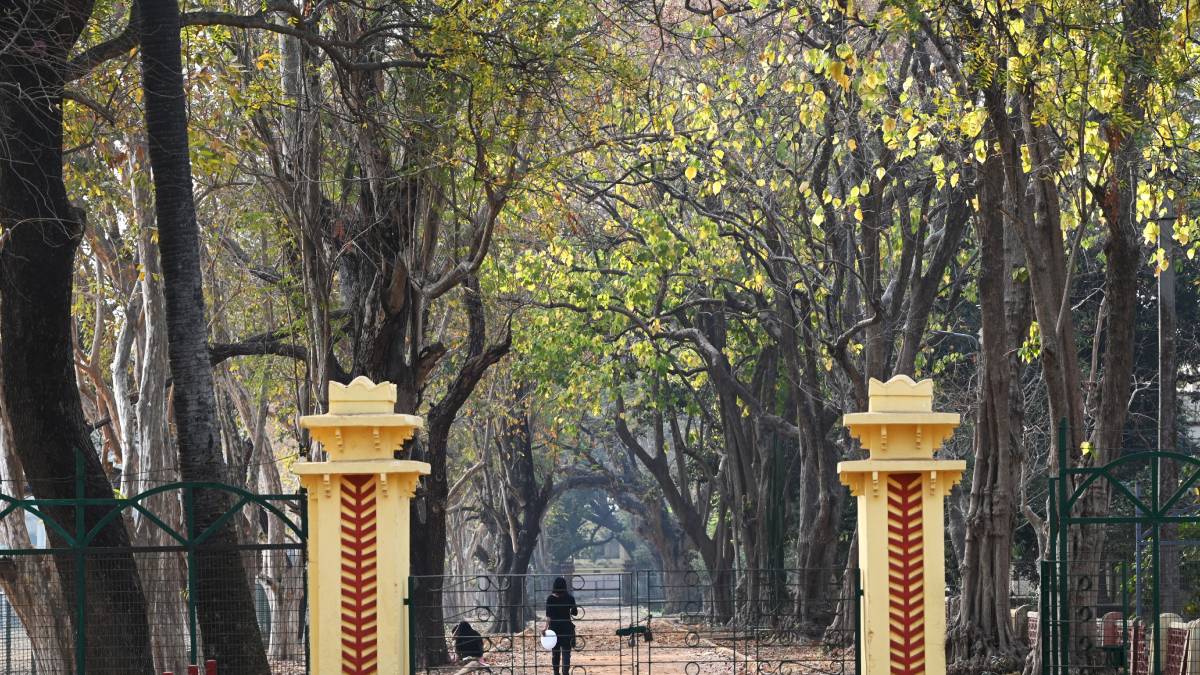
On a gentle February afternoon, as spring began tinting Santiniketan in pale gold and tender green, the Heritage Walk set off from Chhatimtala, just opposite the ticket counter of Visva-Bharati University. The air carried a mild warmth. Dry leaves crackled underfoot. Mango blossoms hinted at the coming season. The descending sun poured honeyed light across open grounds that felt expansive yet intimate.
It was my first guided tour of Shantiniketan.

A small group gathered, travellers from Pune, Kerala and Pakur in Jharkhand, each drawn by curiosity about Nobel laureate Rabindranath Tagore and the ideas he nurtured here. Another group had just left with a Bengali-speaking guide. There was no rush. Visitors paused to read plaques or photograph the landscape. The pace felt unhurried, almost meditative.
Chhatimtala marks the spot where Maharshi Debendranath Tagore, Rabindranath’s father and a leading figure of the Brahmo Samaj, is believed to have meditated, laying the spiritual foundation of what would later become Santiniketan. Beneath the Chhatim(Alstonia scholaris) trees, one senses that this campus began as an inward quest rather than an architectural project.
We walked toward Gour Prangan through groves of bakul (Mimusops Elengi) trees. Along the path were modest open-air study spaces used by students of Patha Bhavana, reflecting Tagore’s belief that learning must unfold in harmony with nature. Soon, Ghantatala came into view, a large bell suspended within a red-painted frame. Gour Prangan, our guide explained, serves as the principal venue for major institutional gatherings and cultural celebrations, including the annual Basanta Utsav, when spring is welcomed with colour, music and dance.
The campus revealed itself through art and symbolism. On the walls of Patha Bhavana’s office were murals by Nandalal Bose, the pioneering modernist and a central figure of the Bengal School of Art, their lines restrained yet evocative. Nearby stood Chaitya, a small tribal art exhibition space that reflects Visva-Bharati’s engagement with indigenous traditions.
We crossed Benukunja, a mud-walled structure that blends seamlessly with its surroundings. A short walk away stood Dinantika, where Tagore and the faculty once gathered for evening tea. Its doors were locked. Through narrow openings, we glimpsed the decorated ceiling inside, also attributed to Bose. Our guide explained that several buildings remain closed to ensure preservation.
The reasoning was practical. The responses were varied.
Prem Kumar from Pakur in Jharkhand felt the restrictions were necessary. “Heritage must be protected,” he said. Akhil Naik, a naval architect from Pune, expressed quiet disappointment. “When you travel this far and cannot enter, you miss the details,” he observed. “Limited access would deepen understanding.”
We continued past Cheena Bhavana and the girls’ hostel across the road. Mango trees heavy with blossoms scented the air. Tagore’s affinity for nature seemed palpable. Of the roughly 310 songs he composed in the nature category, more than 100 celebrate spring, underscoring how deeply the season shaped his creative imagination.
By then, we had reached Notun Bari, begun around 1902 with mud walls and a thatched roof. After the sudden death of his wife, Mrinalini Devi, before its completion, Tagore chose not to live there. Today, it houses the Samindra Library. Just beside it stands Dehali, a modest two-storeyed house shaded by trees, where Tagore spent much of his Shantiniketan years and composed many of the poems later included in Gitanjali. A short walk away is Santosh Alaya, a single-storey tiled-roof structure named after Santoshchandra Majumdar, one of the earliest students of the Shantiniketan Vidyalaya. As the guide narrated these stories, the walk took on a quiet, nostalgic rhythm.
We reached the Santiniketan House. In front stands Ramkinkar Baij’s striking sculpture, the work of the pioneering modernist sculptor and one of India’s foremost 20th-century artists, its bold form embodying movement and humanity. The house itself was closed. Nearby, the Upasana Griha, often called the Glass Temple, shimmered in the late light, its coloured panels luminous even behind shut doors.
From Chhatimtala onward, the campus unfolded as a layered narrative, part memory, part philosophy and part architectural experiment. Shantiniketan is less a collection of structures than a living idea, education without rigid walls, art without hierarchy, nature as classroom.
In 2023, Shantiniketan was inscribed on the UNESCO World Heritage List. The formal Heritage Walk was introduced in August 2025. Tickets are priced at ₹300 for Indian adults and ₹1,200 for foreign visitors. As per Visva-Bharati’s schedule, walks are conducted on Fridays and Saturdays at 3:00 PM, and on Sundays in designated morning and afternoon slots.
As shadows lengthened and the grounds grew quiet, the walk ended without ceremony. The campus seemed to return to its own rhythm.
Shantiniketan does not announce itself loudly. It invites patience. Visitors leave with images of red earth and blossoming trees, but also with a question: how does one preserve a living philosophy without placing it behind glass?
Perhaps the answer lies in walking slowly enough to listen.
