



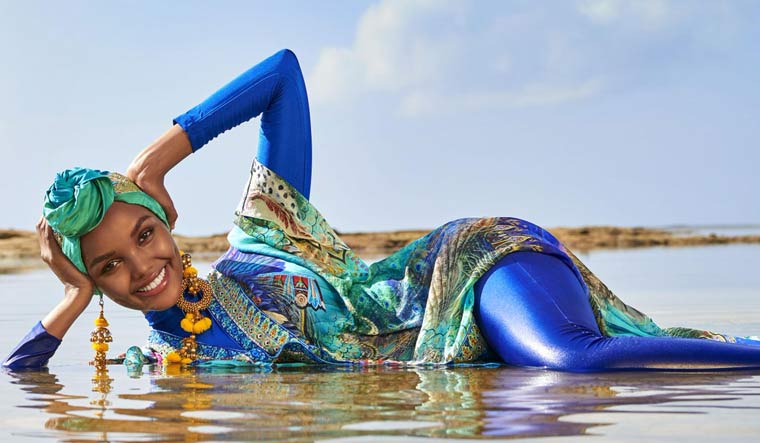
Somali-American model Halima Aden made history again by becoming the first woman to wear a hijab and burkini in the Sports Illustrated swimsuit issue. This is not the first time that Aden is making headlines. In 2016, she became the first contestant in Miss Minnesota USA to wear a hijab and burkini and reach the semifinal stage of the pageant. In March this year, Aden became one of the three black hijabi models, alongside Ikram Abdi Omar and Amina Adan, to feature on the cover of Vogue Arabia, for the magazine’s first group hijabi cover.
In a behind-the-scenes video, Aden said, “Growing up in the United States, I never really felt represented because I never could flip through a magazine and see a girl who was wearing a hijab.”
In a video shared on Twitter by Sports Illustrated, Aden referred to herself as a “burkini babe”. Describing it as a “dream-come-true” moment, Aden said that she is “not afraid to be the first”. She believes that “it’s sending a message to her community and the world that women of all different backgrounds, looks, upbringings…can stand together and be celebrated”.
A Muslim Somali-American, Aden chooses to wear the hijab and is a symbol of fashion and beauty, not being tied to a sole definition. She was born in the Kakuma refugee camp in northeastern Kenya and moved to the United States at the age of seven. For the photo shoot, she returned to Kenya and was photographed by Yu Tsai on Watamu Beach.
Aden’s popularity is not limited to aesthetics but is also termed as a market-led move. The Islamic fashion industry is set to be worth GBP 267 billion by 2021, with modest fashion dominating the AW18 runways of Gucci, Calvin Klein, Alexander Wang, Versace, Chanel, Balenciaga, Dior and more.
This is an important fashion trend as the female Muslim dress code has always been the target of populist policies across Europe and Asia. In August 2016, the photos of French police officers forcing a Muslim woman to take off her modest swimwear aka the “burkini” at a Cannes beach elicited varied response across the world. The French fashion obsession followed the deadly attack in Nice after which a wave of xenophobia inspired 30 coastal districts to ban the burkini.
In September 2016, Bulgaria became the third European country, after France and Belgium, to ban the use of the niqab in public. It was followed by Austria in October 2017 and Denmark in May 2018. The Norwegian parliament voted for a niqab ban in all educational settings in June 2018. In addition, some European regional governments, including those of Lombardy (Italy) and Tessin (Switzerland) have recently implemented similar bans.
In Arab countries, the situation is no different. Women are not allowed to swim in public swimming pools in Saudi Arabia. At public beaches, they are restricted to the abaya, which is a full-length black covering that is to be worn by those who choose to dip their toes in the water. In other Gulf countries too, bikinis and swimsuits are only allowed in private beaches and resorts.
However, the real craze surrounding the burkini has nothing to do with apparel choices, and arguably little to do with the women themselves. It started as a pragmatic sportswear option that has been painted as a Muslim extremist ‘provocation’.
Many argue that the mass adoption of modest garments such as the hijab or niqab is an act of resistance against Western neo-colonialism, sexual promiscuity, or the ubiquitous male gaze. In some cases, it also acts as a decision driven by piety.
Nevertheless, the historic move of Halima Aden becoming the first woman to wear a hijab and burkini on a Sports Illustrated swimsuit issue sends across the message that “the idea of beauty is vast and subjective”. M.J. Day, the editor of the swimsuit issue, said in a statement that she and Aden know that “women are so often perceived to be one way or one thing based on how they look or what they wear”. What matters more, she said, is whether you feel your most beautiful and confident in a burkini or a bikini, and to consider yourself as worthy.
