



IFFI Goa, amid the machinery of cinema-spotlights, red carpets, reputations, fashion showcase ‘Handloom Sarees in Motion: 70MM on Runway’ staged a quieter drama. It was not about trend forecasting or celebrity dressing. It was about time. About labour. About the radical act of slowing down in a culture addicted to speed. To present handloom at India’s most prestigious film festival was, in itself, a statement: that craft, like cinema, is a language of memory, collaboration, and disciplined imagination.
Each sari that moved down the runway carried months of work and centuries of knowledge. The process begins at the loom, where weaving can take 15 to 90 days, depending on design complexity. In Maharashtra, weavers Shantilal Bhangde and Rohit Shinde represent a tradition where technique is learned not in classrooms but in homes, through repetition and correction. Their labour is physical—hours of pedalling, counting. Adjusting tension—but also intellectual. Patterns are memorised, not sketched; errors corrected in real time.
From Jharkhand, Muskan Kumari embodies a newer generation of weavers sustaining regional practices often marginalised in mainstream narratives of handloom. Giram Shamim, working across traditional weaving methods, and Meruva Vyanktesh of Srikalahasti, a region historically associated with narrative textiles, add to a collective whose work is rarely attributed individually, even though each decision—thread, density, spacing—shapes the final fabric.
The textiles themselves spoke in different registers. Banarasi-inspired brocades asserted density and discipline, where zari work requires weeks of precision and an almost architectural understanding of pattern. Chanderi, in contrast, whispered. Its silk-cotton translucence relies on restraint; motifs float rather than dominate, allowing air and movement to complete the design. Tussar and Gheecha silks, rooted in forest economies, refused polish. Their uneven textures and natural hues insisted that luxury need not erase origin.
Then there were the technically audacious traditions—Ikat, where dye precedes weave, and the design exists first as calculation. Here, one misalignment can destroy weeks of labour. These sarees carry an invisible scaffolding of mathematics and memory, their ease on the body masking extraordinary risk and control.
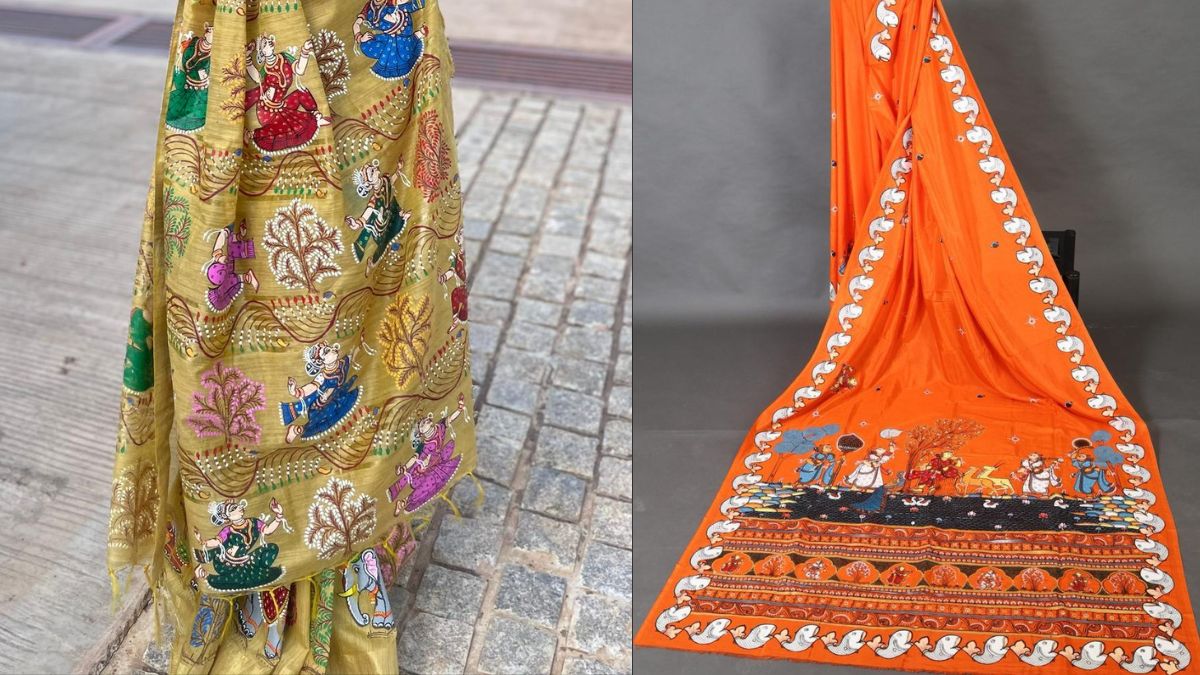
After weaving comes another journey, one that transforms cloth into narrative. Over nearly a month, several saris were hand-painted by traditional artists across India. From Rajasthan, Arun Sahu brought Pichwai art, devotional and dense, demanding sustained concentration across six metres of fabric. From Bhopal, Reshma Sham translated Gond art onto cloth, her rhythmic lines carrying forest cosmologies that resist linear storytelling.
In Bhubaneswar, Babita, a Pattachitra artist, approached the saree as a scroll figure, deliberate, every line accountable to tradition. From Maharashtra, Sanjay, working in Warli art, reduced form to rhythm: human, animal, landscape, collapsing into geometry and movement. And from Patna, Mama, a Madhubani artist, layered symbolic density across fabric, negotiating repetition, mythology and scale with remarkable control.
Painting on a six-metre saree is not decorative work; it is physically demanding and slow. After painting comes drying, fixing, and finishing processes that cannot be rushed without compromising integrity. In total, nearly three months go into a single saree.
There is no standard market rate for such work. Artists and weavers price according to time, intricacy and instinct. Bargaining is limited because replication is impossible.
Authenticity is guarded through artisan cards, handloom marks and silk certifications systems overseen by the Office of the Development Commissioner (Handlooms), Ministry of Textiles, whose presence at the event underscored a crucial point: handloom is not nostalgia; it is policy, livelihood, and cultural infrastructure.
The Development Commissioner’s role is not merely symbolic. Through certifications, cluster support, awards, and platforms like IFFI, the Ministry works to ensure that handloom remains both economically viable and culturally visible. Yet, as practitioners themselves acknowledge, government recognition alone is not enough. Artists are often known not by name but by the NGOs or brands representing them. Visibility, fair compensation, and sustained platforms remain urgent needs.
Curated by Shikha’s Kariigarii, the showcase made a deliberate choice to foreground makers. Artists were paid, transported, housed, and brought into direct dialogue with audiences. In previous editions, visitors were invited to paint themselves—turning spectators into participants and crafting into living memory. This is not incidental. Seventy per cent of India’s handloom workforce is women, many sustaining households through undervalued labour. Craft survives only when dignity accompanies skill.
That this was staged at IFFI matters. Cinema is a collective of art-writers, technicians, performers, and editors working in concert. Handlooms are no different. Both demand time, collaboration, and trust in processes invisible to the final viewer. To place the handloom on the IFFI runway was to insist that craft belongs not on the margins of culture, but at its centre.
"The showcase resisted romanticising poverty or fetishising tradition. Instead, it argued clearly and confidently for craft as intelligence. Against speed, we offered time. Against anonymity, names. Against spectacle, labour. Like enduring cinema, or A.R. Rahman’s music takes time to understand-but once it does, it stays," said Shikha Ajmera, Founder, Shikha’s Kariigarii.
