



India and Sri Lanka are just 30km apart. That’s the distance between Dhanushkodi, at the tip of Rameswaram, and Talaimannar, in northern Sri Lanka.
The relationship between them, meanwhile, is centuries old—the two connected by the Adam's Bridge, the epic Ramayan, and, most importantly, centuries of cross-migration.
Despite such proximity and overlapping cultures, India surprisingly has few Sri Lankan restaurants. That absence feels even stronger in Delhi, which otherwise boasts a happening food scene, with cuisines ranging from the trending Korean and Japanese to the little-explored Latin American.
That’s about to change with Zetu, a new Sri Lankan restaurant opening in Delhi, inside the 1AQ complex in Mehrauli, on June 4.
Why Zetu? “We wanted this restaurant to be a conversation between the two countries,” said co-founder Sarah Nikahetiya ahead of the launch.
The Sanskrit word 'setu' means ‘bridge', with the ‘Z’ offering a contemporary twist.
“The restaurant is based on the everyday lived experience of being in Colombo rather than a touristy version of Sri Lanka,” added Nikahetiya, a former British diplomat to India, who is married to a Sri Lankan.
A slice of Sri Lanka
The experience begins at 1AQ’s entrance itself. You’re handed tender coconut water, and a golf cart whisks you off to the restaurant.
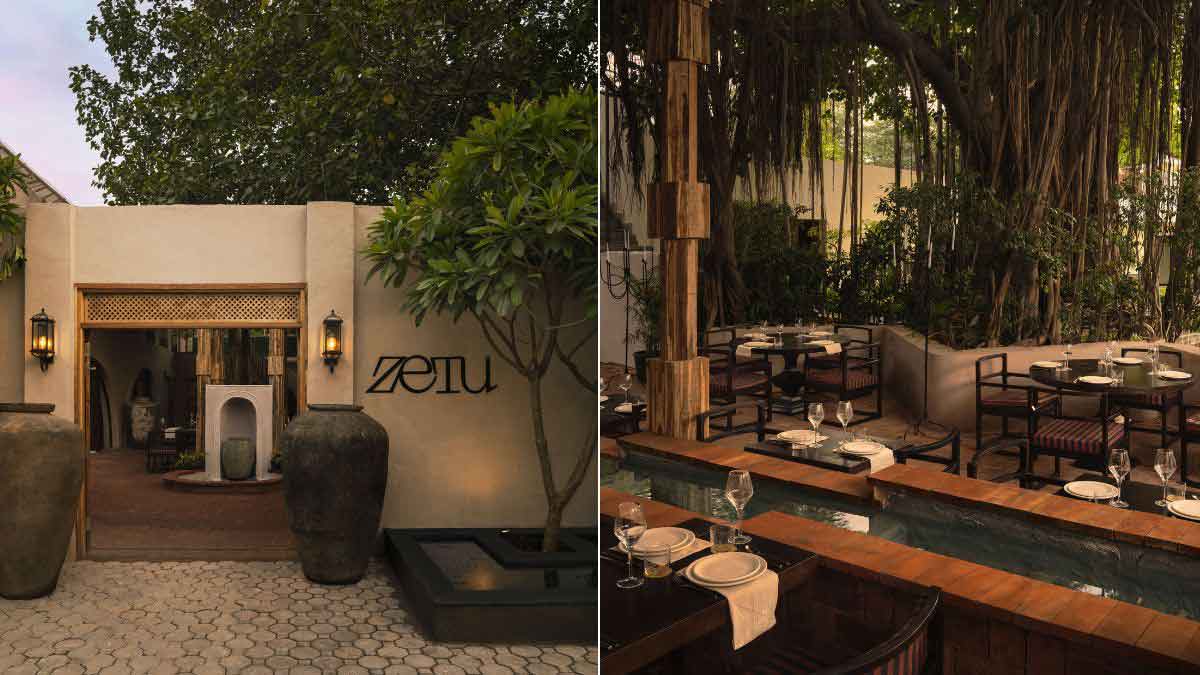
Once inside Zetu, what instantly catches attention is the sheer greenery created inside the space, with plants all around and anchored by a big banyan tree.
“When I saw the banyan tree here, I immediately thought it was perfect for Sri Lankan food. It already had that indoor-outdoor vibe that feels so natural in Sri Lanka,” noted Nikahetiya.

The space, in fact, feels straight out of the Geoffrey Bawa tropical modernism experience. The sunlight filters in aesthetically, and the space itself feels like it is breathing at a slow pace. And in the process, you slow down, quite removed from the frantic pace at which Delhi usually operates.
The inside seating space, too, complements the tropical modernism experience. Sri Lankan design elements are woven everywhere, as the approach itself tilts towards being restrained, understated, and inviting.
Zetu has been designed by its co-founder and architect Anurag Dania. Abhishek Mathur and Sagar Garg are the other two co-founders.
The unfamiliar tropical flavours
As the interiors set the tone, the experience is taken forward by the kitchen helmed by Sri Lankan chef Dush Ratnayake, alongside Indian chefs Mohit Kumar and Romil Malhotra.
The menu offers a good variety of the many influences that have shaped Sri Lankan cuisine, such as Tamil culture, trade, and colonialism. There are street foods, community-specific dishes and family recipes—all presented with a contemporary sensibility.
The experience opens with the choon paan, a mobile bakery, usually on a tuk-tuk, which drives through neighbourhoods selling fresh bread. At Zetu, you get a smaller version of the bread, served with three flavours of butter—tandoori, cashew, and curry leaf with pesto.
While choon paan makes for a quintessential Sri Lankan experience, there’s ‘Tea and Treasure Rolls’, a dish that came from China, which is an ode to the trade relationship.
There’s also the 'Gram Dahl', a red lentil curry, but here served in small bites on top of wooden coconut spoons.
There are the iconic Sri Lankan dishes such as kiribath, kothu, and lamprais, adapted to a contemporary sensibility.
“Globally, Sri Lankan food tends to be represented at two extremes. On one end, you have the traditional restaurants serving food cooked in clay pots and presented exactly as it would be at home. And on the other hand, you have highly experimental tasting-menu restaurants where the food is inspired by Sri Lankan ingredients and techniques but becomes something entirely different. While both approaches are valuable, I felt there was a missing middle ground,” said chef Ratnayake.
“What we're trying to do here is preserve recognisable Sri Lankan dishes while presenting them thoughtfully and elegantly.”
While Sri Lankan cuisine shares similarities with South Indian cuisine, it was a careful choice not to present the familiar.
“There are already so many excellent South Indian restaurants in Delhi. If we were going to introduce Sri Lankan cuisine, it had to stand on its own,” the chef said.
The bar programme, too, furthers the Sri Lankan flavours, with an ample use of coconut, cinnamon, tea, curry leaf, and tropical spices.
While the food experience could be subjective, what Zetu does, and successfully so, is offer a Sri Lankan experience not known to Delhi otherwise.
