



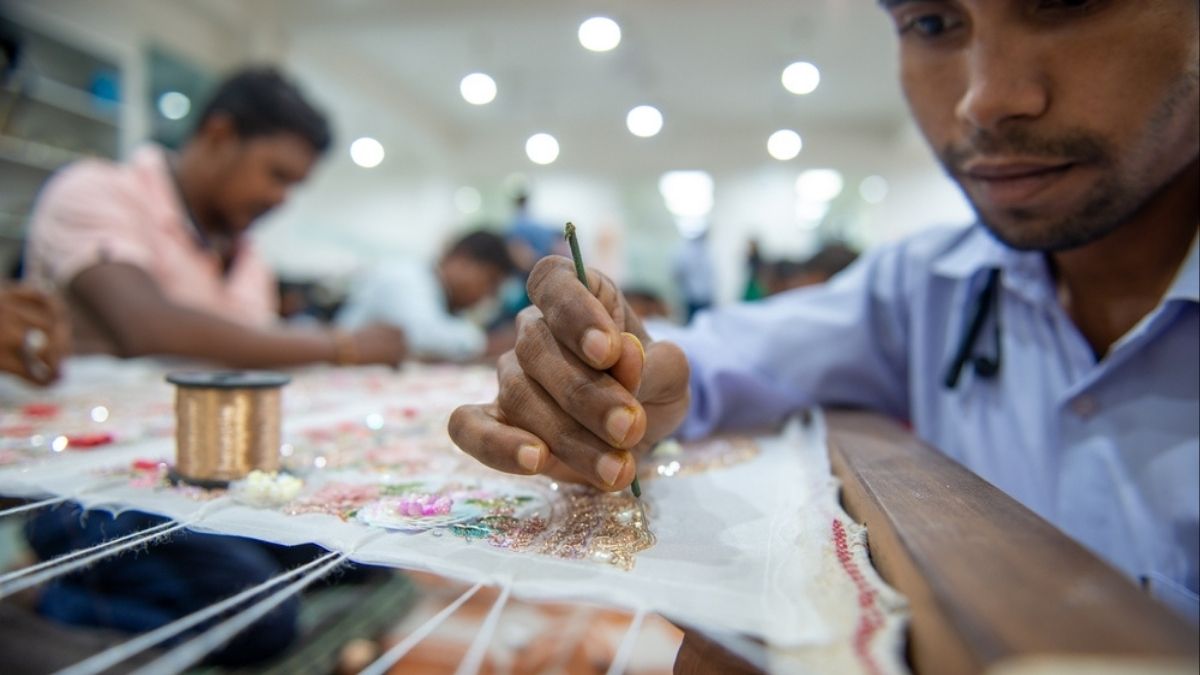
In quiet towns across India, artisans sit at their looms for hours, silently weaving intricate patterns and tie-dyeing silk, slowly creating the highly sought-after Pochampally Ikkat, Bandhej, Zari, and Mekhela Chadar sarees.
"I have been into handloom weaving for the last 40 years now. What we do is skilled artwork, but the income we earn is meagre. I work here for 10-12 hours a day to earn ₹9,500 per month. On average, it takes us about 4-7 days to make one saree, and I weave around 5-6 sarees a month," Lakshmannan, an old Pochampally weaver, told Humans of Hyderabad in 2021.
Five years later, artisan wages remain low, and the number of handloom units has declined further, as reported in the Economics of Indian Craft research conducted by the Craft Council of India (CCI) and the Institute of Human Development (IHD). The report highlights problems faced by handloom artisans across Rajasthan, West Bengal, Assam, Tamil Nadu, and Uttar Pradesh.
It estimates that the average wage for artisans across these five states is ₹270. While the figure is averaged and may vary by state and artisan, more than 50 per cent of Handloom units reported financial constraints, suggesting that most artisans are underpaid. Competition from mass-produced handlooms was also reported by establishments, a key factor in their financial difficulties.
“Big entities with a larger number of workers and fixed capital are producing the same products at lower prices. They produce them on a larger scale with price per unit being cheaper than what the artisans can accept," said G.C. Manna, Former Director-General of the National Sample Survey Organisation and the team lead from IHD.
A little over 64 per cent of the products from West Bengal's artisans are Zari sarees, and 85 per cent of the products from Rajasthan are Bandhej work. Mass E-commerce marketplaces like Amazon India and Meesho provide the powerloom imitations of these at low prices. Bandhej sarees are available on Meesho for as low as ₹289, and Zari sarees are available on Amazon, with prices starting at ₹400.
Another space where handloom continues to thrive is the Luxury Fashion market. Indian luxury brands such as Anita Dongre, Archana Jaju, and Shanti Banaras repeatedly incorporate Bandhej, Zari, and Kalamkari into their pieces.
"For our Gul-E-Laal campaign, the Zari work was developed in-house at our Hyderabad atelier with artisans we work with directly as part of our larger craft ecosystem. As a brand, we collaborated with skilled artisans across 17 craft clusters in India rather than working through external vendors," said Archana Jaju, an Indian luxury fashion brand, discussing how they incorporated Zari work into one of their collections.
While they offer no direct price competition to artisans, concerns about credit follow this sector, as 23 per cent of establishments in Rajasthan and 12 per cent in Assam reported competition from copying.
Khushi Shah, the Creative Director and co-founder of Shanti Banaras, talks about this, stating that they take inspiration, not replicate. “At Shanti, we often ask ourselves how we can build on heritage rather than simply reproduce it. The idea is not to recreate the past exactly as it was, but to give it a contemporary context while staying honest to its origins. There is a difference between borrowing aesthetics and genuinely engaging with a craft, and we always try to approach it from a place of authenticity and respect.”
However, credit in the sector does not necessarily translate into economic benefits. While both brands shared that the artisan’s share is determined by the complexity of the technique and the time required to make the piece, supply chain realities can mean that only a small proportion of the marked-up price reaches artisans.
The lack of direct access to these marketplaces was also reported across most handloom centres, with artisans still being dependent on contractors or the master weaver to sell their products.
Gita Ram, immediate-past Chairperson of CCI, comments on this, "Only master weavers have access to the markets. Policies should be made to expand market access."
A small percentage of establishments said that they sell their products via organised fairs. Exports were negligible, with only 0.1 per cent of the handloom units in Jaipur and Bareilly reporting it, proving that increased visibility is struggling to turn into economic benefits.
